
In 2026, Formula 1 introduced an entirely new rule set: new power units, new aerodynamics, and even the overtaking weapon DRS was scrapped completely. Some have called it “the biggest change in F1 in 50 years.”
And the Hungarian Grand Prix on July 26 was the most vivid lesson in that transformation—because it put the battle between “speed and strategy” under the new rules on full display: a 22-year-old, starting from P7, led the race at one point and ultimately stood on the podium.
Using official telemetry data, we break this race down corner by corner.
1. Race Result: A Race Won by Strategy
| Position | Driver | Grid | Finish | Position Change |
|---|---|---|---|---|
| 1 | Norris(McLaren) | P1 | P1 | 0 |
| 2 | Verstappen(Red Bull) | P4 | P2 | +2 |
| 3 | Antonelli(Mercedes) | P7 | P3 | +4, biggest gain of the race |
| 4 | Leclerc(Ferrari) | P2 | P4 | -2 |
| 5 | Hamilton(Ferrari) | P5 | P5 | 0 |
| 6 | Russell(Mercedes) | P6 | P7 | -1 |
Norris led from pole to victory in a race that looked calm on the surface. But the real drama was behind him: rising star Antonelli started seventh and finished on the podium—the driver who gained the most positions in the entire field.
2. The Protagonist: Antonelli’s Roller-Coaster Race
If you only looked at his position chart, you might think you were looking at a heart-rate graph:
- Lap 1: P6
- Lap 16: into the top 3
- Lap 21: leading the race!
- Then repeatedly moving between P1 and P5
- Final result: P3
Why such huge swings? Because in a race, the decisive factor is never just being fast—it is when you pit for tyres. Every pit stop reshuffles the order; pitting early or late, gaining track position or preserving tyres, becomes a constantly evolving calculation. Every time Antonelli “led” the race, it was a moment when the strategy gamble had paid off.
3. Tyre Strategy Duel: Why Wasn’t the Fastest Lap the Winner?
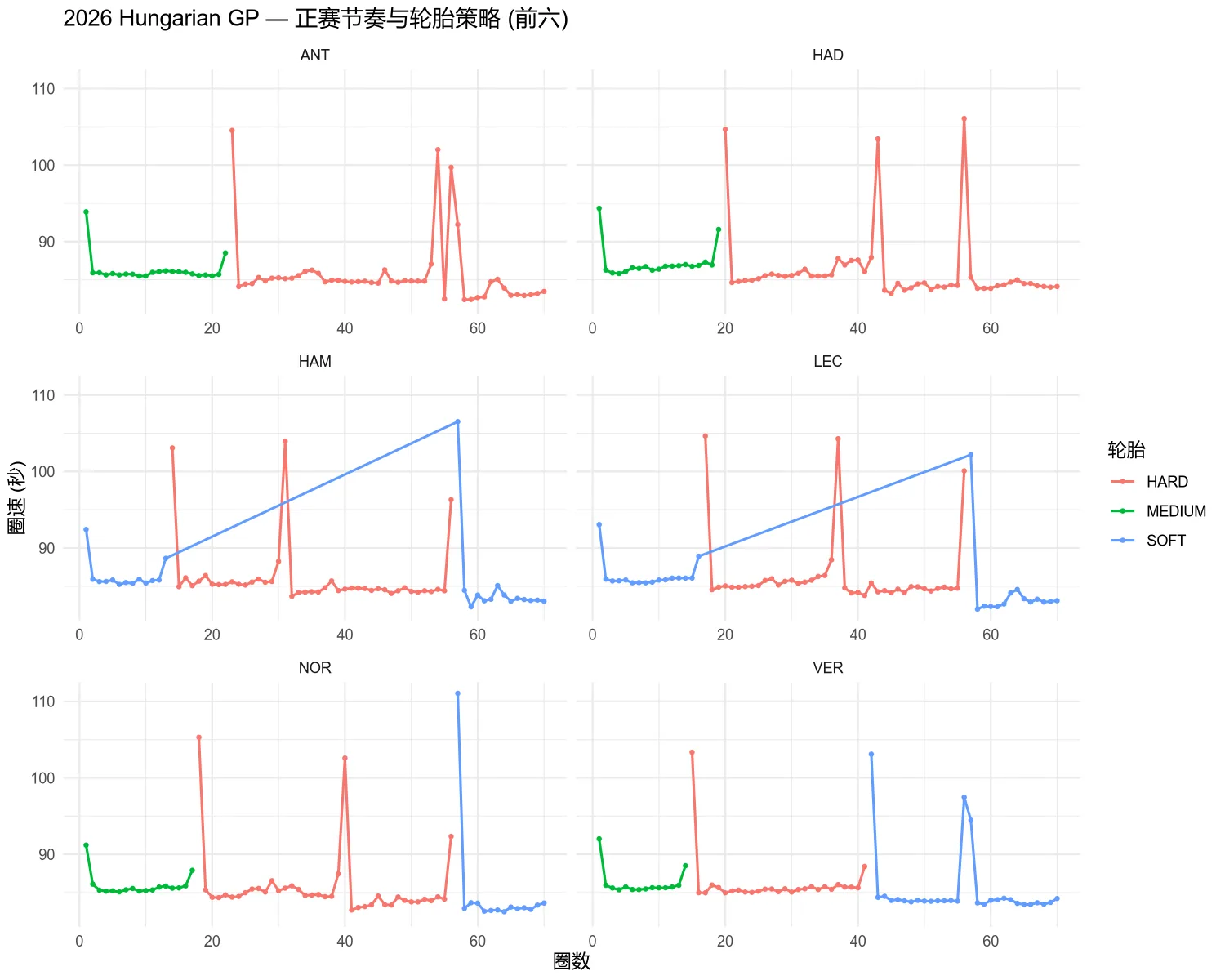
This was the part of the race that most brutally disproved the idea that “speed is everything.”
First, the data: who set the fastest lap of the race? Leclerc, 82.000 seconds, on soft tyres on Lap 58. But he only finished fourth.
Now look at the strategy board:
| Driver | Tyre Strategy | Fastest Lap |
|---|---|---|
| Norris | Medium→Hard→Hard→Soft(3 stops) | 82.49s |
| Antonelli | Medium→Hard→Hard(2 stops, old hard tyres for the final 18 laps) | 82.42s, 2nd-fastest overall |
| Leclerc | Soft→Hard→Hard→Soft(3 stops) | 82.00s, fastest overall |
| Hamilton | Soft→Hard→Hard→Soft(3 stops) | 82.30s |
Leclerc and Hamilton both ran the attacking “soft start + 3-stop” strategy, changed tyres most frequently, and were indeed the fastest over a single lap—but where did they finish? One was fourth, the other fifth.
Antonelli, meanwhile, stopped only twice and nursed old hard tyres through the final 18 laps, yet still set the second-fastest lap of the race. Same level of speed, different strategy, completely different outcome.
The Hungaroring is famously a track where overtaking is difficult and pit strategy matters enormously. This race pushed that trait to the extreme: the fastest driver does not necessarily win; the most efficient one does.
4. The New Rules: In the Data, We Saw the End of the DRS Era with Our Own Eyes
One of the biggest changes in the 2026 regulations: DRS—the adjustable rear wing system that had been in service for more than a decade, allowing the car behind to open its rear wing within one second of the car ahead to gain straight-line speed, and the central overtaking tool of the past ten years—was officially eliminated. In its place came an active aerodynamics system.
This change left a glaring trace in the telemetry data we pulled: every DRS field was 0.
For the past decade, DRS was the most important variable in overtaking data. By 2026, it had disappeared from the data dictionary. Under the new rules, what does overtaking depend on? Speed differences through the corners, strategy windows, and drivers willing to take risks. This Hungarian Grand Prix was the first real sample of the new overtaking era.
5. The Micro Battle: Where Did 0.26 Seconds Go?
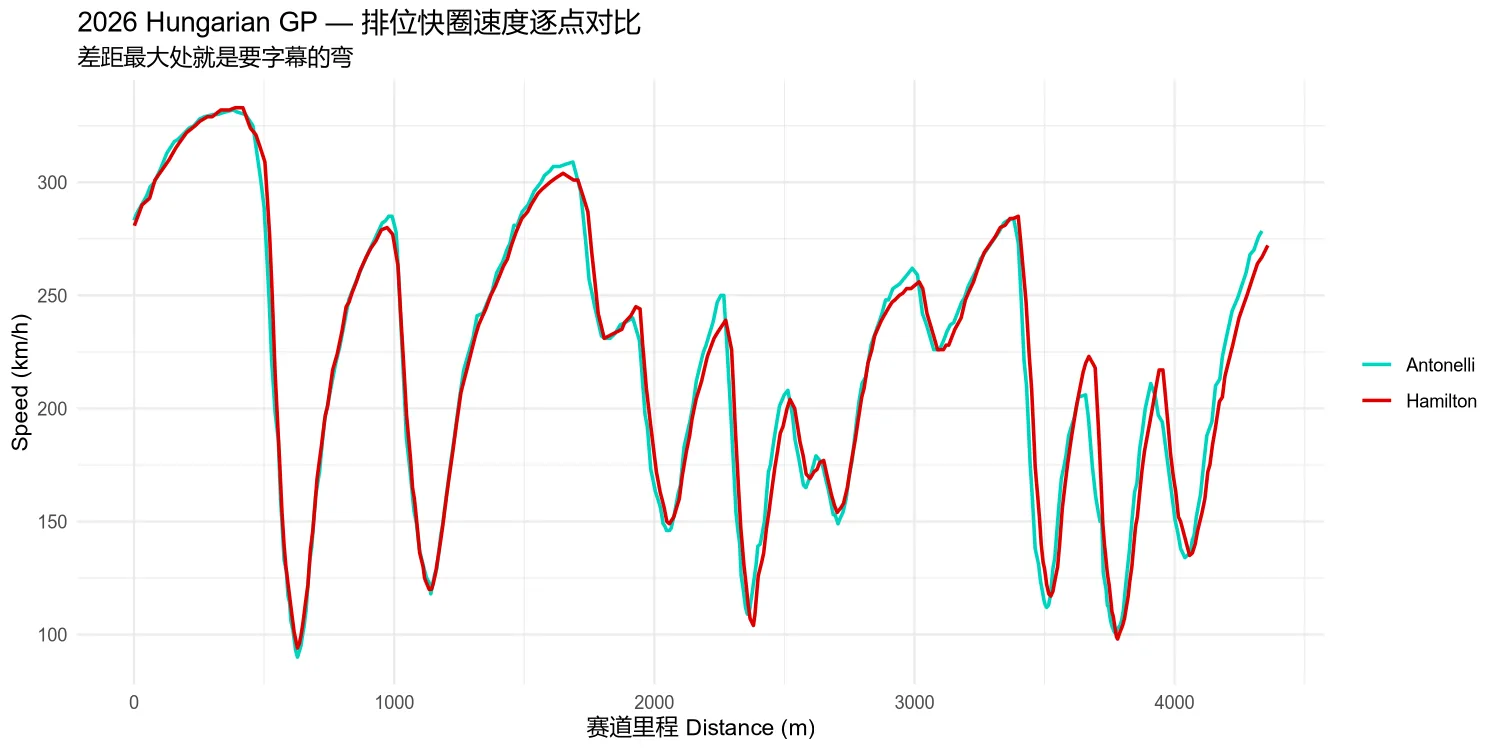
Aligning Antonelli’s and Hamilton’s qualifying fast laps point by point, with telemetry interpolated by distance, Hamilton was 0.26 seconds quicker and 0.56 km/h faster on average over the full lap. Their top speeds were almost identical—332 vs 333 km/h. The gap was not on the straights.
Looking by segment:
- Around 3250 metres: Hamilton was on average 12 km/h faster per segment, the corner where Antonelli lost the most
- Around 4250 metres(the main straight): Antonelli struck back, 11.5 km/h faster
Same circuit, same new-regulation cars, nearly identical top speed—but very different strengths in the corners. That is how driver styles diverge under the new rules—and the data captures it down to every corner.
Appendix: How We Did It(Data Methodology)
- Data source: F1 official timing data, obtained via open-source tools(full 2026 season available)
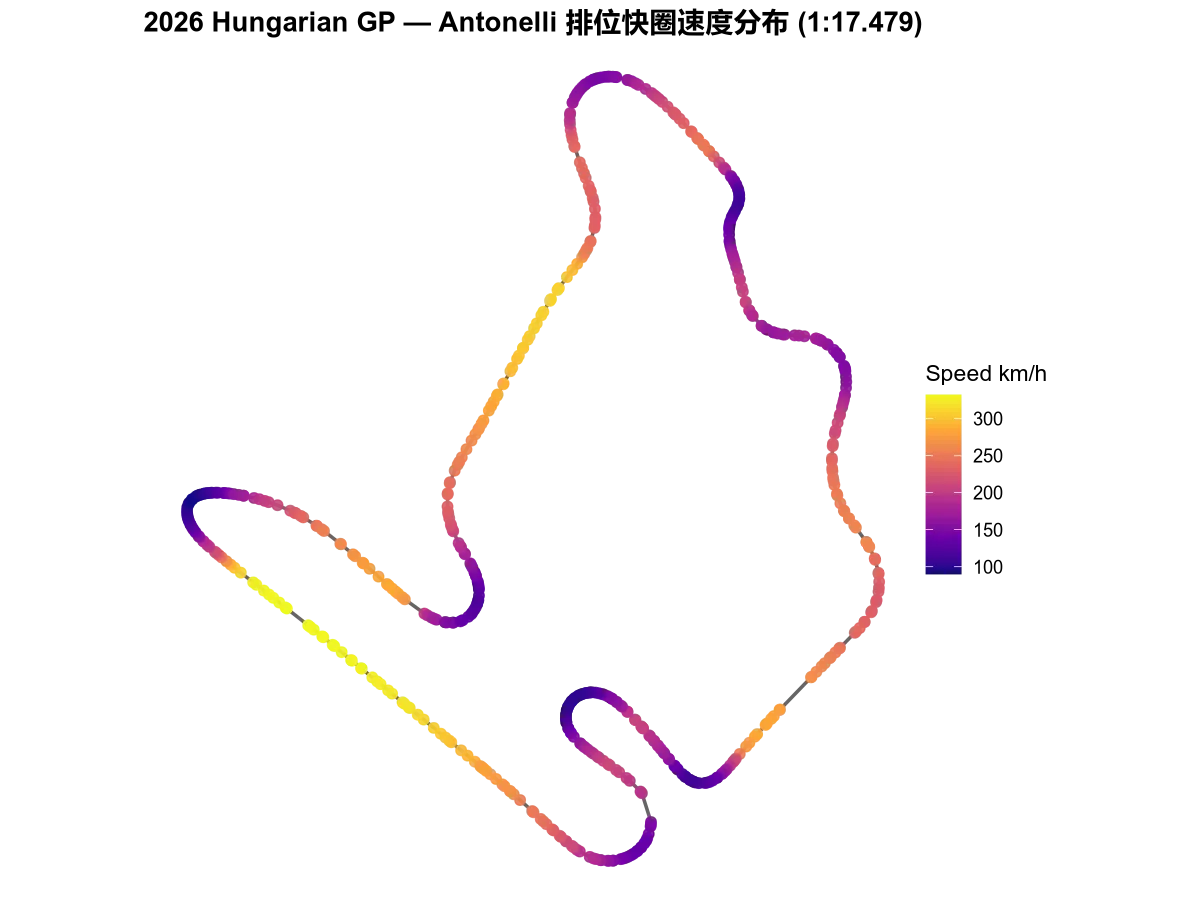
- Telemetry precision: around 590 sample points per lap, including speed, throttle, brake, gear, RPM, and coordinates
- Data cleaning: raw data included dirty laps(an anomalous 21.9-second lap, while a real lap in Hungary is around 82 seconds), filtered according to rules
- Analysis tools: R / Python, with interpolation-based alignment before corner-by-corner comparison
If you are interested in “racing data” or “data-driven management,” feel free to follow us. We will continue updating after each race weekend.
This article is data-driven and is not an official race report. Data source: F1 official timing data.