
When a Police Officer Falls in the Line of Duty, What Does the State Leave to Their Family?
The answer varies far more between countries than most people imagine: some issue a cheque worth millions of yuan; others pay an annuity monthly until the surviving spouse dies; some cover tuition all the way through university; and in yet others, you can’t even produce a single reliable figure — the absence of published data is, in itself, an answer.
This article surveys police death-in-the-line-of-duty compensation and survivor benefits across twelve countries, using the 2024–2026 current standards as the window. For easy cross-country comparison, all figures in this article are presented with the RMB figure first, and the original currency shown in parentheses. Conversion uses the August 2026 exchange rate solely as a rough guide — it is not precise forex. All key figures include source links; final conclusions should follow each country’s official position.
I. Twelve Countries at a Glance (RMB-First Format)
| Country | Lump-Sum Payment (RMB first) | Survivor Annuity | Children’s Education | Funding Source |
|---|---|---|---|---|
| USA | ~RMB 3.32M: Federal PSOB US$461,656 (FY2025-26, tax-free), plus state/local top-ups | Federal FERS survivor 50%; local pension 50%–75% | PSOB education grant US$1,574/month; some states waive tuition | Congressional appropriation + local actuarial contributions |
| China | Martyr: ~RMB 2.90M–3.30M (praise money RMB 1.626M + pension RMB 1.084M + 40 months’ salary); non-martyr: ~RMB 1.50M | Periodic pension: central base, provincial adjustments — from a few thousand to over RMB 10,000/month | Martyrs’ children: +20 Gaokao points (one of five nationwide retained items); grants + tuition waiver | Fiscal budget + Police Martyrs Foundation + local supplements |
| UK | ~RMB 0.81M–1.31M: 3× annual pension income (£88,818–143,229); assault-fatality group life cover adds £150K–300K (~RMB 1.37M–2.75M) | Spouse = 50% of deceased’s pension; each child 25% | No national scheme; Police Legacy means-tested bursaries | Government-supported + Police Federation insurance |
| Germany | ~RMB 0.05M–0.11M: Sterbegeld = 2× monthly salary | Widow’s pension = 55% (60% for duty accidents) of deceased’s retirement pension; orphan 12%–20% | Orphan annuity + flat child allowance €250/month | Federal/state budgets (Versorgungsfonds) |
| France | ~RMB 0.20M–0.30M (estimated): capital décès = 12 months’ index salary + allowances (statutory floor €3,977 ≈ RMB 30K) | Survivor pension = 50% of deceased’s pension (national standard) | Children’s education annuity: €200.25/month under 18; €600.75/month aged 18–27 while studying | State-financed, pay-as-you-go |
| Japan | ~RMB 0.47M–1.42M: fixed benefit ¥3M (~RMB 140K) + mutual-aid top-up; real cases total ¥10M–30M | Widow’s compensation pension: 153–245 days’ daily wage base, scaled to number of survivors | Prefectural education grants (typically ¥50K–100K/month) | Local civil-servant disaster compensation fund + police mutual aid |
| South Korea | ~RMB 0.46M–0.58M: monthly salary ×36 (general)/×45 (hazard); patrol officer ~₩88M–110M | Survivor pension = 85% of retirement-pension equivalent (special for line-of-duty death) | National Police Agency tuition subsidy; local education bonuses | Civil-servant pension fund + Police mutual-aid society |
| Singapore | Statutory cap ~RMB 1.57M (from Nov 2025 ~RMB 1.88M): WICA S$289K→S$346K; SPF Welfare Fund another cap at 36 months’ salary | Spouse 50% (children may share, usually to age 18/21) | Education grants/scholarships (targeted at low-income families) | MHA appropriation + Welfare Fund + CPF |
| Australia | Large state variation; NSW ~RMB 0.81M–2.29M (2–4× salary insurance, based on salary A$88K–124K); VIC 5×, QLD 3–5× | 62.5%–67% (varies by state/scheme) | Police Legacy (state-by-state), A$hundreds–1,500/child/year | State-government contributions + superannuation funds |
| Canada | ~RMB 2.63M–2.79M: Memorial Grant CAD$300K (≈RMB 1.575M, tax-free) + RCMP supplementary death benefit 2× salary (based on CAD$100K–115K) + CPP CAD$2,500 | RCMP survivor pension 50% (CPI-indexed); provincial workers’ comp 55%–85% of net income | No national scheme; some provinces (e.g. Ontario) offer scholarships | Federal pension management + workers’ compensation |
| Russia | Statutory baseline ~RMB 0.23M–0.25M (RUB 3M, set in 2011, indexed annually); “special operation” cases additional ~RMB 0.54M–0.58M incl. insurance | Duty death 50% / non-duty 40% of salary base | No dedicated education subsidy found | Federal budget (MIA disbursement) |
| India | ~RMB 0.30M: CAPF terrorist/violent-sacrifice ₹3.5M (accident ₹2.5M); DCRG pension cap plus ~RMB 0.21M (₹2.5M) | Special family pension = 60% of last pay (enhanced for first 10 years’ service); general 30%, min ₹9,000/month | PM Scholarship (PMSS): ₹2,500–3,000/month (tiered) | Central fiscal + group life insurance + Bharat Ke Veer donation fund |
Note 1: Australia, Canada, Russia, India, the USA, and Germany all have multi-tier police systems (state/provincial/federal, or central armed forces vs. local police). The table shows the institutional backbone; actual provincial figures vary significantly. Note 2: India’s CAPF (Central Armed Police Forces) and state police operate under separate regimes; state police compensation is not covered here. Note 3: RMB conversions use the August 2026 rate: 1 USD ≈ 7.2 CNY, 1 GBP ≈ 9.15 CNY, 1 EUR ≈ 7.75 CNY, 100 JPY ≈ 4.75 CNY, 1 KRW ≈ 0.0052 CNY, 1 SGD ≈ 5.42 CNY, 1 AUD ≈ 4.62 CNY, 1 CAD ≈ 5.25 CNY, 1 RUB ≈ 0.077–0.0825 CNY, 1 INR ≈ 0.086 CNY. Figures marked “estimated” are based on local officer salary levels; the same convention applies to all charts below.
How Big Is the Gap When Converted to RMB?
Putting the “lump-sum payment” column on a single ruler, the gap between the top tier and the bottom is roughly 40-fold:
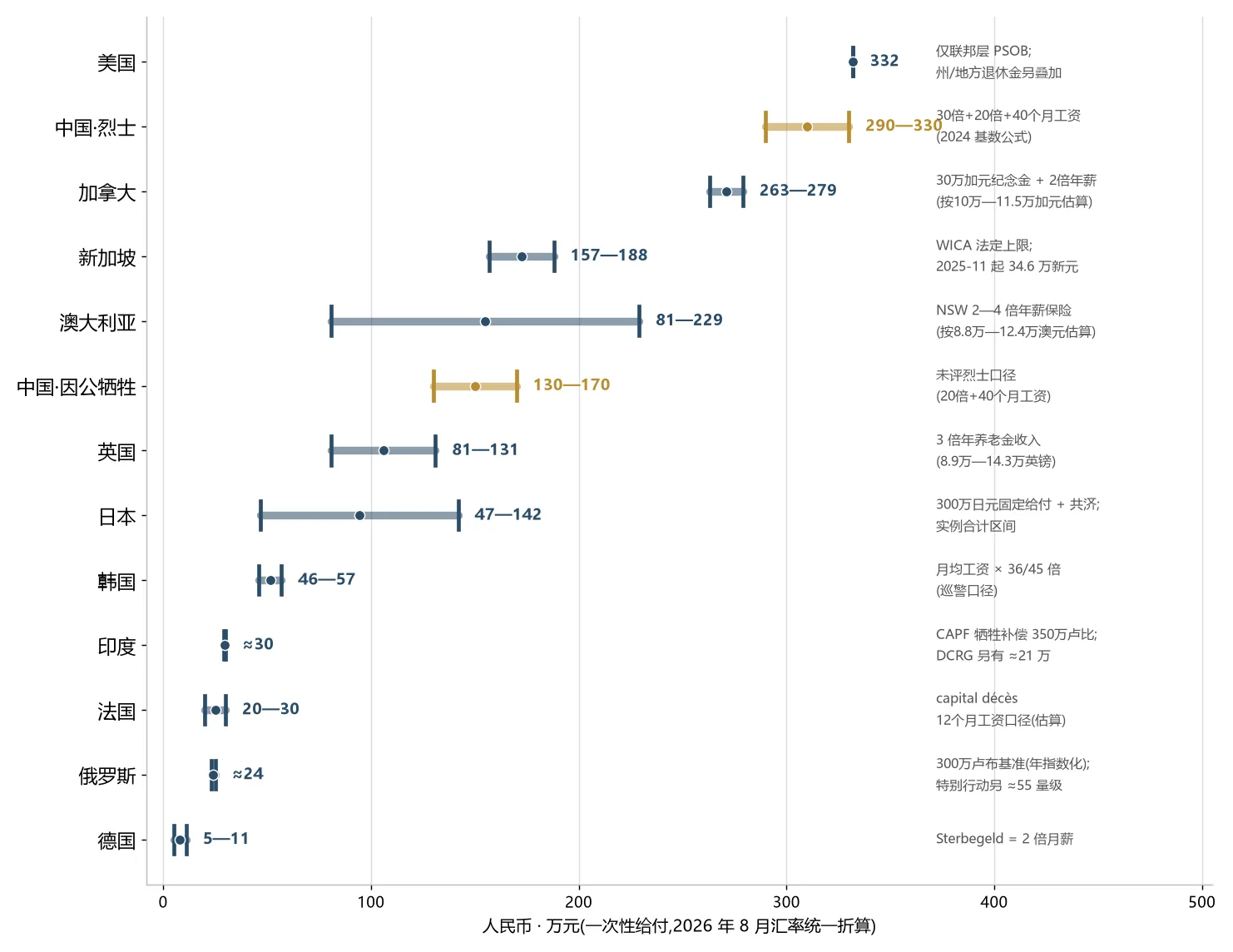
Three readings:
- The top tier is a “federal cheque + dedicated fund” combo. The US federal level alone approaches RMB 3.32M, with state and local pensions stacked on top; Canada relies on a tax-free CAD$300K memorial cheque plus a 2× salary supplement, totaling over RMB 2.63M. These two countries sit at the very top for lump-sum payouts.
- China’s martyr category leads the second tier, but there is a sharp fault line. The same line-of-duty sacrifice: rated a martyr, roughly RMB 2.90M–3.30M; not rated, roughly RMB 1.50M — a full doubling. Whether one is recognized as a martyr is the difference between two worlds of money.
- Continental Europe’s philosophy is “less up front, more over a lifetime.” Germany and France’s lump sums sit at only ~RMB 0.05M–0.11M and ~RMB 0.20M–0.30M respectively, looking bottom-tier. But both countries’ survivor and orphan annuities are paid monthly for life; the true total only makes sense when annuities are included.
II. Three Models of Family Security
Laying the twelve countries side by side reveals three institutional approaches:
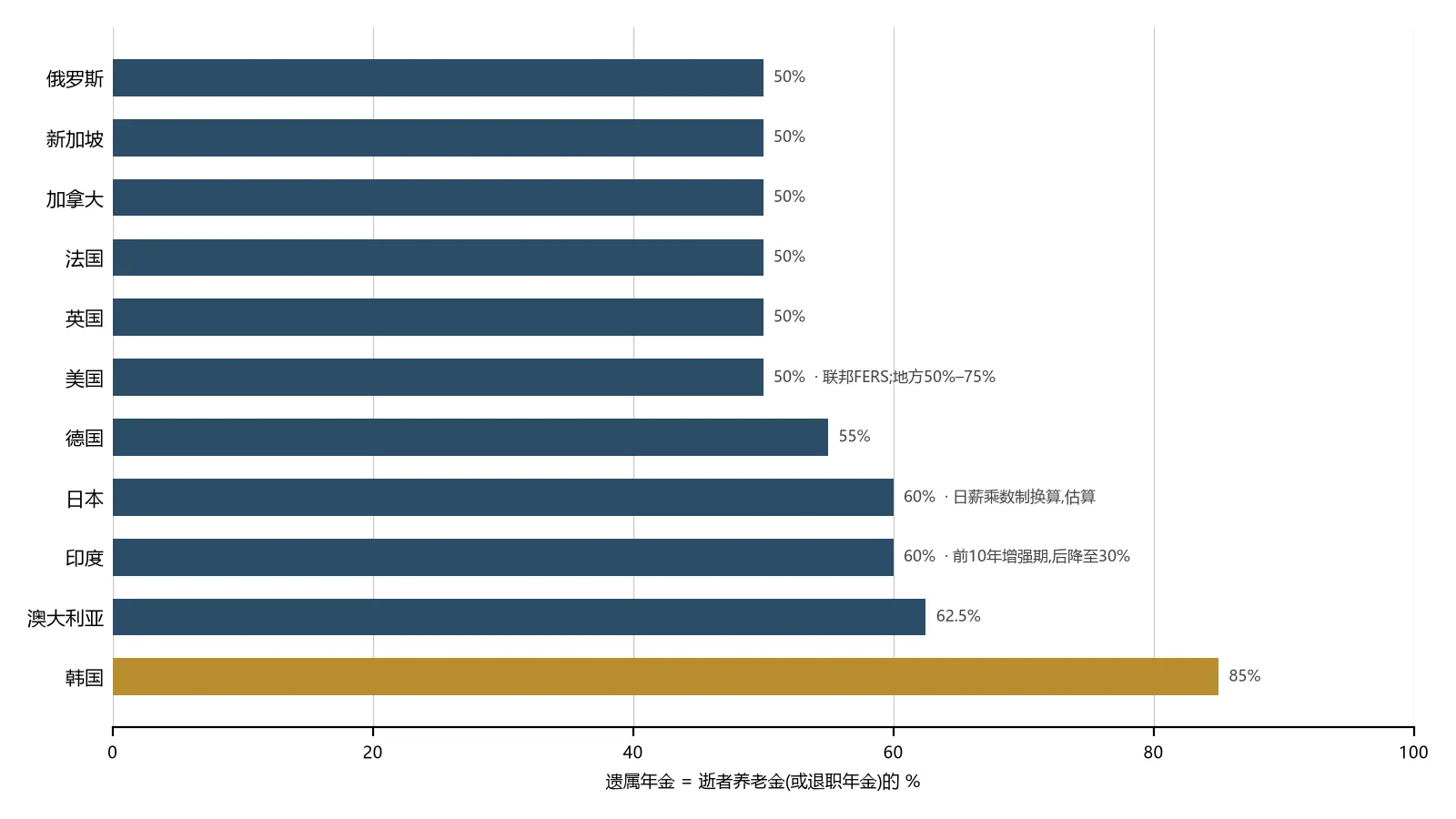
Civil-servant pension systems (UK, Germany, France, Canada, Australia, Japan, South Korea, Singapore, US local level). The logic is “police are first and foremost civil servants, and benefits follow the occupational pension”: the lump sum is a doorway, but the real safety net is the survivor annuity — a spouse receives 50%–85% of the deceased’s pension, paid monthly for life. The money comes from employer contributions and government guarantees, not from whichever year’s budget happens to feel generous.
Fiscal pension systems (China, Russia, India). The logic is “state honor + formulaic accounting”: lump-sum pensions are tied to large multipliers (China’s per-capita income 20×/30× formula, Russia’s 3M-ruble flat-rate set in 2011), and monthly allowances follow central or provincial standards. The hallmark is clear, unified standards, but the amounts are predictable and subject to fiscal-year cycles, with significant local variation.
Insurance / dedicated-fund systems (US federal level, Korean mutual-aid society, Singapore Welfare Fund, Canadian Memorial Grant). On top of the state layer, a “dedicated” layer is added: the US PSOB is a congressional appropriation, nationally uniform, and indexed to CPI annually; Canada gives every line-of-duty fallen first responder’s family a tax-free CAD$300K cheque. The merit of this approach is its independence from the ordinary civil-servant system — ring-fenced for its purpose.
No model is unambiguously superior, but the impact on surviving families is tangible: pension-system families receive a steady stream that may not cover a down payment; fiscal-system families get a satisfying lump sum but must understand which circumstances qualify for the higher tier; dedicated-fund systems are most inflation-resistant but have a ceiling.
III. Details Worth Paying Attention To
The US “federal + local” stacking is the ceiling for lump-sum payouts. PSOB is adjusted each October by CPI-U: FY2024-25 at US$448,575 (~RMB 3.23M), FY2025-26 at US$461,656 (~RMB 3.32M), tax-free.Stacked with state/local pensions (e.g. NYPD survivor annuity at 50% of final salary), survivors often receive a combined package of “federal cheque + local annuity.” Note that the US definition of “line of duty” is also broad — on-duty medical emergencies and even 9/11-related illnesses can qualify.
China uses a formulaic pension, and “martyr” status is the fault line — with two components in the formula. Article 13 of the Regulations on the Commendation of Martyrs (revised 2024, effective 2025-01-01): martyr praise money = 30× the previous year’s national urban per-capita disposable income (based on the 2024 figure of RMB 54,188, approximately RMB 1.626M); plus a separate one-time pension = 20× the base (approximately RMB 1.084M) + 40 months’ basic salary. In other words, a martyr’s family receives three components — “30× + 20× + 40 months’ salary” — totaling ~RMB 2.90M–3.30M; non-martyr line-of-duty deaths receive only “20× + 40 months’ salary” (~RMB 1.50M). Martyrs’ children also receive +20 Gaokao points (one of only five nationwide items retained after the 2018 reform) and tuition waivers. Note: the 2025 income base will be published in January 2026, at which point the formula automatically updates to the new base.
Commonwealth systems place the weight on “annuities.” The UK’s 2015 Police Pension Scheme (Regulations 127/131/135): lump sum on death is 3× annual pension income (a constable’s ~£88,818–143,229, roughly RMB 0.81M–1.31M), spousal annuity is 50% of the deceased’s pension, each child 25% — the longer both spouses live, the more the annuity’s present value can exceed the lump sum.Stacked with the Police Federation group life insurance (an additional £150K–300K for assault fatalities), the UK offers a three-dimensional combination of “lump sum + lifetime annuity + insurance.”
East Asia’s two countries carry the modern form of mutual-aid tradition. Japanese police fall under local civil-servant disaster compensation: a fixed benefit of ¥3M (~RMB 140K) as a floor, a widow’s compensation pension at “daily-wage base × 153–245 days” (escalating with the number of survivors), and police mutual-aid loan preferential terms; South Korea’s Civil Servant Disaster Compensation Act (effective 2024-01) raised the multiplier for fallen officers from the old 24× to 36×/45× (a patrol officer’s roughly RMB 0.46M–0.58M), nearly doubling for hazardous duties, with survivor pensions at a special 85% of retirement-pension equivalent (versus the 70% rate for spouses of those who die after retirement).
IV. Hold Off on Direct Comparisons — Five Statistical-Accounting Traps
- One tier or two? The US, Canada, Germany, and Australia all stack “federal/central + state/provincial”; comparing only federal numbers severely underestimates. Russia and India similarly have two tracks (MIA vs. local police; CAPF vs. state police). China, France, Japan, and South Korea are relatively unified, with local supplements being “the cherry on top.”
- Lump sum or annuity? Discounting the UK spouse’s 50% annuity over 20–30 years may exceed another country’s entire lump sum. Looking only at “how much you get upfront” leads to the opposite conclusion.
- Who bears the tax? US PSOB and the Canadian Memorial Grant are tax-free; Singapore is tax-free for “tax-dependent” recipients and taxable for non-dependents; China’s one-time pension is tax-free. A flat comparison is unfair.
- What counts as “dying in the line of duty”? The US includes on-duty medical emergencies and 9/11-related diseases; most countries require a direct causal link to duty; Russia has a separate “special operation” channel. How broad or narrow the definition directly determines which families receive money.
- Exchange rates and timeliness. This article’s RMB conversions use August 2026 rates; JPY, KRW, RUB, and INR all fluctuate significantly. Some country data windows reflect 2024 standards; 2026 updates (e.g. China’s new income base, Singapore’s November cap increase) will require separate verification when they take effect.
A final note on transparency: figures for the US, UK, Germany, Canada, Australia, Japan, South Korea, and Singapore can largely be traced directly on official pages. For Russia, India, and China, local implementation figures and actual fund-disbursement records are not fully public; where sources are not individually cited, please consult the official primary texts.
V. Conclusion
The safety net left to fallen officers’ families is, at bottom, a society’s answer to the question: who picks up the people who fall for the public? Some countries debate a US$460K formulaindexed to inflation; others calculate “30× + 20× + 40 months’ salary”; still others bake school tuition and public-housing allocations into the institutional design. Beyond the numbers, this article wants to say: these institutional differences are not cold policy tables — they are the first promise that family waiting behind the door receives in those dead-of-night moments when someone knocks.
Data may update with each country’s new fiscal-year regulations; figures reflect statutory standard rates and individual cases vary by rank, years of service, and region. Please verify against the original sources when citing.
References
- US PSOB annual benefits table: https://bja.ojp.gov/program/psob/resources/benefits-by-year
- China, Regulations on the Commendation of Martyrs (2024 revision): https://www.gov.cn/zhengce/content/2011-08/01/content_1917749.htm; Ministry of Veterans Affairs: https://www.mva.gov.cn
- UK Police Pension Scheme 2015 Regulations (death benefits and survivors): https://www.legislation.gov.uk/uksi/2015/445/regulation/127
- Germany, Beamtenversorgungsgesetz §18 (death benefit) / §20 (widow’s pension): https://www.gesetze-im-internet.de/beamtvg/
- France, National Pension Authority — survivors’ rights: https://retraitesdeletat.gouv.fr/deces/la-reversion-les-droits
- Japan, Local Civil Servant Disaster Compensation Act: https://elaws.e-gov.go.jp/document?lawid=342AC0000000147; Fund: https://www.chihokosaikou.or.jp/
- South Korea, Civil Servant Disaster Compensation Act: https://www.law.go.kr/법령/공무원재해보상법; Civil Servant Pension Act Article 67: https://www.law.go.kr/법령/공무원연금법/제67조
- Singapore, WICA death benefit: https://www.mom.gov.sg/workplace-safety-and-health/work-injury-compensation
- Australia, NSW Police Superannuation Act: https://legislation.nsw.gov.au/view/html/inforce/current/act-1906-028; CSC: https://www.csc.gov.au/members/our-schemes/pss
- Canada, First Responders Memorial Grant: https://www.publicsafety.gc.ca/cnt/cntrng-crm/plcng/frst-rspndrs-mmr-grnt-pgrm-en.aspx
- Russia, Federal Law No. 247-FZ: https://www.consultant.ru/document/cons_doc_LAW_116957/
- India, PIB compensation notice: https://www.pib.gov.in/PressReleasePage.aspx?PRID=2117803; PMSS: https://www.desw.gov.in/prime-ministers-scholarship-scheme-pmss
This article was produced by a dual-engine deep-research pipeline powered by Grok + Tavily: a dedicated investigator for each country searched official sources, subjected to three-lens adversarial verification across “benefit formulas / policy timeliness / source authority,” with key disputed points (China’s praise-money multiplier, Gaokao bonus points, India’s pension tiers) separately cross-checked with dual engines before finalization. Confidence is moderate for countries with limited public channels (Russia / India).