
If you’re looking for something truly special among the sea of new GitHub projects, MiroFish is absolutely worth your attention.
It topped GitHub’s Trending New Stars list today (racking up 73K stars in short order) not through flashy technical炫耀, but with a complete “digital sandbox” solution—letting thousands of agents with distinct personalities and memories freely interact and socially evolve in a virtual world, thereby enabling推演 of future events. While others are still debating the conversational capabilities of large language models, MiroFish has already moved the battleground to the dimension of collective intelligence.
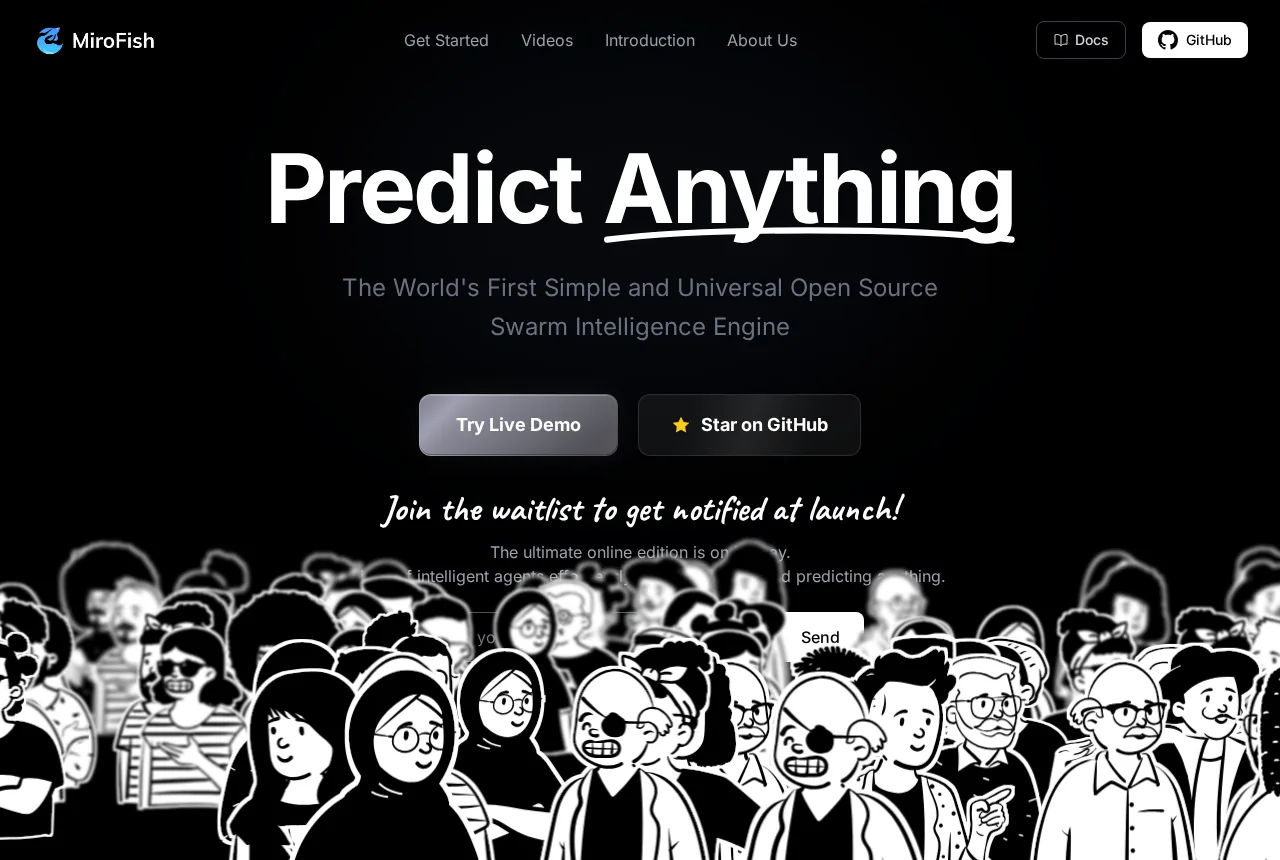
Core Capability: Building a Predictable Digital Parallel World
MiroFish’s working principle isn’t mysterious, but its implementation is quite ingenious. It captures seed information from the real world (a breaking news story, a policy draft, or earnings report data) and uses it as a starting point to construct a high-fidelity simulated world in digital space.
In this world, each agent carries an independent personality setting, long-term memory, and behavioral logic as it interacts. You can dynamically inject variables from a god’s-eye perspective and observe how events ripple outward like a stone cast into water. This is no longer a prediction model in the traditional sense, but rather a “future rehearsal laboratory”:
- At the macro level, decision-makers can test policy effects and PR strategies in a zero-risk environment;
- At the micro level, creators can use it to explore novel endings or investigate “what if” historical forks in the road where different choices were made.
Three Steps to Get Started, No Need to Build from Scratch
The project’s installation process is remarkably approachable, with two paths offered officially. Source code deployment suits users who want deep customization:
- Prepare Node.js 18+, Python 3.11-3.12, and uv (Python package manager);
- Copy
.env.exampleto generate your config file, then fill in your large model API keys and Zep cloud service credentials; - Run
npm run setup:allto install all dependencies in one command; - Finally,
npm run devto launch both frontend and backend services simultaneously.
Visit http://localhost:3000 locally to access the interactive interface. Upload analysis reports or novel excerpts, describe your prediction needs in natural language, and the system will return a prediction report along with a deeply interactive digital world.
Docker users have it even easier—after configuring .env, a single docker compose up -d command brings up the complete environment.
Technical Highlights and Design Trade-offs
MiroFish’s backbone comes from Camel-AI’s open-source OASIS framework, a foundational engine designed specifically for social interaction simulation. On top of this, the project team made several key trade-offs:
Multi-agent collaborative architecture. Rather than having a single large model directly answer questions, it organizes multiple agents with distinct role divisions into a social structure. When a “policy adjustment” variable is injected, the evaluator role assesses the impact, the evaluator suggests adjustments, and the reporter handles summary output. This division of labor reduces single-point complexity and more closely mirrors real-world decision-making chains.
Dual-platform parallel simulation mechanism. The simulation process splits into a main path and a parallel verification path—the former ensures smooth推演 progression, while the latter periodically retraces to check logical consistency. This design sacrifices some computational efficiency but significantly boosts result credibility—after all, the value of prediction lies not in speed, but in accuracy.
Long-term memory and knowledge graph fusion. Each agent’s conversation history isn’t simply discarded; instead, it’s structured into a knowledge graph via GraphRAG technology. This allows agents to remember key人物 relationships and event causes-and-effects even after hundreds of interaction rounds, avoiding the “forgetting what was said earlier"困境 of traditional conversational systems.
Who Should Pay Attention? Comparison with Similar Projects
MiroFish’s target user base is quite clear:
- Researchers: Those who need to study social phenomena, public opinion evolution, or policy effects, but find traditional surveys and experiments too costly;
- Content creators: Writers of novels, screenplays, or game settings who want to explore the plausibility of different plot branches;
- Corporate strategy departments: Those conducting careful market pre-tests to identify potential risk points before making real decisions;
The market isn’t without similar attempts. Compared to other comparable projects:
- Stronger than single-agent simulation: Most projects focus on single-agent planning capabilities; MiroFish emphasizes collective social evolution;
- More stable than pure LLM prediction: Instead of relying on a single model’s reasoning chain, MiroFish lets multiple agents debate, correct, and reach consensus;
- More usable than research-grade frameworks: Camel-AI’s OASIS is inherently academic; MiroFish has done extensive engineering adaptation and interaction optimization.
There are当然 limitations: the current version has a strong dependency on large model APIs, and Zep’s cloud service free tier is suitable for lightweight experimentation—frequent use requires cost consideration.
Final Thoughts
What’s most打动人 about MiroFish is that it doesn’t seek to replace human judgment, but instead extends a hand saying “I’ll think through this with you.” When we can’t easily recreate those “what ifs” in reality, it offers a gentle alternative: in a safe digital sandbox, lay your imagination open and wide.
If one day we truly can predict economic fluctuations or public opinion storms—I think that won’t come from some prophet’s intuition, but from the collective wisdom that emerges after thousands of agents repeatedly collide and trial-and-error in a virtual world.
Perhaps that’s the truly captivating posture of collective intelligence.