
#1 Key Launch Details
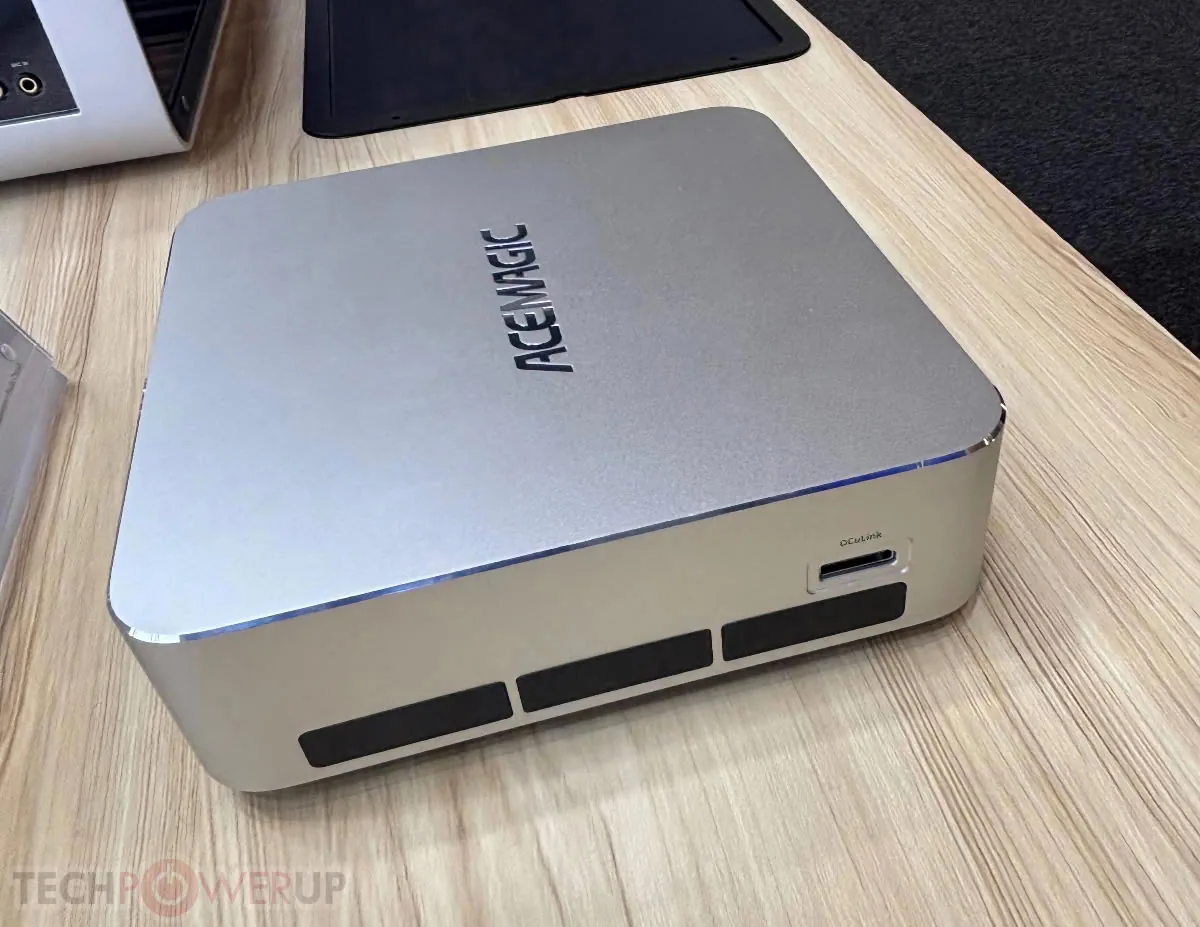
ACEMAGIC’s F7A mini PC debuted at IFA 2026, featuring the Intel Core Ultra X7 358H processor. As the latest addition to the F-series, it targets professional users seeking performance and expandability in a compact form factor.
Core specifications and availability:
- Processor: Intel Core Ultra X7 358H (same as F2A)
- Memory: Up to 64GB LPDDR5, 8533 MT/s
- Storage: Dual M.2 2280 NVMe slots (one PCIe Gen4 x4 + one PCIe Gen5 x4)
- Connectivity: Wi-Fi 7 and Bluetooth 5.4
- Processor power target: 65W TDP
- Dimensions: 143 × 143 × 40 mm (notably larger than F2A)
- Status: Shown at IFA, price and release date not announced
#2 Form Factor and Thermal Design: Bigger Chassis for Better Performance
F7A departs visually from the earlier F2A model. While sharing the same CPU, the increased chassis size enables improved thermal dissipation for sustained 65W operation. In the compact PC segment—where heat constraints often throttle performance—the architectural trade-off of “larger size for better cooling” represents a meaningful engineering pivot.
The LPDDR5 memory hitting 8533 MT/s stands out; this speed far exceeds typical board-mounted LPDDR5X chips (6400–7500 MT/s) seen in competing models. Higher memory bandwidth directly benefits integrated graphics and multitasking responsiveness.
Storage flexibility also impresses: Independent Gen4 and Gen5 M.2 slots offer future-proof flexibility. Enabling a full-gen5 interface on a 65W platform remains uncommon in紧凑 form-factor devices, suggesting active thermal management or power delivery optimizations.
#3 F7A vs F2A: Serviceable Upgrades Table
This comparative table reflects only publicly reported specifications:
| Feature | ACEMAGIC F7A | ACEMAGIC F2A |
|---|---|---|
| Processor | Core Ultra X7 358H | Core Ultra X7 358H |
| Dimensions | 143 × 143 × 40 mm | Smaller than F7A |
| Thermal design | Upgraded cooling | Standard cooling |
| Max memory | 64GB LPDDR5 (8533 MT/s) | Undisclosed |
| Storage slots | Dual M.2 (Gen4 + Gen5) | Undisclosed |
| Wireless | Wi-Fi 7 + BT 5.4 | Undisclosed |
| Power target | 65W | Undisclosed |
F7A’s improvements target system-level convenience rather than CPU architecture: memory ceiling expansion, interface modernization, and network standard upgrades. This approach lets OEMs refresh offerings without renegotiating Intel platform licensing or supply chains.
#4 Buyer Advisory: Who Should Pay Attention?
- Prioritize if you: Need a portable workstation, light creative tool, or embedded solution; require dual NVMe bays (especially Gen5-ready); or prefer sealed large-RAM configurations over拆机 upgrades.
- Wait and see if: Budget-conscious;天天 office tasks suffice; or curious about real-world thermal behavior—65W in a 40mm-thin chassis poses power delivery challenges. Await official pricing and user reviews before committing.
In Conclusion
The F7A signals a broader shift: OEMs are extracting more performance per cubic centimeter, pushing compact PCs toward workstation parity. As LPDDR5 breaks 8000 MT/s thresholds, everyday devices gain workstation-grade responsiveness—hinting at a new era where performance is no longer dictated by physical footprint alone.