
AI-Agent Autonomous Triage: Cloudflare Open-Sources Astro Issue Automation System
Cloudflare has officially open-sourced its internally validated AI issue triaging workflow, releasing triagebot-action (a standalone GitHub Action) and Flue (an agent orchestration framework). The system automatically classifies, diagnoses, and fixes open-source project issues through multiple isolated sub-agents working in coordination within GitHub Actions. For the Astro project, this solution reduced open issues from over 200 to about 30, a decrease of approximately 85%, with the team aiming for zero open issues.
- triagebot-action: Now open-sourced as a standalone GitHub Action, directly integrable into any repository’s workflow
- Flue: A declarative agent orchestration framework, deployable on Node.js, GitHub Actions, or Cloudflare infrastructure
- Licensing: All components released under MIT license, no commercial license required
The Five-Stage Automated Triage Workflow
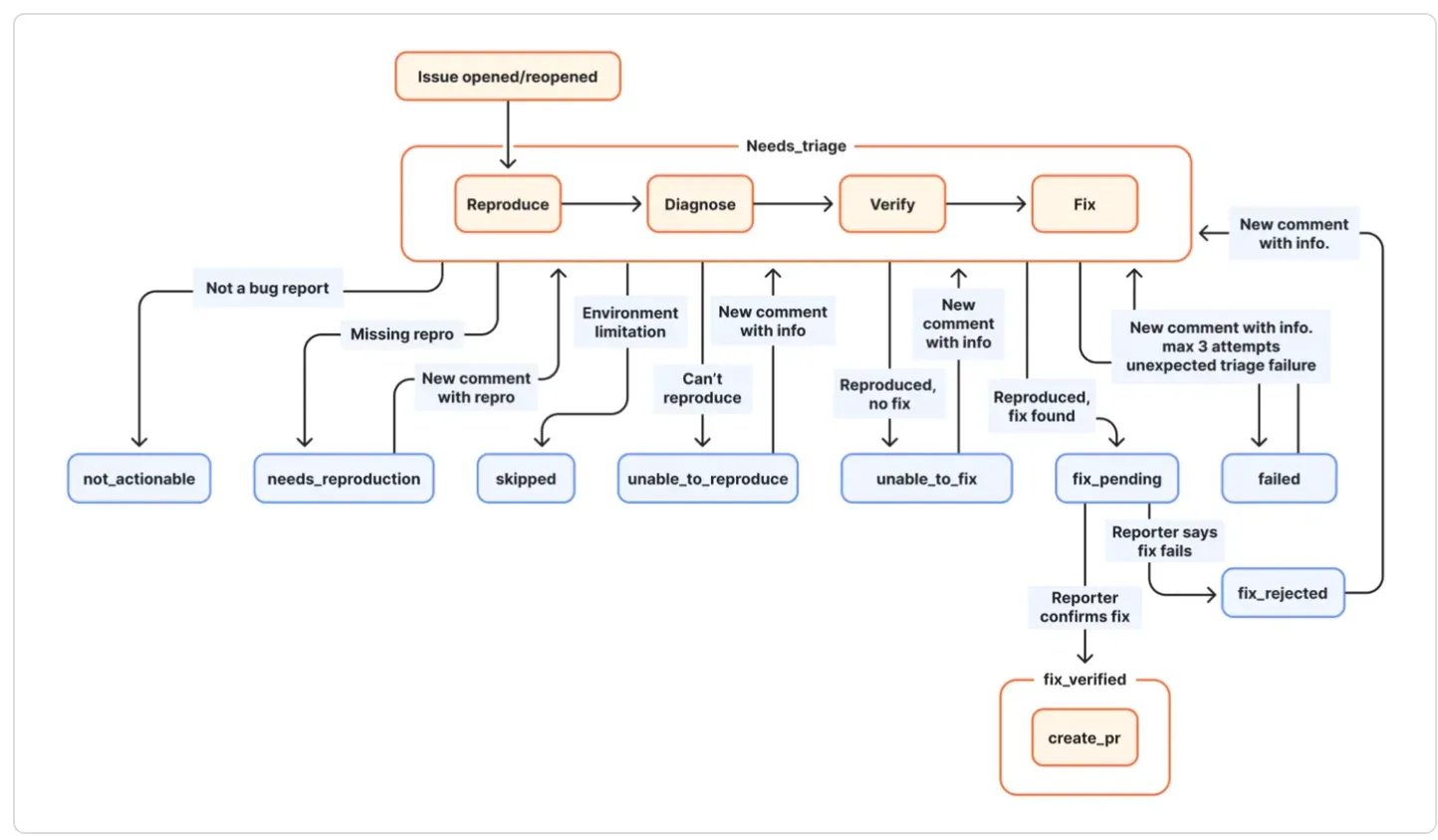
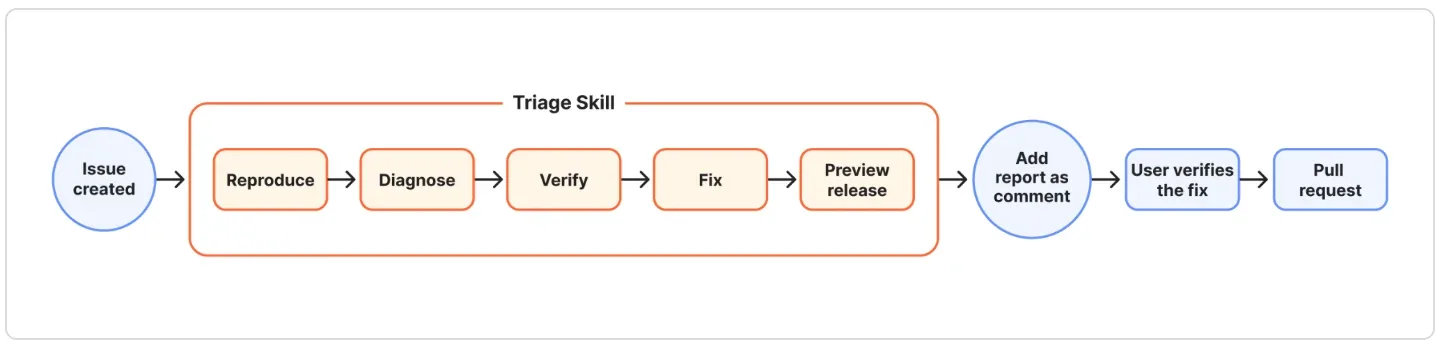
This system is not a single AI model call, but an explicit workflow composed of four bounded sub-agents. Each agent passes context through a report.md file rather than sharing execution context, ensuring traceability and resumability.
- Reproduction Agent: Verifies reported issues are genuinely reproducible, filtering out environment or configuration issues
- Diagnosis Agent: Instruments code to pinpoint root cause precisely
- Validation Agent: Checks test coverage, documentation completeness, and annotation accuracy
- Fix Agent: First converts reproduction scenario into test cases, then implements code fixes
The workflow uses a tag-driven state machine model: new issues trigger processing with the triage needed label; after fix confirmation, it transitions to fix verified state. Upon generating a preview, the fix agent publishes analysis, logs, and installation instructions to the issue; once validated by reporter, a pull request is automatically created.
An unexpected counterpoint: Despite high automation success, processing quality depends critically on codebase maintainability. In a hot module replacement case, insufficient test coverage caused the fix agent to repeatedly modify conditional logic, introducing regressions; adding a descriptive comment immediately improved agent behavior—validating the principle that “agent quality reflects code quality.”
Flue Framework: A Declarative Agent Orchestration Paradigm
Flue is the general-purpose orchestration framework distilled from Astro’s workflow, innovating by replacing iterative logic with declarative configuration. Developers define agent context (model, skills, sandbox, instructions) without writing state-transition or retry loops.
Key features include:
- Persisted execution history: Uses append-only event logging for state, supporting resumption from interruption points
- Sandbox isolation: Each agent runs in isolation to prevent cross-contamination
- External integration: Supports event triggers from GitHub, Slack, Linear, Discord
When integrated on Cloudflare’s platform, agents run as Durable Objects, gaining persistent execution and isolated storage. Astro’s triage workflow is a concrete instance of Flue’s general model: a high-reliability software workflow composed of bounded tasks, persisted state, external events, and human approval nodes.
Implementation Guidance: When to Adopt

Recommended for immediate trial:
- Open-source maintainers seeking to reduce low-priority triage load, especially for reproducible defect reports
- Small teams lacking dedicated DevOps, wanting to lower issue tracking cognitive overhead
- Repositories with baseline test coverage (>60%); agents are sensitive to test quality
Worth waiting for:
- Highly specialized issue types (e.g., >70% business-logic defects) requiring domain expertise
- Codebases with poor test coverage and missing documentation, risking erroneous fixes
- Strict compliance requiring dual-man verification for production-safe code, currently missing in the workflow
In Closing
This case marks AI engineering’s evolution from “single model calls” to “systematic workflow orchestration.” Its core value lies not in replacing humans, but in shifting focus from repetitive triage to higher-value architectural decisions and code review—agents act as filters and executors, humans remain ultimate gatekeepers. At 85% automated coverage, teams can redirect attention to complex architecture and genuine user needs.