
A shift from scientific computing to scientific execution
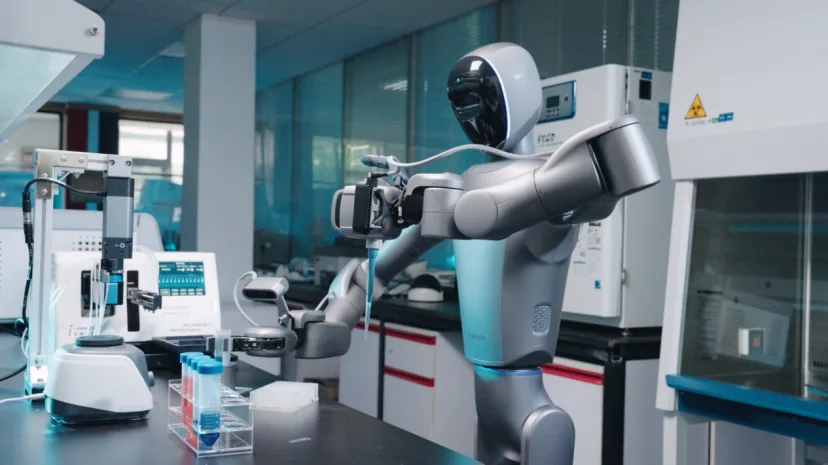
AI for Science is moving beyond simulations and data analysis into the physical laboratory. According to InfoQ AI, a national-level research platform in China introduced its first batch of Monte2 humanoid robots in mid-July. The robots were jointly developed by Yuanluo Technology and the laboratory, and are being used for reagent handling, reagent preparation, automated dispensing, cytotoxicity testing, and coordination across multiple lab devices without continuous human operation.
Monte2 is not presented as a futuristic-looking robot. Its design is practical: two robotic arms and a compact body built for bench-top work. The key difference from conventional six-axis industrial robots is that Monte2 is intended for long, flexible experimental sequences, including micro-volume liquid transfer, instrument handling, tool use, nucleic-acid extraction preprocessing, and cell-culture-related cytotoxicity workflows.
Autonomous labs are becoming a global research direction
Lab automation has existed for years, but autonomous laboratories add a new layer: AI can help decide what experiment should happen next. In 2024, a University of Liverpool team demonstrated a robotic system that operated continuously for eight days, switched between instruments such as chromatography and nuclear magnetic resonance, and completed 680 experiments. The work was published in Nature.
Other examples point in the same direction. Berkeley’s A-Lab focuses on materials synthesis, using AI to analyze literature and generate preparation plans; robots synthesized 41 new materials in 17 days. A project at the University of North Carolina improved experimental workflows and increased data collection speed by 10 times, compressing screening work from months to weeks.
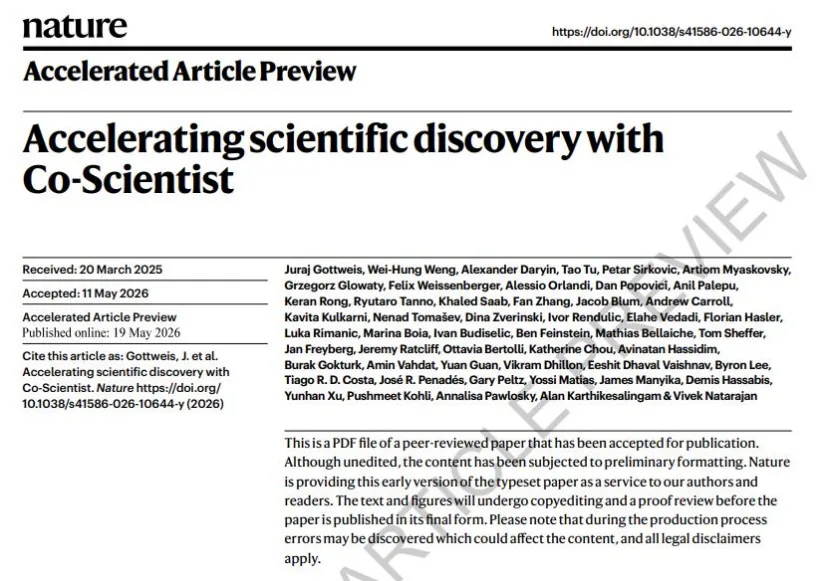
Large models are also becoming the “brains” of future labs. In simple terms, a large model is an AI system capable of processing large-scale text, data, or multimodal information and generating reasoning results. Systems such as Carnegie Mellon University’s Coscientist, Google DeepMind’s Co-Scientist, and Sakana AI’s AI Scientist are exploring literature understanding, experimental design, hypothesis generation, and even support for scientific writing.
What “Lab 3.0” means
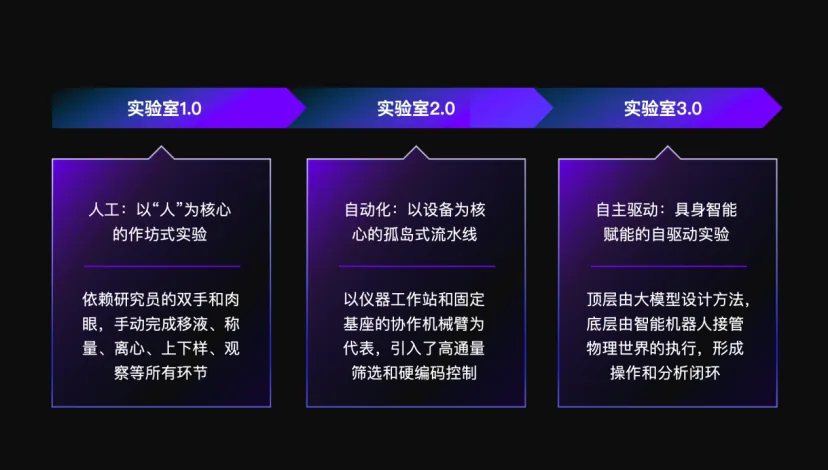
The article describes three stages of laboratory evolution. Lab 1.0 is centered on human researchers, who manually perform pipetting, weighing, centrifugation, observation, and other procedures. Lab 2.0 is centered on equipment and pre-programmed automation, improving efficiency but often operating as isolated automation islands. Lab 3.0 combines large-model planning with embodied robots that execute tasks in the physical world. Embodied intelligence means AI systems that perceive, interact with, and act through a physical body.
Yuanluo Technology’s approach is based on its OPN, described as an object-centered physical-native model. Its goal is to help robots understand experimental objects, tools, instruments, and their relationships, rather than merely replaying fixed instructions.
Key capabilities include:
- Object-centered scene understanding: recognizing reagents, tubes, cells, instruments, and how operations affect one another;
- Long-duration task execution: maintaining stable performance across multi-step workflows and multiple devices for several hours;
- Multimodal sensing and adjustment: combining vision, force, and touch to respond to changing liquid levels, tube angles, and gripping conditions, with sub-millimeter-level precision.
The significance is that the robot is no longer just a mechanical arm pressing buttons. It becomes an execution layer that can organize sequences of actions around scientific tasks and adjust to a changing environment.
Early value in cell biology workflows
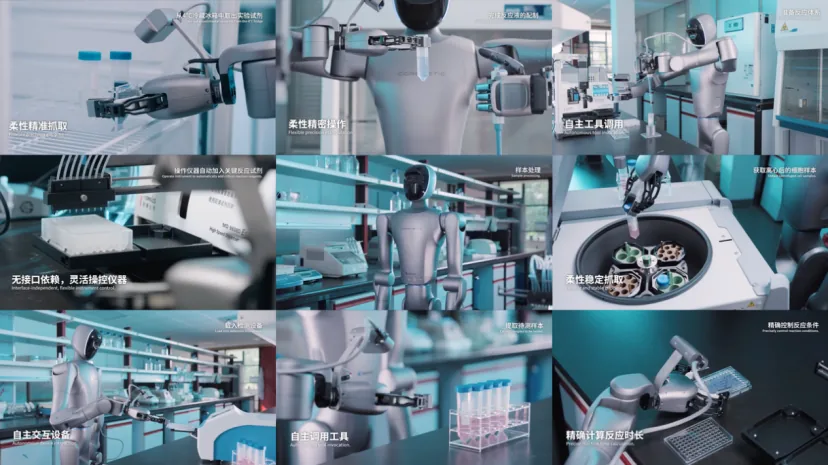
Cell toxicity testing and cell passaging are strong early use cases because they involve many repetitive, fine-grained operations: sampling, solution preparation, repeated liquid handling, and instrument operation. Small variations in pipetting depth or added volume can affect the final result. Human operators also face fatigue and experience-based differences, which can reduce consistency.
According to the report, after deployment at the national-level research platform, Yuanluo’s robots can autonomously complete workflows such as cell passaging and cytotoxicity testing, coordinate multiple instruments, and perform more than 40 fine biological experimental operations. The lab director said humanoid robots could help relieve bottlenecks in throughput and consistency caused by manual work. The lab plans to expand to around 100 robots by the end of 2027 and use AI to schedule the robot fleet.
Collaboration, not replacement
The core value of robotic laboratories is not replacing scientists, but freeing them from repetitive, high-intensity, long-duration execution. Milad Abolhasani of North Carolina State University has argued that autonomous labs will act as collaborators, reducing the time and cost needed to reach scientific solutions, while not replacing human expertise and creativity.
That is the more realistic near-term outlook for AI for Science. Robots are well suited to stable, repetitive, data-rich experimental execution, while large models can help extract hypotheses from literature and data. But deciding whether a discovery matters, whether a mechanism is convincing, and whether a research direction is worth pursuing still requires human scientific judgment. Yuanluo has launched the Origin Program to recruit its first 100 partners across biomedicine, materials science, and chemical analysis. The next phase of laboratory competition may depend less on individual instruments and more on the coordination among AI systems, robots, experimental workflows, and human insight.