
Adoption Is Not the Same as Acceptance
AI is becoming harder to avoid, but the public response is moving in the opposite direction: more people are using or encountering AI, while trust in the technology and its builders is weakening.
The central tension is no longer whether AI can be deployed at scale. It is whether ordinary users believe the trade-offs are worthwhile. Silicon Valley long assumed that ubiquity would normalize AI, much as earlier waves of computing became part of daily life. The evidence cited in the report suggests a different outcome: widespread exposure is not automatically producing public approval.
Polls Point to a Broader Backlash
Several recent surveys show a consistent pattern of concern:
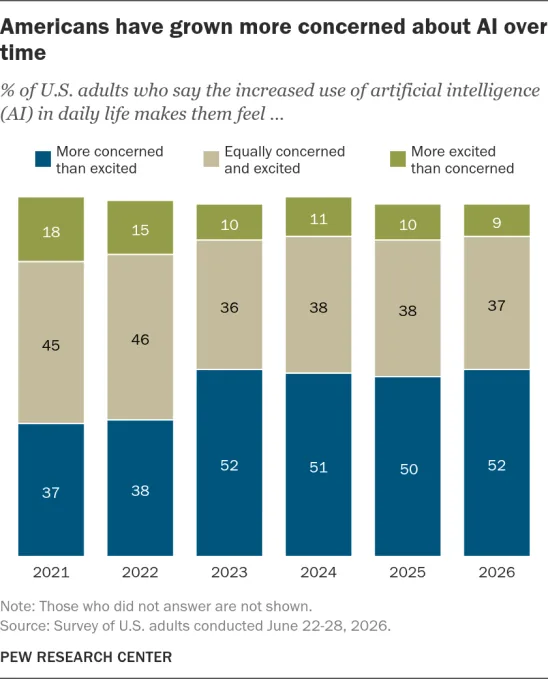
- Pew Research found that 52% of Americans are “more concerned than excited” about increased AI use in daily life, up from 37% in 2021.
- A CNBC poll of 18- to 34-year-olds found that, when shown the names of nine leading AI figures, a majority did not trust them to act responsibly on AI.
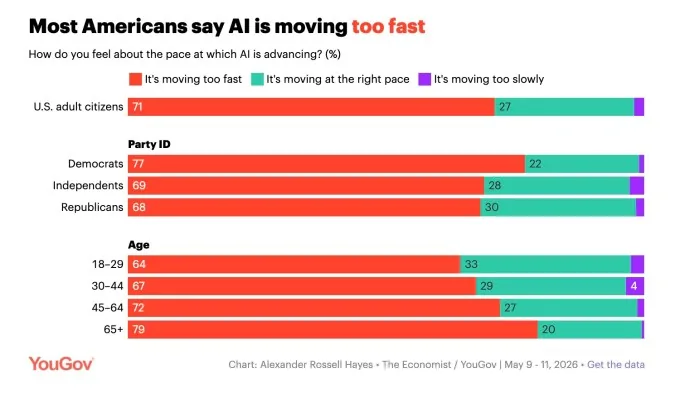
- A May Economist/YouGov poll found that more than 70% of Americans believe AI is advancing too quickly.
The concern is not limited to consumer apps. Axios reported that the National Republican Senatorial Committee warned major AI companies that U.S. data centers were hurting the party’s chances in a key Ohio election. The Wall Street Journal also reported that technology companies building AI data centers across the country are facing local public relations problems and have had to improve their offers to communities, including job guarantees, clean-water investments and other local benefits. In one Louisiana parish, the package reportedly included $50,000 bonuses for teachers.
A data center is a facility that houses large numbers of servers and related power and networking equipment. For AI companies, these sites are essential because training and running advanced models require large amounts of computing power. For local communities, however, they can raise questions about land use, water, electricity and economic benefit.
Why the Benefits Feel Abstract
The resistance described in the report stems from a simple imbalance: many consumers do not clearly see how AI improves their lives, but they are being asked to live with its costs.
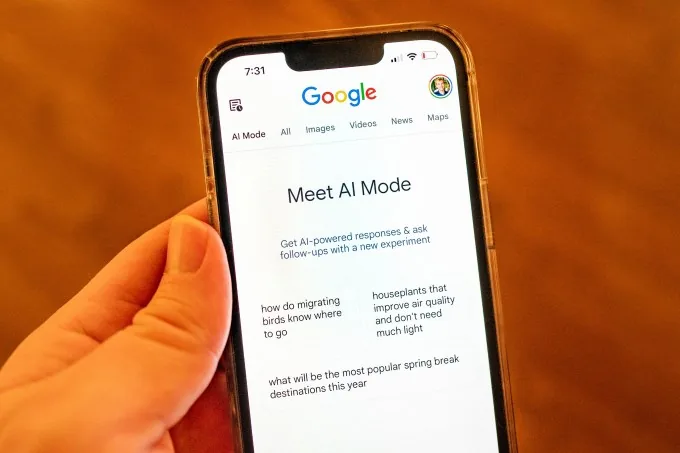
For most people, AI is not an abstract technical breakthrough. It appears as a chatbot, an AI search result, a summary inserted into a product, or a feature added to email, televisions and other everyday services. It is also associated with students cheating, including at the college level; with uncertainty about the value of degrees; and with models trained on large amounts of intellectual property later used to generate art, video, music and writing.
That makes AI feel different from earlier consumer technology shifts such as the iPhone, the personal computer or the internet. Those technologies offered immediate and visible utility: communication, access to information, entertainment and productivity. AI’s current consumer-facing benefits can feel narrower, while the perceived risks—job loss, loss of control, weakened creative ownership and unwanted product changes—feel concrete. If the upside is a web-page summary or a chatty TV, while the downside is economic disruption, skepticism becomes rational rather than irrational.
Even AI Leaders See the Trust Problem
Some in Silicon Valley may frame the backlash as a messaging failure: if executives explained AI better, the public would recognize its value. But the article notes that some prominent leaders now acknowledge a deeper issue.
Airbnb CEO Brian Chesky said on a recent podcast that the AI backlash is real and is partly tied to the industry not shipping enough products that “regular people” love. He argued that people need more everyday examples of AI value, such as access to an on-demand doctor for someone who otherwise could not afford care.
Anthropic CEO Dario Amodei also wrote on X that negative public perception of AI is a “big problem” and fundamentally a “crisis of trust.” He said people do not trust companies, governments or the technology industry because they suspect these institutions are “cooking up some new way to screw them over.” He added that the most accurate criticism of AI companies, including Anthropic, is that they have not yet delivered on their biggest promises to benefit the world, citing curing cancer as an example of the scale of promise the industry needs to fulfill.
What Comes Next
AI companies have raised hundreds of billions of dollars around the idea that the technology is inevitable. But inevitability is not the same as legitimacy. The next phase of AI adoption will be shaped not only by model performance and infrastructure spending, but also by public trust, local politics, labor concerns and consumer choice.
The industry is unlikely to stop pushing AI into search, software, devices, customer service and content tools. Yet if users continue to feel that AI is imposed rather than chosen, and that its benefits remain vague while its costs are real, companies will face growing pressure to change both products and deployment strategy. The most important AI race may therefore be less about who builds the largest model, and more about who can prove that AI creates value ordinary people can actually feel.