
The core update
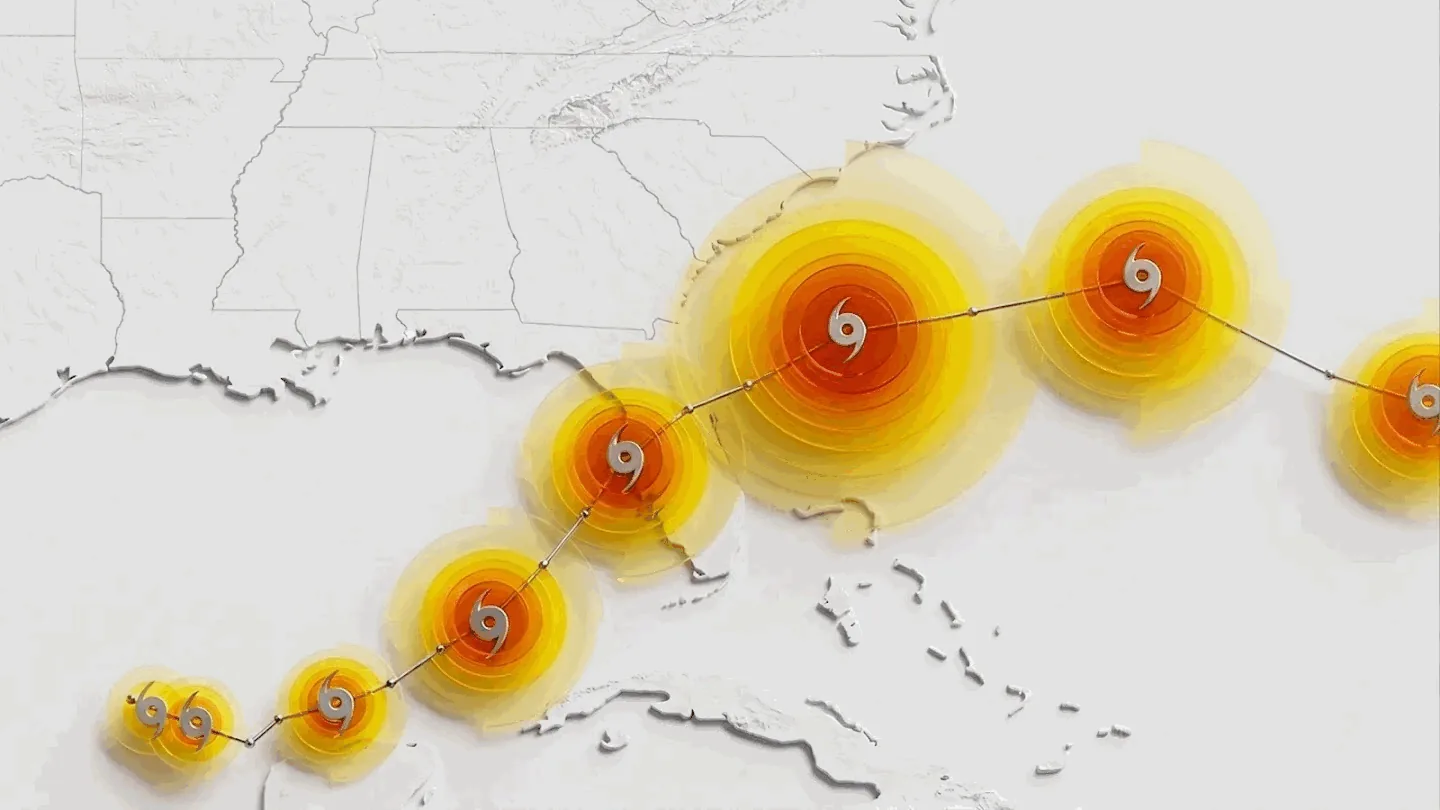
Google DeepMind says its WeatherNext AI system has reached state-of-the-art performance in forecasting tropical cyclones, improving predictions of storm track, intensity and wind structure. The company is also open-sourcing the models used during hurricane-season work, including WeatherNext Cyclones and WeatherNext 2.
According to the Nature paper described by DeepMind, the model gives forecasters, on average, more than a full day of additional useful lead time. Its three-day forecasts are described as being as accurate as what previous models could provide at two days, an improvement DeepMind compares to roughly a decade of meteorological progress.
Why cyclones are hard to predict
Tropical cyclones — called hurricanes or typhoons depending on region — are among the most damaging weather systems on Earth. DeepMind cites more than 700,000 deaths and $1.4 trillion in global economic losses over the past 50 years.
The forecasting challenge is partly a scale problem. A storm’s track is influenced by large atmospheric circulation patterns, which global models are designed to capture. Its intensity, however, depends on much more localized processes around the cyclone core. In weather modeling, “resolution” refers to how finely the atmosphere is divided into grid cells; finer grids can represent local detail better, but usually require much more computing power.
What WeatherNext changes
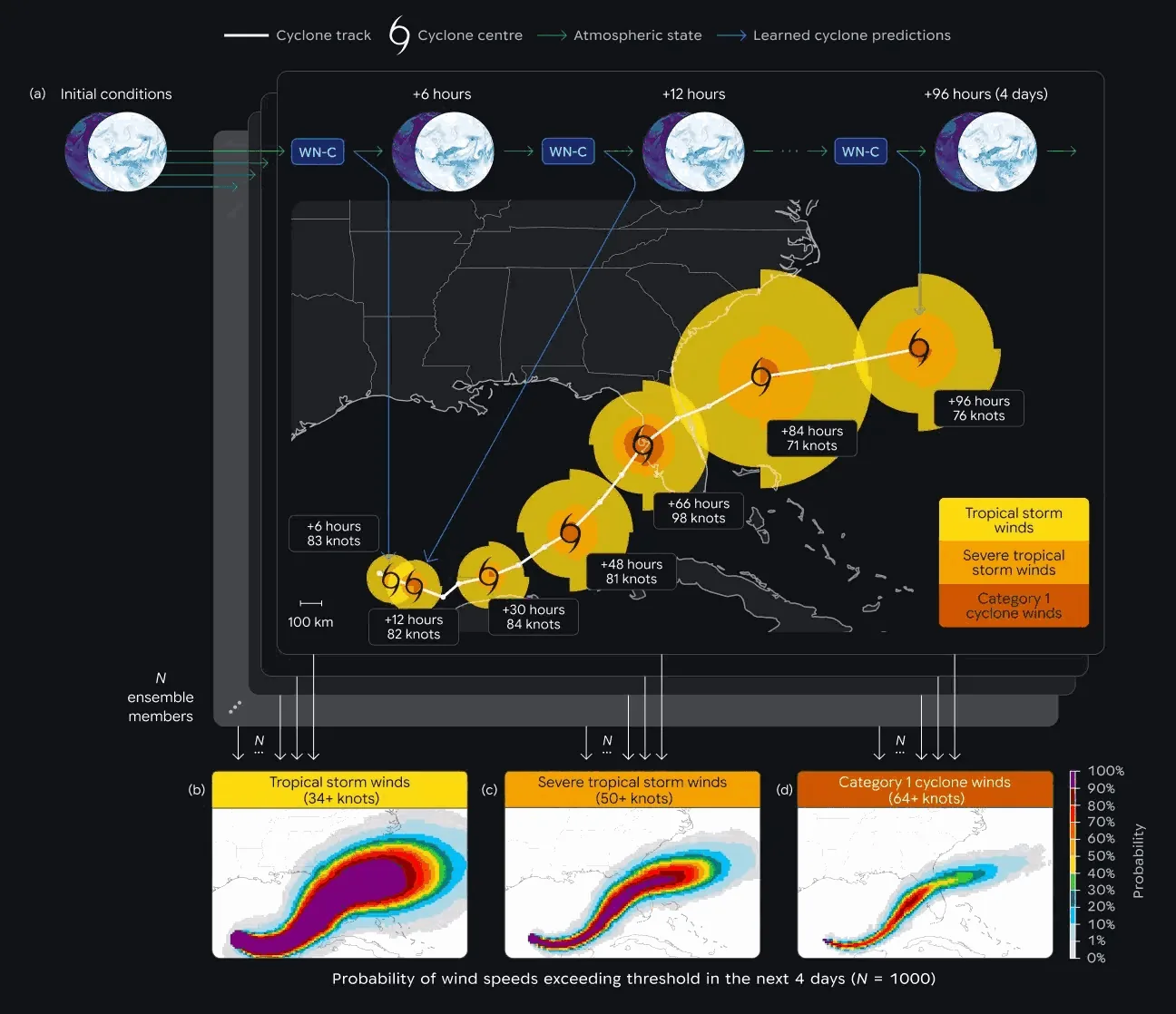
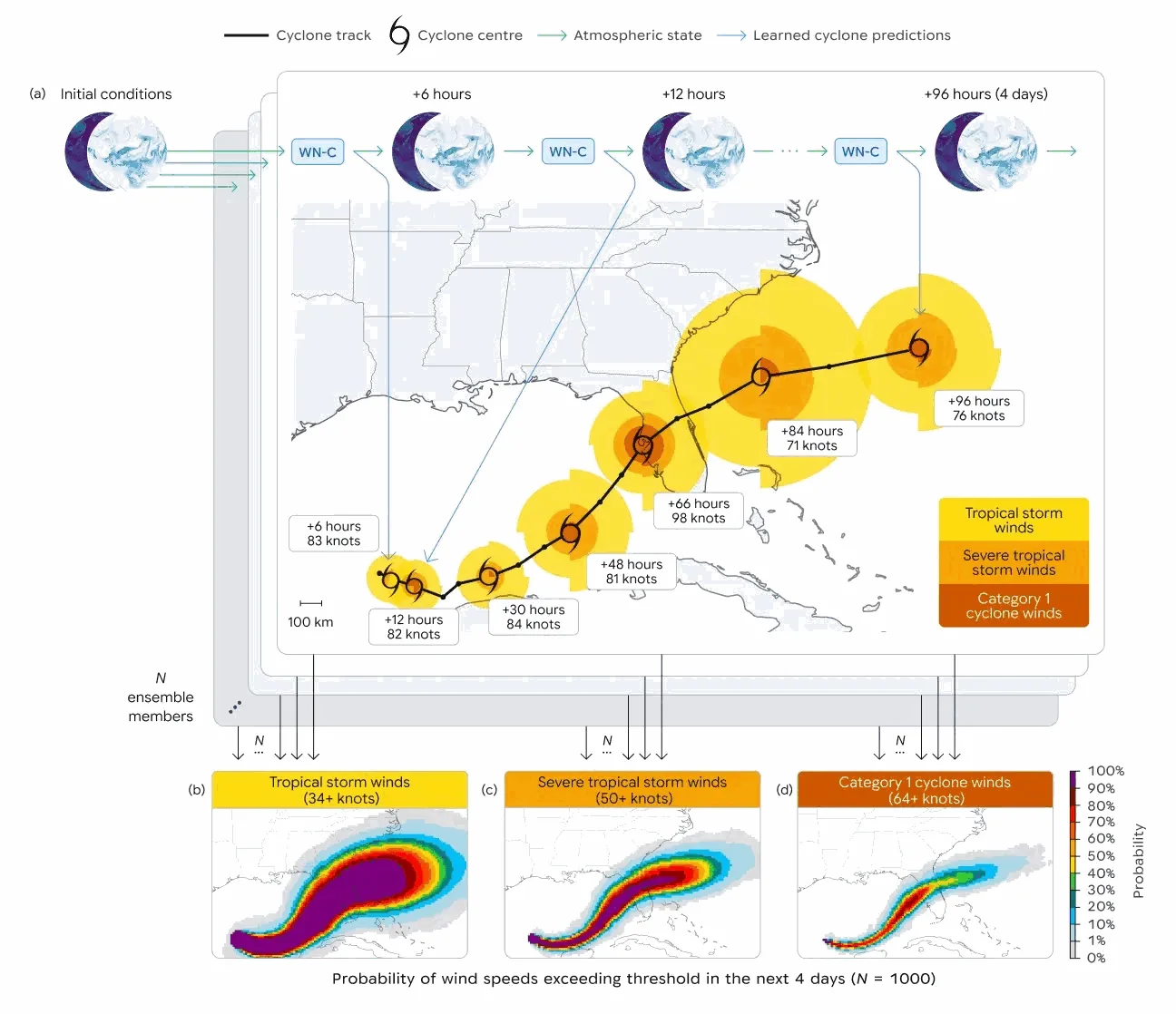
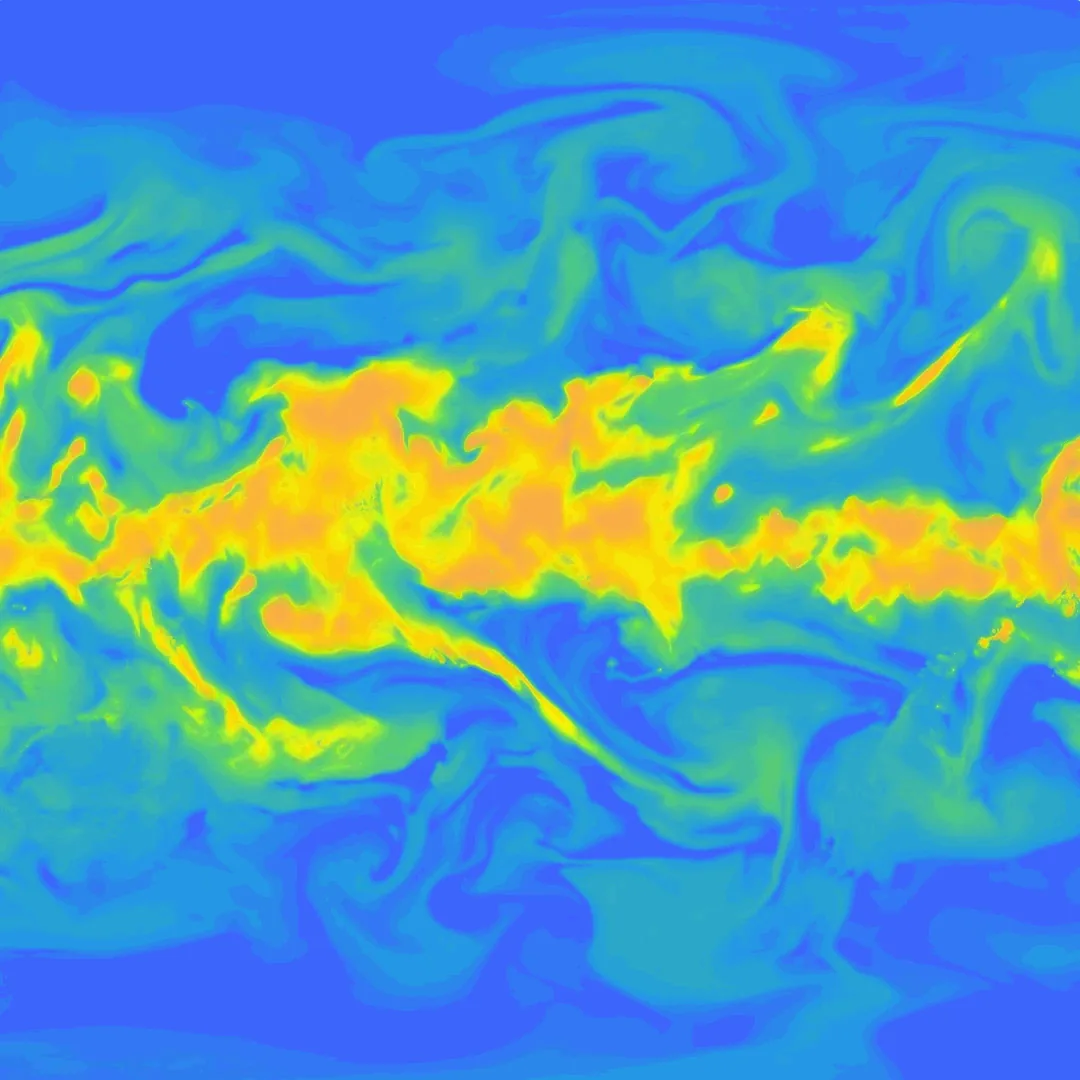
WeatherNext Cyclones is presented as a single AI model that can predict both global weather patterns and cyclone-specific behavior up to 15 days ahead. It was evaluated on historical cyclones from 2023 to 2024 and benchmarked against leading weather models for both deterministic forecasts and probabilistic forecasts.
Key details disclosed by DeepMind include:
- training on nearly 20 terabytes of global atmospheric data;
- use of the IBTrACS database covering nearly 5,000 historical storms;
- more than 24 hours of average lead-time advantage for track, intensity and wind structure;
- a 15-day forecast generated in under a minute on a TPU;
- ensemble size scaled from 50 members last year to 1,000 members this year;
- WeatherNext Cyclones operating with 28×28 km input resolution, with WeatherNext 2-mini using 111×111 km resolution.
An “ensemble forecast” means producing many plausible scenarios rather than one single answer. DeepMind says WeatherNext uses Functional Generative Networks to efficiently generate these scenarios, helping forecasters assess rare but high-impact possibilities such as rapid intensification.
Real-world use and open source release
The work involved teams from Google DeepMind and Google Research, along with forecasters and experts from the National Hurricane Center, the Cooperative Institute for Research in the Atmosphere, the UK Met Office and other weather agencies.
DeepMind says the system already had operational impact during the 2025 hurricane season, when it helped the National Hurricane Center forecast Hurricane Melissa’s rapid intensification and landfall in Jamaica, allowing earlier warning and preparation.
The open-source release includes code and model weights for WeatherNext Cyclones and WeatherNext 2. DeepMind is also releasing WeatherNext 2-mini, a compact version that can run on a single TPU in a free public Colab notebook. The company has also refreshed Weather Lab, now showing cyclone tracks alongside global forecasts such as temperature, precipitation and wind speed. Weather Lab and WeatherNext are part of Google Earth AI.
What it means for forecasting
The significance is not only that the model is fast, but that it performs well at coarser input resolution than traditional expectations for cyclone intensity forecasting. DeepMind notes that why the model can achieve this level of accuracy at that resolution remains an open research question.
The likely direction is not AI replacing meteorological agencies, but AI becoming part of the forecasting workflow: fast scenario generation from AI models, physical modeling for scientific grounding, and human forecasters applying operational judgment. By open-sourcing WeatherNext, DeepMind is inviting researchers and agencies to test, adapt and scrutinize the system. If that process holds up, cyclone forecasting may shift from simply computing finer grids toward delivering earlier and more reliable risk guidance.