
A New Split in the Open AI Model Race
Recent moves by Meta, Moonshot AI and Alibaba suggest that AI open source is moving beyond the simple question of whether model weights are available. The harder question is now how openness can remain economically and technically sustainable.
Reuters reported on August 10 that Meta released Muse Glimmer, an open-weight model aimed at local agent workloads, and said it plans to open the weights of larger models later. Meta’s message is familiar: AI capabilities should be more broadly accessible and usable. Open weights mean the trained parameters of a model are released for download, deployment or modification, but that alone does not necessarily make the whole AI system open source.
Moonshot AI took a different path when it released the weights of Kimi K3 in late July. Its license allows downloading, deployment and modification, but adds a commercial condition: if a company and its affiliates run a MaaS business — Model-as-a-Service, meaning they provide model capabilities as an online service — and their combined total revenue exceeds $20 million in any consecutive 12-month period, they must reach a separate agreement with Moonshot AI before using Kimi K3 or its derivatives commercially. The license also includes branding requirements for certain large-scale commercial products.
Reuters also reported on August 7 that Alibaba is exploring a new mechanism for large-scale commercial use of Qwen3.8-Max, though no detailed plan has been officially released. Taken together, these cases point to a broader shift: open models are no longer just a technical strategy; they are becoming a commercial and infrastructure question.
Capability Is No Longer the Only Benchmark
For much of the past two years, the debate around open models has focused on capability: which model scores higher, which benchmark gap has closed, and whether open models can catch up with closed ones. That remains important, but it no longer describes the whole market.
For developers and enterprises, other questions have become equally critical. Can the model be privately deployed? Does sensitive data have to leave the company’s environment? Can the model be fine-tuned for business needs? What is the inference cost? Can the system be migrated later, or will it be locked into one API provider?
This is where openness becomes practical. Companies often choose open models not because they want to join an ideological debate about open source, but because they need cost control, data protection, customization and architectural control.
Several forces are changing the discussion:
- Token costs are becoming a real technology spending unit;
- Agent workloads increase inference complexity through planning, multi-step reasoning and tool use;
- Commercial MaaS providers and original model developers now need clearer value-sharing rules.
In August, the Linux Foundation launched the Tokenomics Foundation to develop open standards for measuring AI cost and value. Its basic questions are simple: how much does AI cost, and how much value does it create? That context explains why the Kimi K3 license drew attention. If a commercial platform builds a large MaaS business on top of an open model, should the original developer share in that commercial upside? The answer is still unsettled, but the question is now on the table.
Open Weights Are Not the Same as Open Source AI
The boundary of AI open source is also becoming more contested. According to the Open Source AI Definition from the Open Source Initiative, open source AI should give users the freedom to use, study, modify and share the system, while also providing enough information and materials to modify it. Merely publishing final trained weights does not mean the full AI system is open source, because training code, data sources, data processing methods and evaluation systems may remain unavailable.
This is more than terminology. In traditional software, source code usually explains how a program is built. A large model, however, is the result of a much longer engineering chain: training data, cleaning pipelines, training code, model weights, evaluation methods and deployment tools. The industry still lacks a universally accepted answer to how much of that chain must be opened for others to understand, modify or reproduce the system.
The issue has also entered governance discussions. The chair’s statement released at the 2026 World Artificial Intelligence Conference and High-level Meeting on Global AI Governance listed “open source and openness” as an important path toward inclusive AI development. At the same time, it emphasized responsible ecosystem building, intellectual property protection, data security, risk governance, and the decision rights and behavioral boundaries of agents. In other words, the deeper the openness, the more important governance becomes.
From Models to Buildable Ecosystems
As models become easier to obtain, scarcity shifts upward: engineering systems, tools, protocols, datasets and collaboration structures become more valuable. The value of an open AI project can no longer be judged only by GitHub stars, downloads or benchmark scores. It also depends on whether the project offers runnable code, clear interfaces, documentation, reproducible experiments and reusable capabilities.
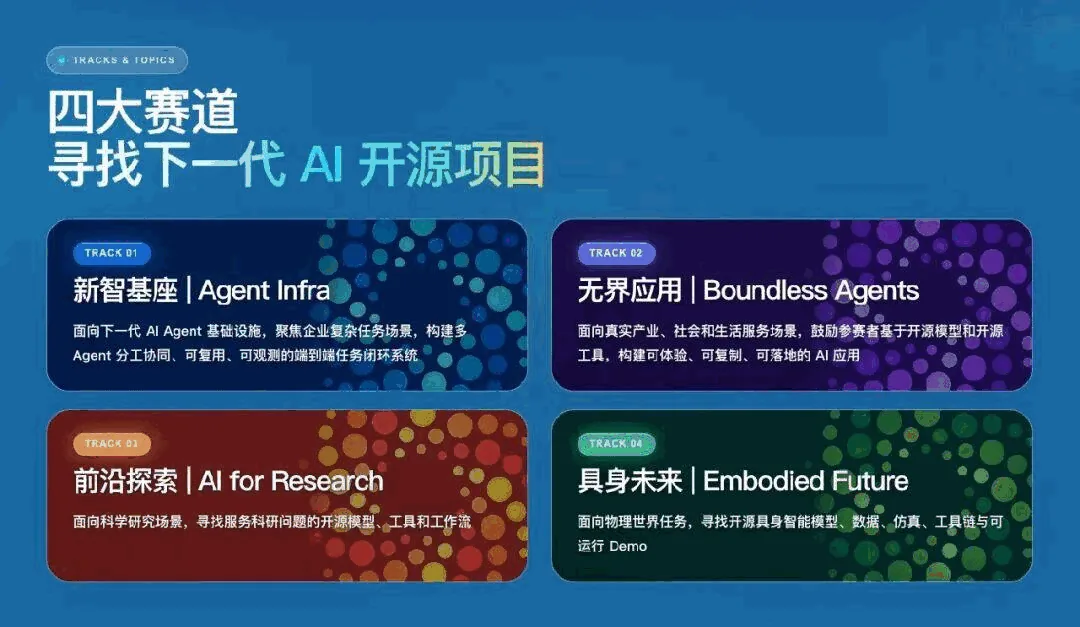
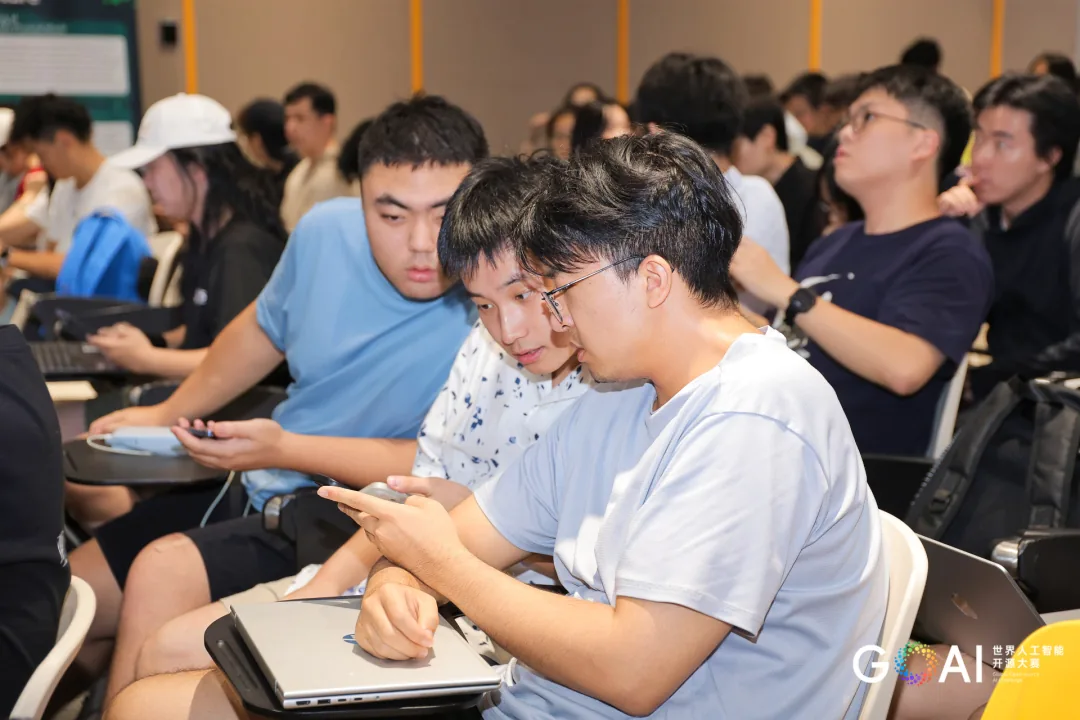
The Global Open-source AI Challenge, or GOAI, initiated by the Hangzhou Open-source AI Foundation, reflects this shift. Supported globally by Agentic AI Foundation and LF AI & Data Foundation, the competition uses the slogan “Open. Share. Build.” It has four tracks: Agent Infra, Boundless Agents, AI for Research and Embodied Future. The total prize pool is RMB 5 million, with a RMB 1 million grand prize.
The tracks focus on what happens after a model leaves the benchmark table. Agent Infra asks teams to build multi-role agent systems with task decomposition, context passing, tool use, result verification and execution evidence. Boundless Agents moves the challenge into scenarios such as glasses, cars, finance, education and industrial manufacturing, discouraging generic chatbots or simple content generators. AI for Research emphasizes explainable, inspectable and extensible processes, and even allows negative results if the method and evidence are preserved. Embodied Future brings validation into physical-world tasks such as dual-arm operation and industrial park patrol.
Outlook: Sustainable Openness Will Define the Next Phase
The second half of AI open source will not be decided only by who releases the strongest model. Training costs, inference economics, licensing boundaries, safety responsibilities, reproducibility and ecosystem collaboration will all shape the future.
Open is only the first step; Share and Build determine whether an ecosystem can last. If openness relies on a few companies subsidizing the entire industry, it may not be sustainable. If licenses become too restrictive, developer innovation could slow. The likely path is a mixed ecosystem: open weights, commercial licenses, hosted services, vertical applications and community governance coexisting. The most influential open AI projects will be those that make models usable — and make it easier for others to keep building on top of them.