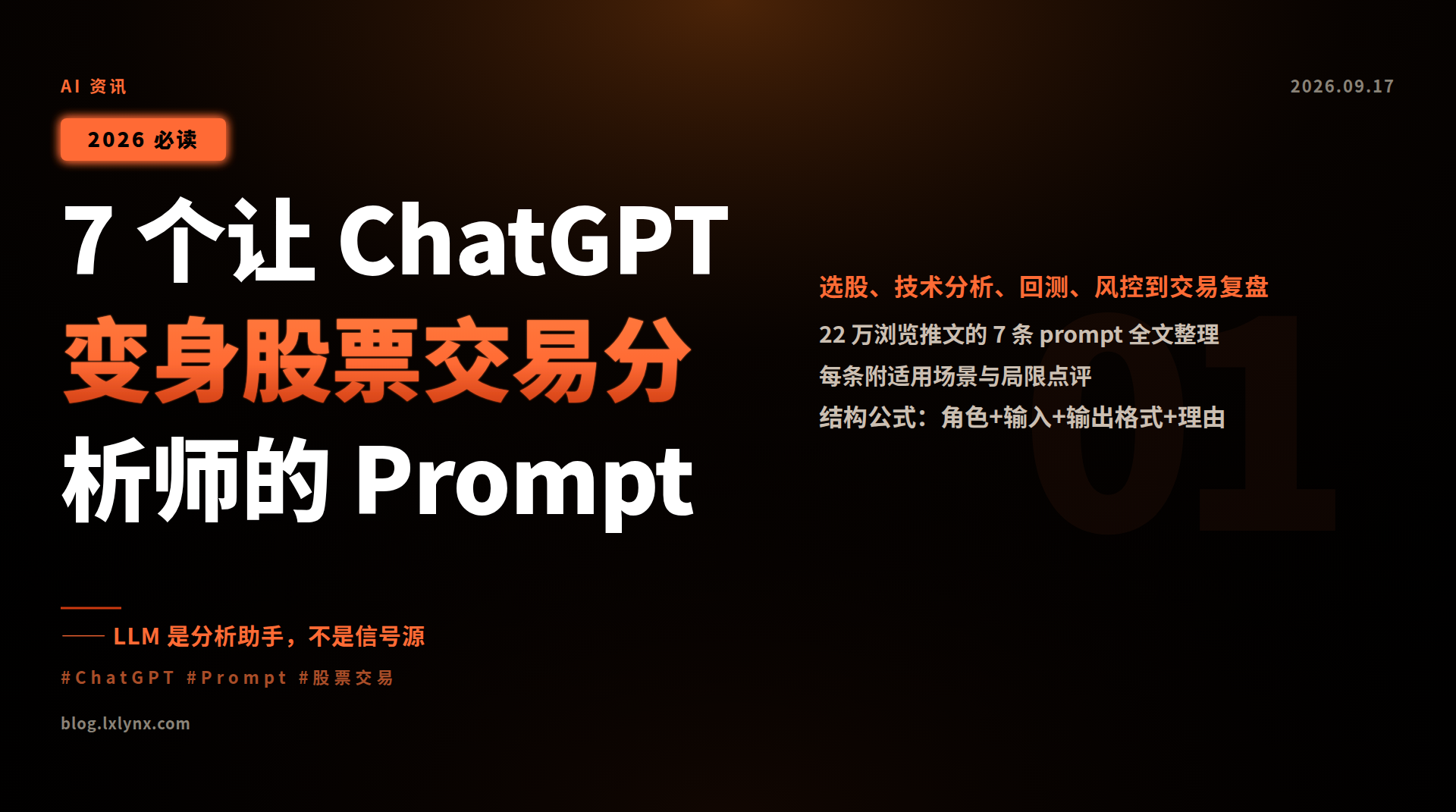
7 Prompts to Turn ChatGPT Into a Stock Trading Analyst
A recent tweet from Raúl (@Raul_IA_Prod) went viral on X with 220K views and has been widely shared on Xiaohongshu. The core message is straightforward: most people have no idea how to use ChatGPT for trading analysis. He breaks a professional trader’s workflow into 7 steps, each paired with a ready-to-copy prompt.
The original post is in Spanish; this is a Chinese整理. Placeholders are marked with [] — replace them with your own symbols.
1. Trade Idea Generator
Analyze the current market and generate 5 high-probability trade setups for [insert stock/index/sector]. Include entry price, exit targets, stop-loss, and risk/reward ratio. Explain why each setup makes sense based on technical and fundamental factors.
When to use it: You don’t have time to watch the market all day, so let AI filter opportunities for you. Note that “high-probability” is the prompt’s framing, not a factual guarantee — focus on whether the risk/reward ratios it gives are reasonable.
2. Automated Technical Analyst
Analyze [insert stock/ticker] using daily and weekly charts. Examine support/resistance levels, trendlines, moving averages, and momentum indicators. Provide step-by-step buy/hold/sell signals with reasoning.
When to use it: Replaces hand-drawing chart lines. The key is demanding both “signal + reasoning” — outputs that give conclusions without logic are impossible to verify.
3. News-to-Action Translator
Summarize the latest news about [insert company/sector] and translate it into actionable impact. Provide potential short- and long-term effects, expected price range, and recommended position direction.
When to use it: When you can’t read through all the news. Its value isn’t in summarizing headlines — it’s in translating “what happened” into “what should I do.”
4. Strategy Backtest
Backtest [insert trading strategy: e.g., MA crossover, RSI divergence] on [insert stock/index] over the past [insert time period]. Present win rate, profit factor, maximum drawdown, and improvement suggestions.
When to use it: To test whether an idea is worth real money. Note: LLM backtests are “estimates,” not precise calculations — treat the numbers as order-of-magnitude references, not gospel.
5. Portfolio Risk Manager
Analyze my portfolio: [insert stock tickers and allocation percentages]. Highlight weaknesses, overexposure, and hidden correlations. Suggest risk-adjusted rebalancing and propose hedging strategies to guard against a 20% market drawdown.
When to use it: For anyone holding a bunch of positions but unable to describe their overall risk. The “hidden correlations” item is the most valuable — many people think they hold ten different stocks when they actually hold one concentrated bet.
6. Trade Journal Analyzer
Review my last 20 trades: [insert trade details including entry/exit levels and results]. Identify recurring mistakes, missed opportunities, and behavioral biases. Give me 3 personalized rules to immediately improve consistency.
When to use it: The most underrated of the 7. AI acting as analyst isn’t surprising — AI acting as “your behavioral auditor” is rare. Most people lose money not from picking the wrong stocks, but from repeating the same mistakes.
7. Fully Automated Trading Plan
Design a daily trading plan for [insert market/asset]. Include pre-market analysis, opening strategy, in-session adjustments, and closing strategy. Deliver as a checklist with timestamps so I can follow it like a professional trader.
When to use it: Locks the outputs from the previous 6 prompts into a repeatable daily routine. The checklist + timestamp format is essentially using AI to build trading discipline.
A Few Sobering Notes
- These prompts won’t predict the market. LLMs have no real-time order book data. “Generate 5 trade setups” is essentially applying analytical frameworks from its training data. Treat it as an analysis assistant, not a signal source.
- The original author himself noted: everyone’s prompts work best for themselves; borrowing someone else’s requires tweaking. Rather than copying verbatim, reverse-engineer the structure — you’ll see all 7 prompts follow the same formula: role + data input + output format + reasoning requirement.
- What’s truly reusable is the methodology: swapping a vague “help me look at stocks” for a structured, placeholder-driven, output-constrained prompt instantly upgrades the quality. This technique applies to every domain beyond trading.