
Most writing about landing AI in the market is still an extension of consumer-product thinking or SaaS thinking: build a product, find customers, sell subscriptions, scale up. But in the market of small and micro businesses, the misfit of that playbook is structural — business owners don’t lack awareness of AI; what they lack is a direct answer to “how much money will this save me this year.”
Recently I had the chance to dissect up close an AI B2B playbook that actually works in the field. It’s not sexy, it doesn’t chase buzzwords, and it even deliberately avoids showing off the tech — but its commercial logic is coherent to an almost ruthless degree. This article lays out the full skeleton of that playbook, for anyone else thinking about how to land AI in the real world.
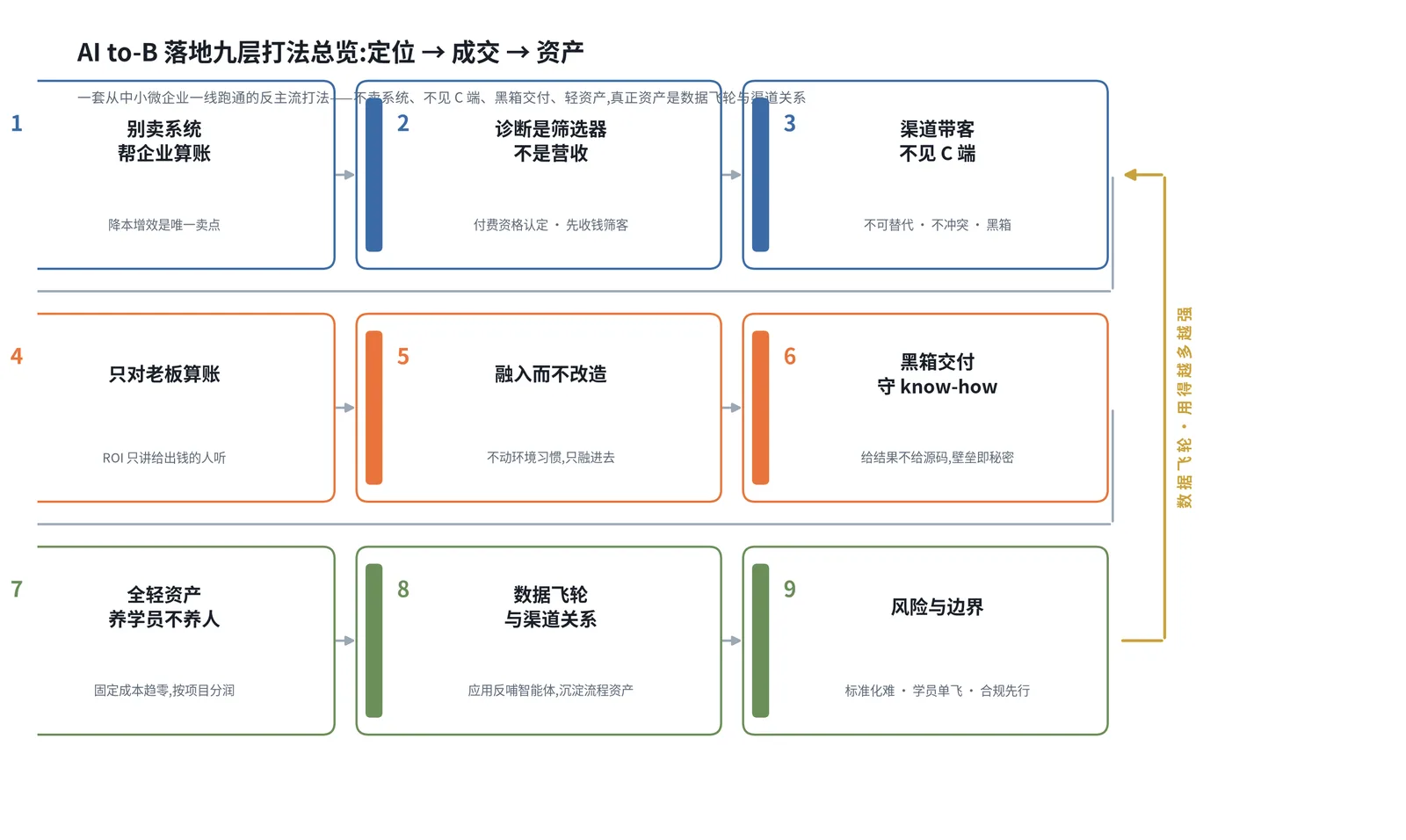
1. The Only Positioning: Not Selling Systems, but Saving Companies Money
This playbook starts with a rejection of the mainstream approach: it has nothing to do with SaaS; you’re not selling the user a system — you’re cutting their expenses.
The logic is simple to the point of brutality: what companies care about most is cost and spending. A company has 10 to 20 people doing data entry, slowly and with errors. You don’t need to talk to them about AI-native architecture, digital transformation, or the capability boundaries of large models — you only need to do one piece of math: the full annual cost of one data-entry clerk (salary, social insurance, desk space, management overhead) versus the cost of running one machine for a year. One machine in one hour does the work of 3 to 5 employees in a day.
Once that math is done, the selling is done. Cost reduction and efficiency gains are the core — the only core.
This positioning leads to a counterintuitive corollary: you barely need marketing at all. Telling companies what problem you can solve is enough. Customer acquisition comes not from ad spend and content, but from channels and referrals — more on that in section three.
2. The Diagnosis Is a Filter, Not Revenue
This playbook contains one element that’s easy to misread: the paid diagnosis. Starting at two thousand per hour, billable by the day, travel expenses charged separately, no contract signed — the format is close to meeting with a lawyer.
On the surface this looks like a consulting business — one-time payments, high turnover, decent cash flow. But its real function is entirely different: the essence of the diagnosis is paid qualification (paid discovery) — a payment made upfront filters out the “let’s just chat” tire-kickers. If the diagnosis finds something deployable, it converts into a deposit and enters delivery; if nothing can be deployed, that’s the end of it, with zero sunk cost on both sides.
A few details are worth noting:
The paying party isn’t necessarily the end company. Many diagnoses and consultations are paid for first by the channel intermediary — so the cash-flow structure differs from the usual “company pays the diagnosis fee” model.
Not signing a contract is deliberate. Signing means mutual commitment, which would tie down the delivery side too. Not signing, billing by the hour, meeting clients the way a lawyer does — the initiative to advance or retreat stays entirely in your own hands.
Not meeting in person is the default. The sequence is: phone call first, then online meeting, and an in-person meeting only after the requirements are clear and a deployable plan has taken shape — eliminating every unproductive meeting. Meeting only makes sense when deployment is actually about to happen.
In sales methodology, this layer corresponds to the Budget and Authority gates in the BANT framework — but it’s a gate built with real money, far more effective than questionnaires and scoring cards.
The whole layer’s logic is wrapped up in one line: build the relationship first, then close. The diagnosis is not a profit center; it’s the entrance and the filter for closing deals.
3. Channels Bring the Clients; You Never See the C-End
The most contrarian rule in this playbook: never approach end-user companies directly; every client you see must come through an intermediary channel, with a clear need in hand.
The direction of customer acquisition is reversed — first you sell yourself to the middlemen (channel partners with access to small and micro businesses, industrial parks, trade associations, service providers), then you bind both sides’ interests together so the channels move on their own to bring you clients.
What binds them isn’t a contract; it’s four things:
- Irreplaceable — when the channel’s clients hit this kind of problem, no one but you can solve it;
- Most economical — your solution is cheaper than any alternative path;
- Know the rules — you understand the channel’s industry rules, written and unwritten, so cooperation is low-friction;
- No conflict — you never run any business that competes with the channel.
There’s one sharper addition: the channel doesn’t know what actually makes you the most money. Information asymmetry is itself a moat — if the channel can’t even see your real profit engine, it naturally can’t replace you. The black-box principle applies not just to clients, but to channels as well.
This is essentially an extreme version of an indirect channel sales strategy (channel partner strategy): never connect directly to the C-end, only receive well-defined demand through intermediary channels, and push customer acquisition cost toward zero.
4. Do the Math Only for the Boss
The communication discipline of this playbook is extremely strict: the words that truly move a company are spoken only to the boss — not even to intermediaries, because it’s useless.
“One machine in one hour does the work of 3 to 5 employees in a day. An employee costs this much per year; a machine costs that much per year. If you were the boss, would you use it?” — words like these are spoken only to the person who can sign the check. Intermediaries neither understand nor care; telling them is wasted breath.
Behind this discipline is a clear-eyed understanding of the corporate decision chain: in small and micro businesses, only one person truly cares about the ROI ledger — the person paying the money. Talking features, architecture, or vision to anyone else is pure noise.
Methodologically, this approach is close to value-based selling: you’re not selling the system itself; you’re selling the arithmetic result — “one machine replaces three to five employees” — laying the monetary value of the customer’s benefit directly on the table.
As for technical implementation — what if OCR accuracy is below 100%? Who develops the workflows? This playbook’s answer: those are technical problems; find professionals to solve them. You can outsource to a university team, you can customize workflows; the delivery side itself only handles the math and the deployment. Technology is not the moat — the ability to deploy, to do the math, and to get clients is. This point runs completely opposite to the instincts of most founders from technical backgrounds.
5. Blend In, Don’t Transform
The procurement experience companies hate most is “bought AI, then got asked to transform.” This playbook does exactly one thing: don’t touch the company’s existing work environment, usage habits, or software applications — blend the AI into them.
In change management this is called minimizing change resistance — what companies fear most when buying AI is not spending money, but the organizational shock of being asked to reshape existing processes and software. Lowering change resistance is lowering the barrier to closing the deal.
The delivery method is plain to the extreme: the workflow is written in half a day with a low-code orchestration tool like n8n; for the demo you bring over a Mac — no deployment, no source code handover, no system integration. The client sees with their own eyes that the machine really can replace a person, and the deal is done.
Whether the tools are the latest versions, whether you use the most advanced coding agent — none of that matters; what matters is that it runs stably. Enterprise clients are far more sensitive to “stable” than to “cutting-edge” — and this holds across compute, model selection, and workflow delivery alike.
6. Black-Box Delivery: Know-How Is the Moat
The deliverable contains no source code; the way the orchestration tool is tuned is never explained; what the client sees is a black box that “gets the work done.”
This is a deliberate trade-secret protection strategy: hold the moat by not disclosing know-how, rather than through patents or exclusive technology. What the client buys is the result (“it really does replace people”); what they can’t buy is the tuning method.
The cost of black-box delivery is that standardization is hard — we’ll return to that in the risks section. But as a starting playbook for an individual or a small team, it compresses delivery cost to the limit: no deployment, no ops handover, no documentation burden.
7. Fully Asset-Light: Grow Trainees, Not Employees
The organizational form of this playbook is also worth dissecting:
No permanent employees. When a project comes in, pull people from the trainee pool and share revenue per project. Trainees are developed through a teaching system whose purpose is not to earn tuition, but to give them access to the client base, the ability to deploy and earn, and real work to do. Work is distributed out to them — you have your own team without carrying payroll; and as the trainees’ skills improve, that feeds back into the team’s capability.
Every non-core function is externalized. Training is outsourced; no MCN operations; corporate training invitations declined — training is not a profit center; it’s a distraction.
Even the office is asset-light. A partner provides several hundred square meters of space for free, no strings attached, and even helps set up meetings. Show up when there’s business to discuss; work remotely the rest of the time; meet only when necessary. Spaces that are nominally free but actually demand equity or revenue share — don’t touch any of them. “I’m here to help you deploy, not to make money for you, and certainly not to rent your venue.”
The economics literature has validated the asset-light model at large scale: a BCG analysis of 2,687 companies across 24 industries found that in every industry, asset-lighter companies had higher average ROA than asset-heavier ones, with the key mechanism being the reduced profit volatility that comes from a high share of variable costs. This playbook pushes that principle to the extreme: fixed costs approach zero; everything is settled per project.
8. The Real Assets: The Data Flywheel and Channel Relationships
The most valuable layer of understanding in this playbook is its answer to “what is the real asset.”
Whether users use the product itself is not the point. The point is that real usage generates feedback, and the feedback drives the improvement of the agent and the iteration of the service — this continually refined stock of workflows and processes is the real asset.
The structure of later-stage monetization becomes clear accordingly: bill by the “number of AI employees” (charge for as many positions as the human positions replaced), plus ongoing service and compute fees. And the core assets are the replicable industry solutions accumulated from successful deployments, plus the channel relationships that reach directly into companies and users — because those are what others lack most and find hardest to replicate.
In other words, the early-stage diagnosis and deployment are means and entry points. Real client usage feeds back into improving the agent, settling into reusable process assets, forming a data flywheel of “the more it’s used → the stronger it gets → the more useful it becomes.”
The expansion logic is equally clear: occupy the position first (land-and-expand). Companies’ understanding of AI will gradually improve. First make the company a user that can’t live without you; once users have real experience and feel, adding modules, transforming, upgrading — everything becomes simple. Take the experience from one industry and replicate it across similar clients — the experience curve keeps driving costs down; attack only a few industries and scenarios early on, and it gets easier the further you go. In essence you turn yourself into a software company for a specific industry — one that simply never ships software.
9. Risks and Boundaries: This Playbook Is Not Without Pitfalls
Any playbook grown out of practice deserves respect, but to be honest, several structural risks must be laid out:
Delivery standardization and replicability. The moat is the personal know-how of “how to tune the workflows” — and that is precisely the hardest layer to standardize. Fuzzy judgment calls that depend heavily on individual experience will fluctuate in quality once replicated to trainees or a team. The classic failure case of the asset-light model sits exactly on this road — when Lego outsourced production to Flextronics (2005–2008), the cost-cutting incentives conflicted with quality requirements, and the partnership eventually ended with Lego buying the plants back. BCG’s analysis of asset-light failure modes also points out directly: under an asset-light model, the risks of intellectual-property leakage and of maintaining critical know-how are greater.
Receivables and cash-flow mismatch. Diagnosis fees collected upfront, deposits converted, later billing by the number of AI employees — it sounds like healthy cash flow, but “the real profit comes later” means early-stage diagnosis and deployment are entry points, not profit centers. Anyone walking this road needs cash reserves to survive the transition period. Industry surveys consistently show a scissors gap among SMBs toward AI adoption — “optimistic expectations but cautious actual spending”: willing to pay for clear ROI, but cautious about fuzzy investment. That means the conversion rate from diagnosis to deposit won’t be high, and the conversion cycle won’t be short.
Trainees going solo and being kicked out by channels. “Trainees learn and then do it themselves” is a structural risk of this playbook, matching exactly the classic risk of know-how leakage in asset-light models. Once trainees reach a certain level, they’re capable of going independent — taking the know-how and the client relationships with them. The same goes for channels: you can kick out the intermediary channel once you’re entrenched in a company, but conversely, the channel holds the clients and the demand, and can kick you out by swapping in a cheaper deployment provider. If the moat is know-how rather than exclusive technology, you have to accept the reality that know-how can be learned.
The compliance status of the underlying models and compute. This is the hardest boundary in the current environment. If deployment depends on calling overseas large-model capabilities, then routing domestic companies’ data — often containing personal information and trade secrets — through unfiled relay channels carries real compliance risk under the current Interim Measures for the Management of Generative AI Services and the Personal Information Protection Law: filing obligations, cross-border data transfer assessments, and even business qualification issues. Practitioners in the industry have already paid a price for this, and regulators have explicitly warned about the cross-border data risks of such channels. The pragmatic conclusion: this infrastructure layer cannot run naked — either attach to a large platform with compliant status, or use domestic models that have completed filing. Until the compliance question is resolved, this link should not go into production.
Client education costs are yours to bear. Small and micro businesses’ understanding of AI is still at a very early stage. “Occupy the position first and wait for awareness to slowly improve” means spending large amounts of time educating clients upfront — and the education cost is carried by the service provider; clients don’t pay to be educated. If a client pays the diagnosis fee, finishes the math, and finally says “let me think about it,” all the upfront investment in that deal sinks.
Conclusion: The Cognitive Framework Is Worth More Than the Playbook Itself
The sharpest thing about this playbook isn’t any single tactic, but its systematic rejection of several popular assumptions:
- Not to-C, but to-B enablement;
- Not selling systems, but helping companies do the math and save money;
- Not transforming companies, but blending into them;
- Not a technology moat, but deployment capability, math capability, and channel relationships;
- Not product assets, but the data flywheel and accumulated process assets;
- Not scale-first, but occupy the position first and expand gradually.
It also has clear boundaries of applicability: a black-box model dependent on personal know-how is inherently hard to scale, quality control in an asset-light trainee network is an ongoing challenge, and the compliance boundary must be thought through before you act.
But for technical founders trapped in the death loop of “build product → find customers → can’t sell,” this playbook offers a completely different starting point: don’t ask whether the company wants to buy AI — ask which business line the company wants to save money on this year. Then, only to the boss, do the math clearly.