
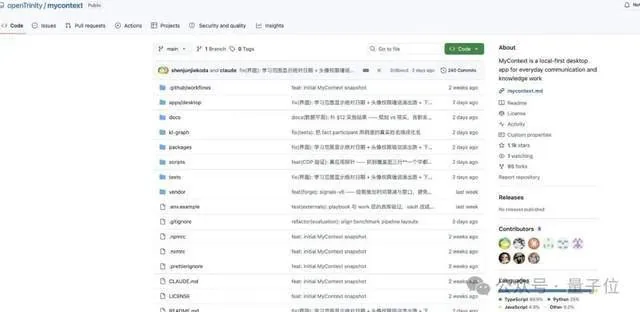
Alibaba’s Qwen Office team has open-sourced MyContext, a context infrastructure project designed to turn workplace data—such as DingTalk chats, enterprise documents, meeting records and business data—into context that AI agents can use directly.
The bottleneck is business understanding
Agent frameworks have improved quickly in tool use, workflow orchestration and multi-step execution. They can already help draft reports, search information, edit spreadsheets and run code. But in real enterprise workflows, a familiar gap remains: an instruction like “update last week’s customer proposal according to the latest company wording” may be clear to a colleague, but not to an agent.
The missing information is usually scattered across IM, email, documents, meetings and business systems. It may also involve changing versions, delayed updates, conflicting facts and permission boundaries. Better model reasoning alone does not automatically give an agent knowledge of a company’s workflow. The article cites a 2026 Confluent survey in which 66% of enterprises said data infrastructure and data quality were slowing Agentic AI adoption, while 80% had made better use of internal data for AI a business priority.
What MyContext adds

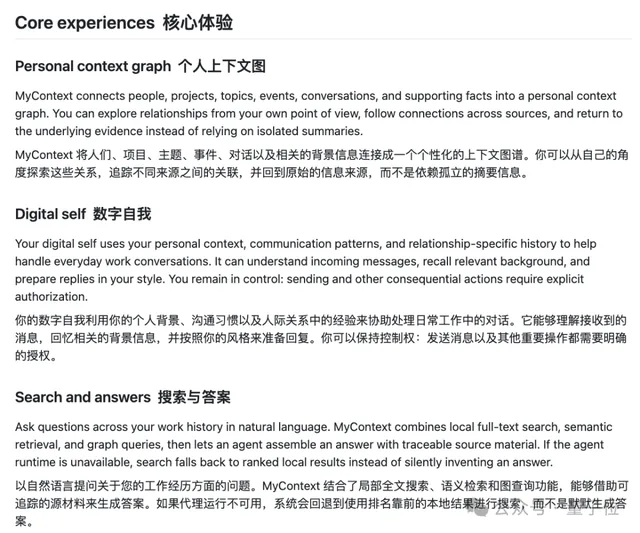
MyContext is not positioned as another chatbot. It is a data-processing layer that prepares “agent-consumable context.” In simple terms, context means the background facts, rules, historical decisions and current business state an agent needs before it can act usefully.
With user authorization, MyContext can collect and organize information from IM conversations, documents, meetings, collaboration records, local and other workplace data sources. It then turns them into a dynamic work profile. Details that users often have to repeat to every agent—what they are responsible for, who they collaborate with, what changed in a project, and which discussions became decisions—can be preserved and reused in later tasks.
The project also emphasizes traceability. Conclusions are linked back to source evidence, such as the original chat, document or meeting record. The information an agent can access remains controlled by user and organizational permissions. This makes the context usable by machines while still auditable by people.
Handling time, conflict and cost
Enterprise context is not just a data-ingestion problem. MyContext focuses on several engineering challenges:
- Temporal data: old timestamps, late-arriving messages and multiple topics in one chat can confuse simple chronological processing.
- Conflicting facts: different teams may describe the same business situation differently, and the newest statement is not always the correct one.
- Continuous cost: if every update triggers full recomputation, embedding, deduplication and model calls can become expensive.
To deal with time, MyContext attaches stable source identifiers to raw information. Even if a piece of data has an old timestamp, it can still enter the pipeline if it has not been processed before. It also uses idle gaps in conversations as session boundaries, making context chunks closer to real human interaction. A sliding time window aggregates evidence so repeated facts can strengthen confidence.
For conflicts, MyContext uses a three-state merge mechanism: consistent information raises confidence, supplementary information is merged into existing conclusions, and real conflicts are preserved as multiple facts with lower confidence. Human-confirmed conclusions receive higher priority and cannot be automatically overwritten by later model output.
For cost control, it relies on incremental computation. Local rules handle what they can; ambiguous cases are sent to models. Previously computed results are reused, multiple updates can be batched, and version caching plus tiered fallback strategies help reduce repeated work.
From personal context to organizational agents
The broader enterprise AI market is moving in the same direction. Palantir uses Ontology to unify enterprise objects, relationships and business logic. Glean highlights Enterprise Graph to connect people, projects, documents and business entities. Microsoft uses Microsoft Graph and Copilot Connector to bring enterprise data, permissions and collaboration context into Copilot.
MyContext’s angle is more focused on turning heterogeneous, time-sensitive, changing and sometimes contradictory business data into stable context that agents can consume. The article also notes that DingTalk covers more than 20 million enterprise organizations and nearly 800 million users, making it a major entry point for workplace collaboration data. Qwen Office can then provide the context governance layer, while agents consume the resulting high-quality context.
Outlook
As agents move toward production use, the key competition is shifting from “which model answers better” to “which system can understand real enterprise operations safely, continuously and cost-effectively.” MyContext does not replace foundation models; it fills the data-processing layer between models and business reality. If such infrastructure can be combined with permissions, auditability, governance and enterprise systems, company data may evolve from a searchable asset into an executable asset for AI-driven workflows.