
The news in brief
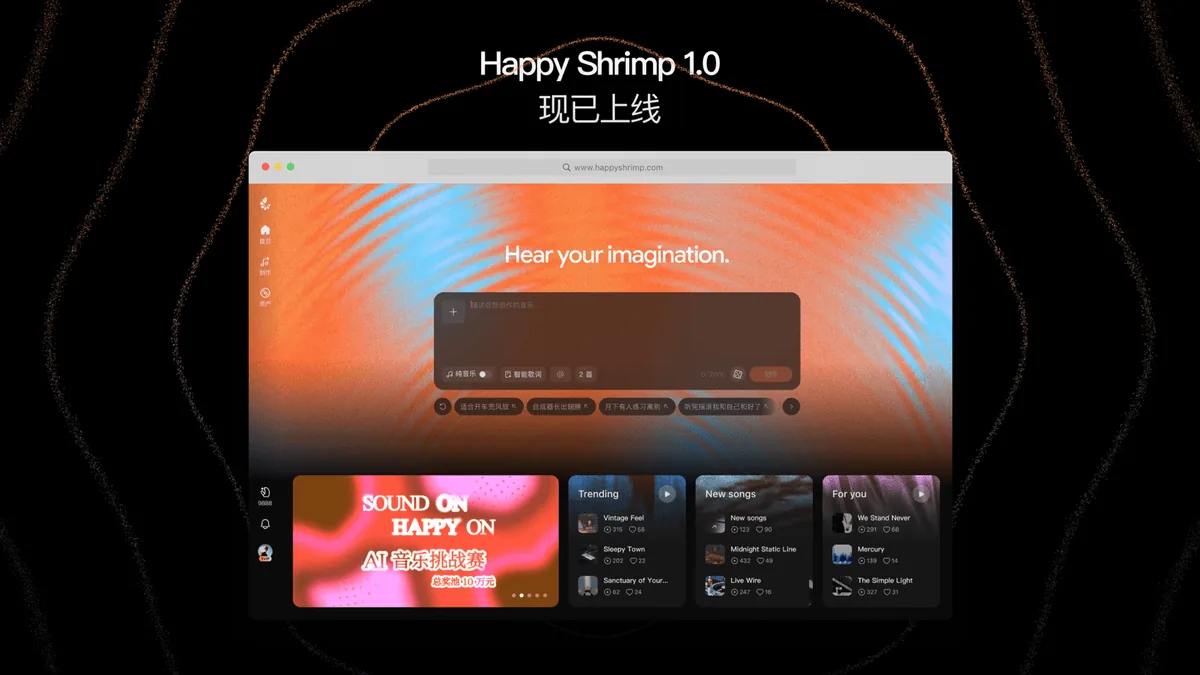
Alibaba released HappyShrimp, also called “快乐虾米” in Chinese, on August 17. The model is positioned as an AI music system that can turn natural-language prompts into complete songs, covering lyrics, composition, arrangement and vocals.
The product is available through PC web versions in both China and overseas markets. Alibaba lists happyshrimp.cn for the domestic service and happyshrimp.ai for the international site, with free credits offered to new users.
Full-song generation as the main pitch
HappyShrimp’s central claim is end-to-end full-song generation. In simple terms, the model is designed not to create lyrics, melody, accompaniment and vocals as separate pieces and then stitch them together. Instead, it plans and generates them within one integrated process.
According to the release material, the model treats music as a special kind of language with grammar, meaning and context. It can take requirements such as text descriptions, lyrics, genre, mood, era and vocal preferences, then generate a complete song while maintaining longer-range structure.
That positioning addresses a common limitation in AI music tools: many systems are good at short clips or standardized style labels, but can struggle with cultural context, narrative intention or evolving emotion across a full track.
Natural language becomes the interface
Alibaba emphasizes that HappyShrimp can understand both professional music terms and everyday descriptions. For example, it can process a genre label such as “Lo-fi R&B,” but also prompts like “a song suitable for a café” or “a song for my newly graduated self.”
This matters because most non-professional users do not naturally think in music-production parameters. BPM, for instance, means beats per minute and describes tempo; instrumentation refers to the combination of instruments or sounds used in a piece. HappyShrimp is designed to infer those production choices from broader intent.
The company says the model can handle multi-dimensional instructions such as vocal gender, singing style, key, BPM, instrumentation and emotional progression, while keeping the song coherent rather than simply copying isolated prompt elements.
Partnership and rollout
On its launch day, HappyShrimp announced a strategic partnership with Taihe Music Group. The two sides plan to explore cooperation around music-industry ecosystem building, AI music platform collaboration and co-creation with musicians.
Key facts disclosed so far include:
- Launch date: August 17;
- Product name: HappyShrimp, Chinese name “快乐虾米”;
- Access: PC web versions in China and overseas markets;
- Partner: Taihe Music Group;
- Upcoming appearance: the 2026 Aranya Xiami Music Festival from August 28 to 30, where HappyShrimp will create on-site atmosphere music inspired by the festival.
The “Xiami” reference is notable because the name is associated with Alibaba’s earlier music business. By placing the new model in a festival context, Alibaba is testing not only a generation tool, but also a scenario where AI music can meet listeners and creators.
What it means for AI music
HappyShrimp reflects a broader shift in AI music from novelty demos to more practical creation platforms. For everyday users, the promise is lower entry barriers: a memory, mood or story can become a song without formal training in composition or production. For platforms and music companies, the appeal lies in faster ideation, event music, interactive content and musician collaboration.
The next stage of competition will not be only about whether a model can generate a song. It will depend on coherence, controllability and industry integration. Alibaba’s immediate partnership with Taihe Music Group suggests that the company wants to connect model capability with real music-industry resources.
Over time, AI music tools are likely to move beyond one-click generation toward editable, collaborative workflows. “Everyone can write a song” may be the starting point; the harder question is how AI-generated music can be used responsibly, heard by audiences and integrated with professional creators.