
What happened
Google DeepMind has introduced AlphaEvolve, a Gemini-powered coding agent designed to discover, verify, and optimize algorithms. The system targets both practical computing problems inside Google’s infrastructure and harder research problems in mathematics and computer science.
AlphaEvolve is not presented as a conventional code-completion tool. It combines the idea-generation capabilities of large language models with automated evaluators and an evolutionary loop. In simple terms, the agent proposes programs, runs and scores them, keeps the strongest candidates, and uses them as the basis for future attempts.
How the system works
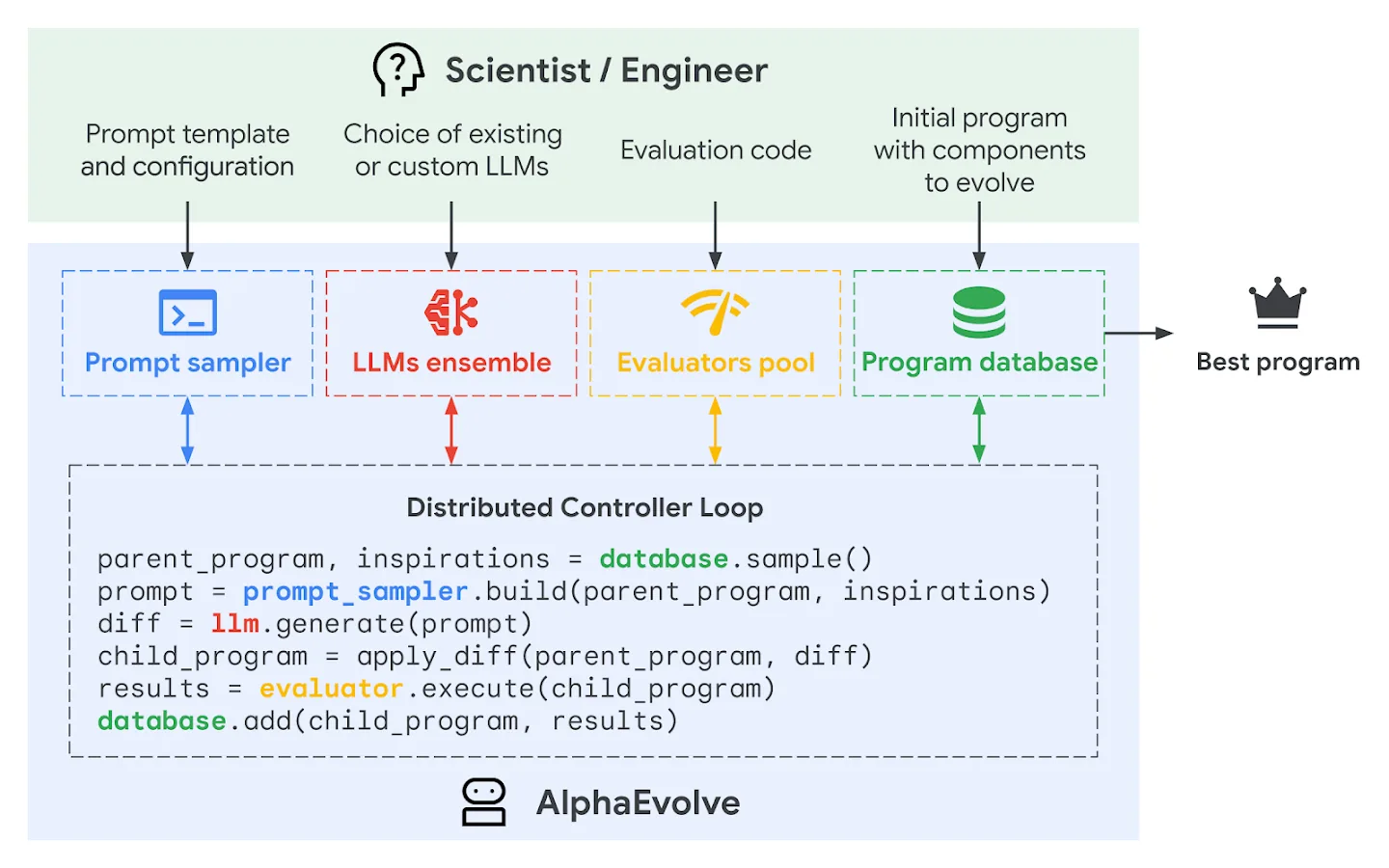
DeepMind says AlphaEvolve builds on its 2023 work showing that language models can generate code functions that contribute to verifiable scientific discoveries. The new agent expands that approach beyond isolated functions, allowing it to evolve larger codebases and more complex algorithmic procedures.
The system uses an ensemble of Gemini models. Gemini Flash is used to explore a wider range of ideas, while Gemini Pro contributes deeper suggestions. Candidate programs are then checked by automated evaluators, which run the code and produce measurable scores for correctness and quality.
An automated evaluator is essentially a machine judge: it does not merely check whether code executes, but also whether it satisfies the task’s objective and improves on a defined metric. That makes AlphaEvolve best suited to domains where progress can be measured clearly, such as mathematics, compiler-like optimization, and computer systems engineering.
Deployed across Google infrastructure
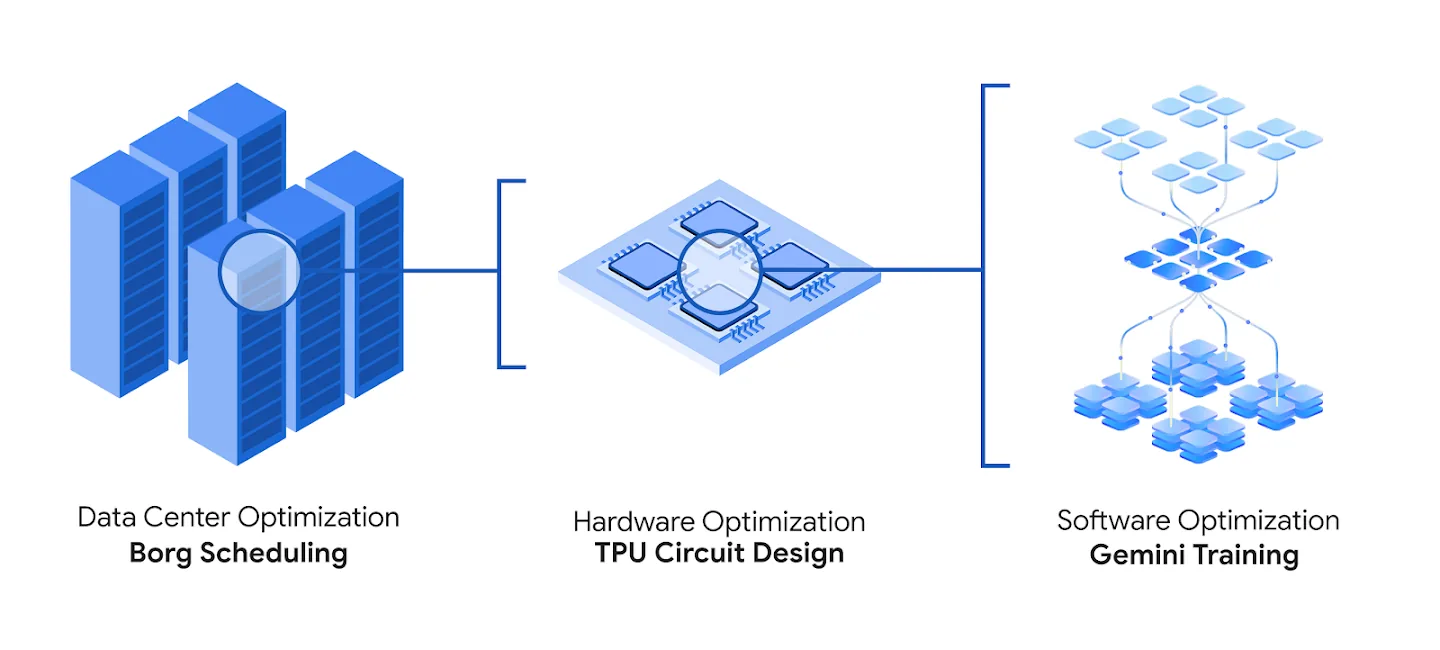
DeepMind says algorithms discovered by AlphaEvolve have already been deployed across parts of Google’s computing ecosystem, including data centers, hardware design, and AI training software.
Key results disclosed include:
- For data center scheduling, AlphaEvolve found a simple heuristic for Borg, Google’s large-scale cluster orchestration system. The solution has been in production for more than a year and continuously recovers, on average, 0.7% of Google’s worldwide compute resources.
- For hardware design, AlphaEvolve proposed a Verilog rewrite that removed unnecessary bits in a highly optimized arithmetic circuit used for matrix multiplication. After verification, the proposal was integrated into an upcoming TPU, Google’s custom AI accelerator.
- For AI training, the system found a better way to divide a large matrix multiplication operation into subproblems. This sped up a key kernel in Gemini’s architecture by 23%, contributing to a 1% reduction in Gemini training time.
- At the low-level GPU instruction layer, AlphaEvolve achieved up to a 32.5% speedup for a FlashAttention kernel implementation used in Transformer-based AI models.
These gains matter because they compound at scale. A small percentage improvement in global compute utilization or model training time can translate into meaningful savings in cost, energy, and engineering effort when applied across large AI systems.
Mathematical and algorithmic discoveries
DeepMind also applied AlphaEvolve to more fundamental research tasks. Given a minimal code skeleton, the agent designed parts of a new gradient-based optimization procedure and discovered multiple algorithms for matrix multiplication.
One highlighted result is an algorithm for multiplying 4x4 complex-valued matrices using 48 scalar multiplications. DeepMind says this improves on Strassen’s 1969 algorithm, previously considered the best known approach in that setting. The result is also positioned as a broader advance over AlphaTensor, DeepMind’s earlier system specialized for matrix multiplication.
To test generality, the team applied AlphaEvolve to more than 50 open problems across mathematical analysis, geometry, combinatorics, and number theory. According to DeepMind, the system rediscovered state-of-the-art solutions in roughly 75% of cases and improved the previously best known solutions in 20% of cases.
The company also says AlphaEvolve made progress on the kissing number problem, a long-standing geometry challenge about how many non-overlapping spheres can touch a common unit sphere. The system discovered a configuration containing 593 outer spheres.
Why it matters
AlphaEvolve points to a shift from AI as a code assistant to AI as an algorithmic collaborator. The important distinction is verification: the system is most useful when a task has measurable goals, executable experiments, and strong correctness checks.
That also defines its limits. AlphaEvolve is unlikely to be equally effective on problems where objectives are vague, evaluation is costly, or correctness cannot be automatically tested. But for domains such as systems optimization, chip design, numerical kernels, and certain mathematical searches, its approach is well aligned with how progress is measured.
The broader direction is clear: future technical workflows may increasingly involve humans defining objectives and constraints, AI agents generating large numbers of candidate solutions, automated evaluators filtering them, and experts validating and deploying the best results. AlphaEvolve is an early but significant example of that model in practice.