Core Announcement: Amazon Triples GPU Order, Extends Partnership Beyond Chips

On August 26, 2026, Amazon Web Services (AWS) and Nvidia announced an expanded and deepened strategic partnership, featuring:
- 2 million additional Nvidia GPUs to be deployed across AWS data centers in 2027 and 2028
- GPU lineup: Blackwell Ultra, Rubin, and Rubin Ultra — Rubin shipments began in Q2 FY2026
- Expanded collaboration scope: First-time integration of Nvidia CPUs (Vera), full physical AI stack, networking hardware, open models, and data processing software
- Deployment timeline: New GPUs and Vera CPUs are already underway, with early adopters including Oracle and SpaceXAI confirmed
Notably, this announcement came just five months after AWS previously committed to deploying over 1 million GPUs — with Nvidia explicitly stating demand “exceeded those expectations,” directly triggering the threefold order increase.
Technical Integration: From GPU to Full-Stack Physical AI
The 2-million-GPU addition brings AWS’s total Nvidia GPU commitment to approximately 3 million units (including the prior 1 million), representing a deal valued in the tens of billions of dollars at typical GPU unit pricing (exact financial terms undisclosed).
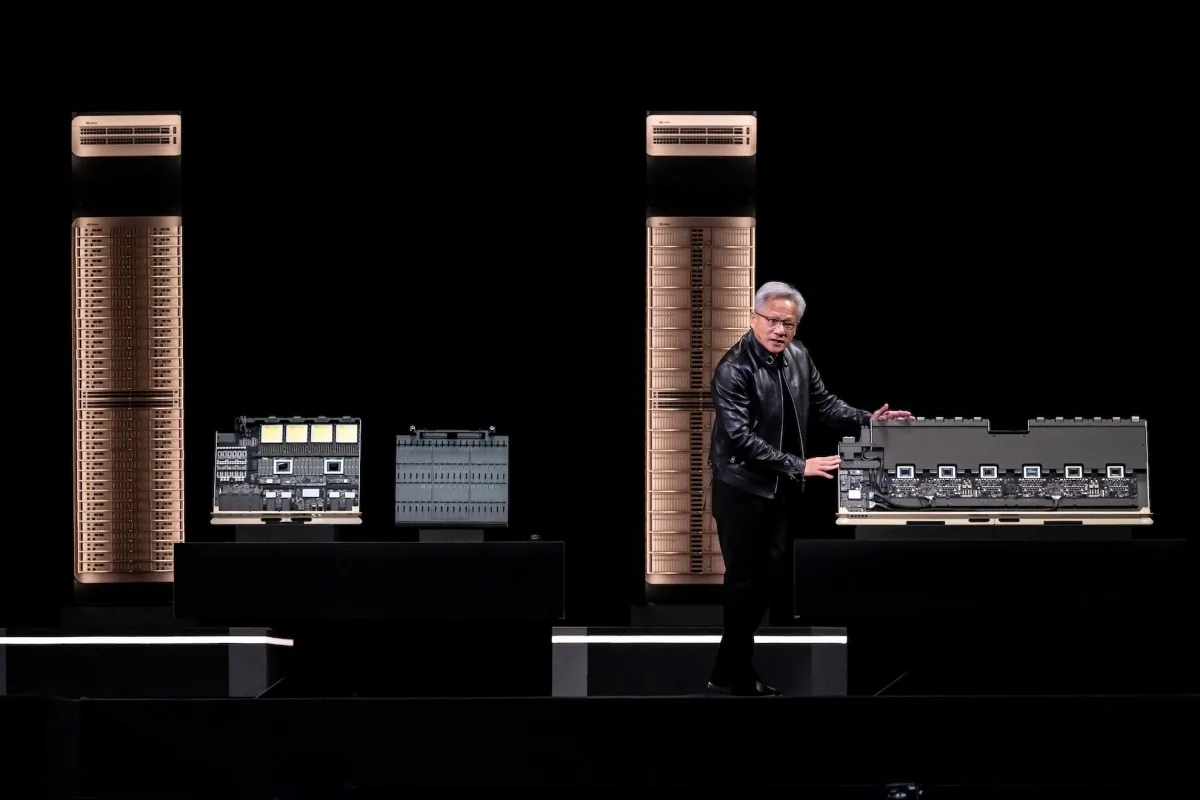
Alongside GPUs, Nvidia will deploy an unspecified number of Vera CPUs to AWS, with some integrated with Rubin GPUs and others deployed stand-alone. Vera is Nvidia’s new CPU product line, introduced by CEO Jensen Huang in May 2026, which he positioned as targeting roughly $20 billion in new total addressable market.
Broader technical integration is also underway:
- Nvidia’s interconnect and networking hardware will link thousands of GPUs into unified training arrays
- SDK software stack, open models (including Nemotron family), and CPU configurations will be accessible via AWS Bedrock and SageMaker
- Full physical AI stack now integrated with Amazon warehouse robots: encompassing Omniverse (simulation and digital twin), Cosmos (world models), Isaac (robotics development), and Jetson (edge AI hardware)
As CFO Colette Kress noted on the earnings call, Vera deployments are already underway with “every major hyperscaler, neocloud, AI lab, and system OEM,” specifically citing Oracle and SpaceXAI as lead partners.
The Competitive Tension: Amazon Buying More While Building Its Own

The most counterintuitive aspect is that Amazon simultaneously ramps up Nvidia purchases while aggressively commercializing its own chips.
Supporting facts:
- Amazon’s Trainium AI chips are marketed as direct alternatives to Nvidia’s H100 and Blackwell chips for deep learning workloads
- Graviton CPUs, based on Arm architecture, openly challenge Intel and AMD in general-purpose server processors
- Amazon’s custom chip business crossed a $25 billion annualized revenue run rate, supported by $225 billion in total commitments from AI labs including Anthropic and OpenAI
This dual-track strategy serves dual purposes: supply chain resilience and enhanced vendor leverage for AWS customers who can choose between competition-driven alternatives and Nvidia’s mature ecosystem.
Yet when Trainium and Graviton scale remains modest, Nvidia reported $96.2 billion in Q2 revenue ($89 billion in data center, up 117% year-over-year). The company expects $108 billion in Q3, with early Rubin sales viewed as a critical indicator of continued demand.
Key Metrics and Capital Commitments
| Category | Value | Notes |
|---|---|---|
| New GPU procurement | 2 million units | Delivery in 2027–2028 |
| Previous GPU commitment | >1 million units | Announced March 2026 |
| Q2 2026 total revenue | $96.2 billion | Data center: $89 billion |
| YoY data center growth | +117% | Implied Q2 2025 base: ~$40.5 billion |
| Q3 2026 guidance | $108 billion | Includes first Rubin quarter |
| Total capital commitment | $279 billion | Up from $119 billion last quarter |
| FY2026 remaining spend | $92 billion | |
| FY2028 projected spend | $87 billion | |
| Vera TAM estimate | ~$20 billion | Huang May 2026 disclosure |
Breakdown of Nvidia’s capital commitment:
- Rest of FY2026: $92 billion for supply chain security
- FY2028: $87 billion for future data center capacity
- Primary focus: Securing memory components and foundry wafer capacity to meet multi-year AI demand
Implementation Guidance
- Large AI labs and model developers: For maximum training throughput and ecosystem maturity, prioritize Rubin Ultra + Blackwell Ultra stacks; for cost-sensitive deployments, evaluate Trainium or combined Graviton + custom accelerator alternatives
- Small and medium development teams: Leverage Nemotron open models via AWS Bedrock and SageMaker to bypass low-level hardware configuration and rapidly validate business use cases
Final Notes
AWS and Nvidia’s deepening tie-up reflects the industry’s collective bet on “end-to-end validated performance” — raw compute has ceased to be the bottleneck; the real question now is whether profitable token generation scales alongside infrastructure investment. As Huang stated, AI has entered a “productive and useful work” phase, where the competitive divide shifts from “can we run it?” to “how cost-effectively can we profit?”