
Core Event: GDDR7 Memory Support Submitted to Linux Kernel
AMD submitted a patch to the Linux kernel’s DRM/AMDGPU driver earlier this month, to register GDDR7 memory names for device identification. According to IT之家’s report on September 23, this foundational change prepares the open-source driver for future hardware while RDNA 5 graphics cards remain unconfirmed.
- Area modified: DRM/AMDGPU graphics driver
- Support added: GDDR7 memory name registration and device recognition
- Expected launch window: 2027 mid-year to 2028 early, per industry estimates
- Initial adoption: RDNA 4 cards use GDDR6; 部分RDNA 5 models expected to use GDDR7
Notably, GDDR7—formalized by JEDEC in 2024—delivers up to 88 Gbps per pin, roughly 37% faster than current mainstream GDDR6X. However, high cost and compatibility challenges have delayed its consumer adoption.
Technical Details and Context
This patch represents a low-level hardware enumerative change rather than a performance enhancement. RDNA 4 architecture (e.g., RX 9000 series) currently ships with GDDR6 memory, though suppliers including Samsung and Micron have begun tapering GDDR6产能 in favor of higher-bandwidth alternatives.
A critical timing discrepancy: AMD has implemented GDDR7 driver support while the RDNA 5 product line lacks official confirmation. Historical patterns show AMD typically adds driver support 18-24 months before product launch, suggesting early-stage hardware validation is underway.
GDDR7 employs a 1.1V operating voltage—18% lower than GDDR6’s 1.35V—potentially improving power efficiency, though actual gains depend on the broader architecture. AMD has disclosed no official specifications, leaving GDDR7 adoption limited to industry rumors at this stage.
Neural Rendering Rumors and Architectural Direction
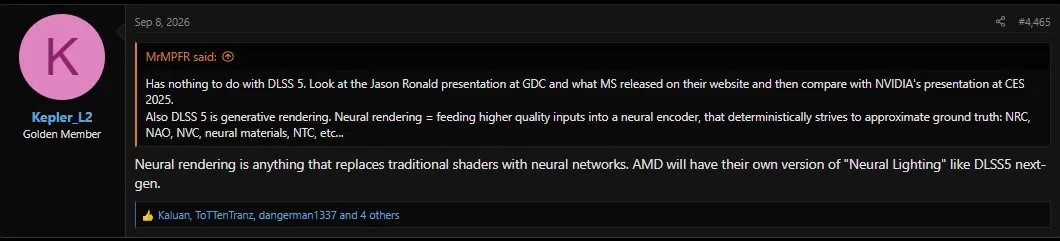
Solo reporter Kepler_L2 recently posted on Anandtech forums claiming RDNA 5 will feature “Neural Lighting,” AMD’s proprietary AI rendering technology, positioned as a DLSS 5 equivalent. Due to substantial computational demands, this feature would likely be exclusive to the RDNA 5 platform.
The爆料 suggests AMD’s approach differs from NVIDIA’s: raw game data—geometry and depth buffers—may be passed directly to AI models rather than reconstructed via inference. Furthermore, illumination and shading could be decoupled into separate neural networks, contrasting NVIDIA’s unified inference pipeline.
Important caveats remain: this is a single unverified source. No official AMD announcements confirm RDNA 5’s existence or neural rendering capabilities. Industry analysts note such AI features require extensive driver and API integration, with real-world availability likely years away despite early driver groundwork.
Upgrade Recommendations
Current RDNA 4 GPU pricing reflects transition-phase dynamics: declining GDDR6 supply pressures mid-range stock clearance, while high-end models await GDDR7 validation. Early GDDR7 modules carry a 15-20% cost premium over GDDR6X, restricting initial deployment to flagship SKUs.
Consider upgrading soon if:
- You require high-bandwidth memory for 8K creation or ray-traced workloads
- You use AMD GPUs on Linux and value future hardware driver compatibility
Delay purchases if:
- Your target resolution is 1080p/1440p gaming—GDDR6 remains viable and cost-effective
- You seek wait-and-see stability: driver maturity for GDDR7 typically improves after Gen-2 launches (~ late 2027)
| Memory Spec Comparison | GDDR6 | GDDR6X | GDDR7 |
|---|---|---|---|
| Peak per-pin bandwidth | 16-24 Gbps | 20-24 Gbps | Up to 88 Gbps |
| Operating voltage | 1.35V | 1.25V | 1.1V |
| Current adoption | RX 7000 series | RX 7900 XTX | Expected on RDNA 5 |
In Closing
This driver patch signals AMD’s systematic preparation for next-generation GPU architecture. Early GDDR7 integration reflects confidence in bandwidth scalability, while potential neural rendering—if realized—could establish AMD’s distinct path in AI-assisted graphics rendering.