![Featured image of post Ant[a]pper Opensource HOP 3.0: Enabling Trusted, Controllable Autonomous Agents via Native Agent Language](/images/ant-a-pper-opensource-hop-3-0-enabling-trusted-controllable-autonomous-agents.webp)
Core Announcement: HOP 3.0 Open-Sourced
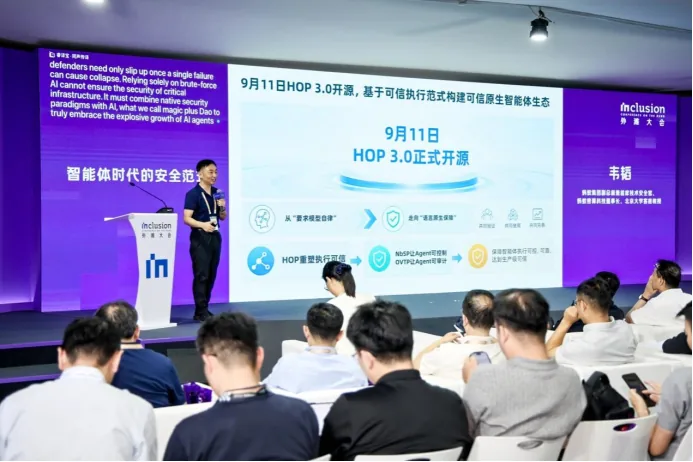
Ant[a]pper announced at the 2026 Inclusion·Bund Conference that its Trusted-Native Agent framework HOP 3.0 is now open-source, with the ‘Native Agent Language’ technology stack fully available to developers, enterprises, and industry experts. Key facts:
- Release date: 2026 Inclusion·Bund Conference (HOP 1.0 launched at 2025 World AI Conference; upgraded to 3.0 at 2026 WAC)
- Open-source status: Officially available on GitHub (https://github.com/hoplogic/hop3)
- Core promise: Transitioning from model-dependent reliability to clear boundaries, controllable processes, and verifiable outcomes
- Target users: Developers, enterprises, and domain experts—particularly in finance, healthcare, and government sectors
Structural Innovation: Solving the Skill-Harness Split
Current agent ecosystems普遍 face a fundamental split: task specifications written in natural language (Skill) versus control logic implemented in procedural code (Harness). This separation makes natural language inadequate for complex multi-step, multi-branch workflows, while code-based Harness remains inaccessible to non-programmers—even developers struggle to audit distributed logic across prompts, code, and runtime states.
HOP 3.0 introduces the Native Agent Language, which unifies explicit structured logic with large model reasoning within a single expressive system. Explicit structured logic defines goals, boundary conditions, data dependencies, critical workflows, and verification requirements; the large model operates within these constraints for reasoning and planning. The result is: ‘lock objectives, hold boundaries, empower paths’.
Notably, HOP 3.0 achieves a counterintuitive capability democratization. Using Qwen3.0 27B (2.7B parameters), HOP has enabled a普通 model to effective handle tasks previously requiring hundreds of billions—even trillions—of parameters in prior LLMs. Crucially, this does not mean the model became ‘smarter’; rather, structured language and execution engine offloaded complex control burdens. Result: 91.7% reduction in model failure rate, 100% scores for output completeness, success rate, and requirement-code consistency.
Execution Paradigm: Exploring—Verifying—Submitting(trial)
Inspired by SQL transaction commits, HOP 3.0 explicitly separates exploration, verification, and submission at language and runtime levels:
- Exploration phase: Agents conduct trials in reversible space without affecting production systems
- Verification phase: Results undergo independent validation for boundary compliance and correctness
- Submission phase: Only verified outcomes enter irreversible commit operations
High-risk actions like file deletion or database drop are explicitly isolated to the submission stage, ensuring safe exploration. Validated exploration paths can be固化 into reusable workflows, becoming reusable organizational assets.
Production Metrics and Cost Efficiency

HOP 3.0 significantly reduces long-task control pressure by delegating global objectives, state tracking, branching logic, context management, and verification to language/engine—allowing LLMs to reason only at constrained current nodes. This slashes processing requirements: average token consumption drops by ~13% per execution cycle.
| Version | Release | Key Evolution | Open-Source |
|---|---|---|---|
| HOP 1.0 | 2025 WAC | First trustworthy application framework | Yes |
| HOP 2.0 | 2026 WAC | Pre-3.0 iteration (details not disclosed) | - |
| HOP 3.0 | 2026 Inclusion·Bund | Native Agent Language + three-phase execution | Yes |
Adoption Guidance
- Early adopters: Teams in highly regulated industries (finance, healthcare, government) needing to encode domain expertise into agent workflows; organizations seeking to reduce token consumption and agent failure rates
- Wait for maturation: Organizations requiring highly customized agent Triangulation (cross-validation) mechanisms, or those lacking domain experts capable of co-designing structured agent flows with engineers
Final Take
HOP 3.0 moves trusted execution from external compliance layer to core language primitive, marking the inflection point where autonomous agents shift from ‘capable’ to ‘reliable’. Combined with secretotent computing, it forms a coherent chain—‘data—model—agent—outcome’—enabling scalable, trustworthy enterprise AI adoption.