
Core Announcement: Three LingBot-World 2.0 Variants Open-Sourced
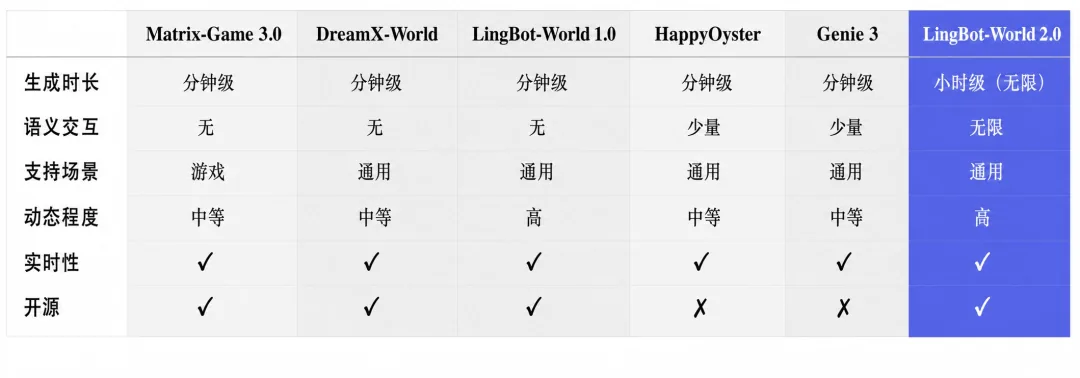
On September 13, Ant Group’s Lingbo Lab released three new variants of the LingBot-World 2.0 real-time interactive world model:
- LingBot-World 2.0 Small (1.3B): Designed for consumer-grade single-GPU deployment, featuring 1.3 billion parameters
- LingBot-World 2.0 Bidirectional: Integrates bidirectional attention mechanisms for enhanced editing and multimodal understanding
- LingBot-World 2.0 Causal Pretrain: Uses causal pretraining paradigm to fundamentally suppress error accumulation
An earlier 14B full version was open-sourced on July 9. Full model weights and inference code are publicly available under a non-commercial license. Developers can deploy out-of-the-box via SGLang, while online demos are accessible through Reactor (PC) and Lingguang APP (mobile).
Technical Breakthrough: Hour-Long Stability Meets 60fps Interactivity
LingBot-World 2.0 breaks two fundamental limitations of prior video generation models: short-term drift and high latency.
Traditional interactive world models typically degrade after seconds to minutes due to error accumulation. In contrast, the 14B model maintains visual sharpness and scene coherence for over one hour in continuous stress tests, making it the only open-world model currently capable of hour- to infinite-length generation.
For interactivity, the system delivers stable 720p/60fps real-time rendering through:
- Causal Pretraining Paradigm: Suppresses compounded errors at architectural level
- Mixed Bidirectional and Autoregressive Attention (MoBA): Balances quality and stability
- Consistency and Distribution-Matching Distillation (DMD): Creates distilled fast variants with reduced sampling cost
Engineering optimizations include compiler-level attention kernels, hybrid parallel inference, dynamic KV cache scheduling, and asynchronous streaming—enabling continuous “generate-decode-stream” pipeline.
Counterintuitive Finding: 1.3B Model Enables Consumer Hardware Access
Notably, the 1.3B Small variant belongs to the same 2.0 generation as the 14B flagship, not the previous 1.0 series. This indicates successful knowledge distillation compressing a 14B model into a 10x smaller variant without架构 compromise on core interactive capabilities. Single-GPU消费级 GPU users now gain access to capabilities previously limited to enterprise clusters.
| Model Version | Parameters | Target Hardware | Architecture | Use Case |
|---|---|---|---|---|
| LingBot-World 2.0 Small | 1.3B | Single consumer GPU | Causal pretraining distilled | Local quick deployment, lightweight experimentation |
| LingBot-World 2.0 Bidirectional | Undisclosed | Mid-high-end GPU | Mixed bidirectional attention | Controllable editing, multimodal understanding |
| LingBot-World 2.0 Causal Pretrain | Undisclosed | Multi-GPU cluster | Causal pretraining | Long-term evolution simulation |
| LingBot-World 2.0 (14B) | 14B | High-end GPU cluster | Full architecture + MoBA | Research validation, complex world construction |
Deployment_recommendation
Users with mid-tier GPUs (e.g., RTX 4070 or above) should try the 1.3B Small variant for local real-time world simulation. Research teams requiring multi-agent coordination or complex event-driven scenarios should opt for the 14B full version with Director Agent modules.
Consider waiting if:
- You only need short (<5-second) video clips—wait for upstream video model updates
- You require 4K/120fps output—the current specification caps at 720p/60fps
Final Note
LingBot-World 2.0 shifts interactive world models from lab-only prototypes to accessible developer tools. By open-sourcing both desktop-grade and production-grade versions simultaneously, it establishes a viable open foundation for embodied AI, game development, and autonomous vehicle simulation. As world models operate on hour-long horizons rather than minutes, the technical boundaries of AI-native interactivity are being permanently redefined.