
Ant Ling Opens Dual Models, Redefining AGI Pathways
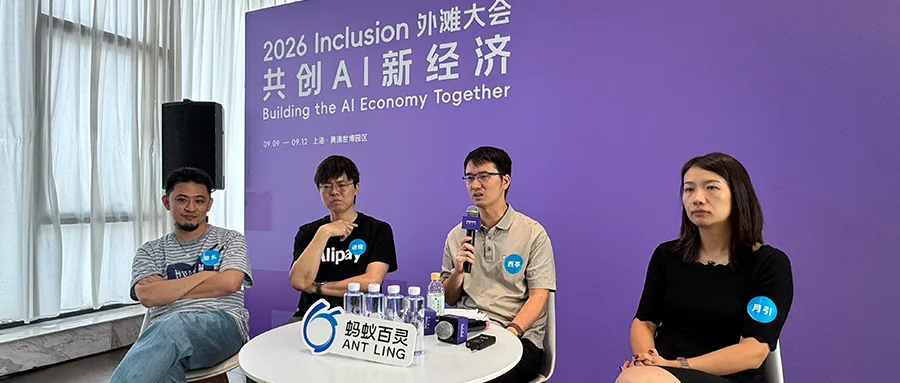
At the 2026 Inclusion·Bund Conference, Ant Ling open-sourced its first native multimodal large model Ling-3.0-flash-VL and its first finance-enhanced model Ling-3.0-flash-Fin. Both are built on the Flash architecture, emphasizing high intelligence-to-efficiency ratio and real-world deployment readiness.
- Ling-3.0-flash-VL: First native multimodal model, supporting image, audio, video inputs and outputs, targeting finance documents, medical imaging, and other practical scenarios
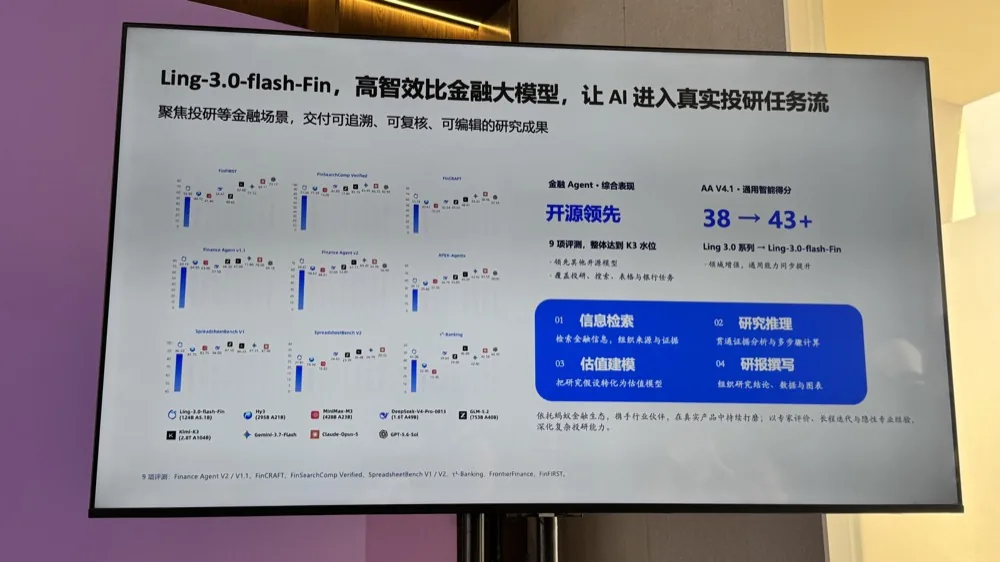
- Ling-3.0-flash-Fin: Specialized for financial research & analysis, outperforming leading general-purpose models in multiple capability evaluations
- Technical approach: MoE sparse architecture, hybrid linear mechanism (KDA+MLA), and Token-Efficient design to compress large-model intelligence into compact parameter sizes
- Open-source strategy: Benchmark release + ecosystem collaboration, supporting private-data fine-tuning and industry-specific customization
The core philosophy is “intelligence-to-efficiency ratio”—solving end-to-end problems within reasonable cost and faster response, not merely maximizing generation throughput.
Supporting Mass Adoption: the Tech Behind 150M Users
Ant Ling’s base models now empower multiple mass-consumer AI applications:
- AFU (阿福): Health AI app with over 150 million users and 20 million daily queries, potentially the world’s largest health AI app
- ABao (阿宝): AI-powered Alipay, experiencing continued growth
- LingGuang (灵光): Native AI assistant, also in growth phase
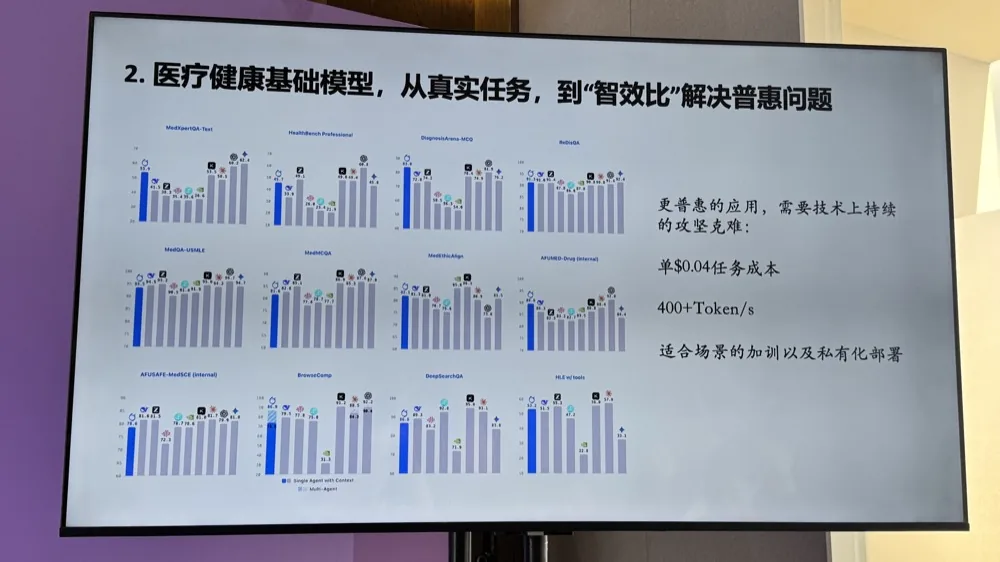
Scaling to such interaction volumes presented three major technical challenges: inference cost, response latency, and data privacy. Tech lead Jinjie noted that C-end applications must respond within 5 seconds—or users abandon the session—while B-end/enterprise users prioritize security and explainability.
A key contrast: at tens of millions of users, running the largest available model for all queries is unsustainable. Ling adopted a “small models exceed waterline” strategy, deploying Tiny models across many internal scenarios to boost efficiency while preserving professional capabilities.
How Finance and Medicine Feed Back to the Base Model
The Ling team views domain-specific models and base models as mutually reinforcing:
Finance (Yueyin):
- Targets high-difficulty tasks (investment research), leveraging verifiable components like analysis and valuation modeling
- Advantage: ten to twenty years of expert-validated data across primary and secondary markets, with domain knowledge embedded in pre-training—not just post-training
- Domain knowledge flows back to base model, enabling ToC services—for instance, delivering professional financial advice to AFU’s 150M users
Healthcare (Xiting, Jinjie):
- Rural users lack top-tier medical access; urban users face stress and health issues despite resource availability
- Dermatology chosen as entry point due to high consultation volume and suitability for telemedicine
- Long-term vision: AI-augmented medical teams to improve clinician throughput and patient management
Architect Lingyi emphasized: Domain applications generate high-quality negative samples (refusals/“I don’t know” responses), training models to recognize knowledge boundaries—a critical capability for严肃场景.
Evaluating Models: Three Core Metrics
Xiting proposed three essential metrics for models entering real-world use:
| Metric | Description | Rationale |
|---|---|---|
| Intelligence-to-efficiency ratio | Unified trade-off of compute/parameter/token costs | MoE sparsity increases intelligence (before临界点) |
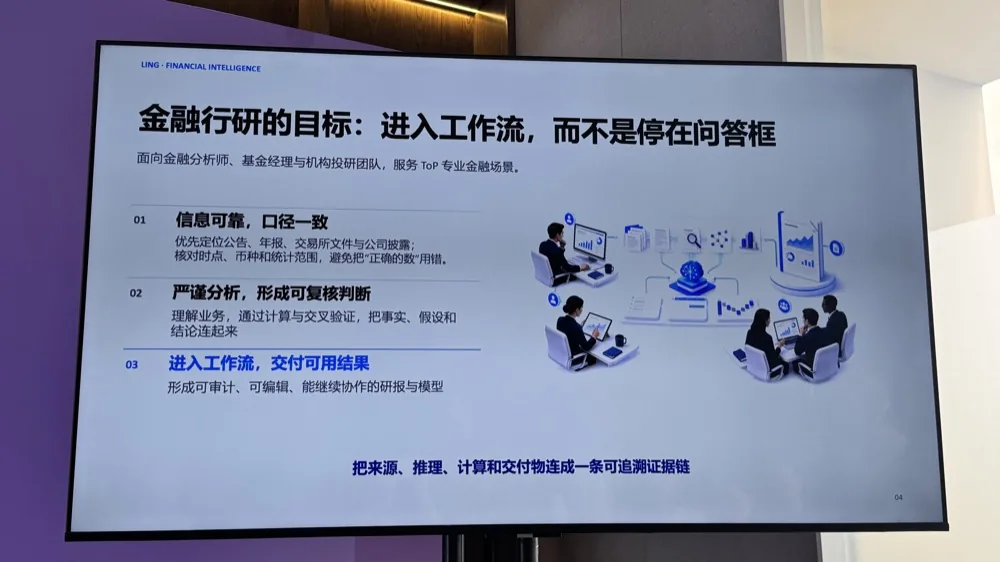
| Domain expertise | Attains usable proficiency in specialized tasks | Finance requires real-decision support—not multiple plausible answers |
| Openness | COT explainable, feedback loop closed | Medical PPT/form errors must be visible and correctable |
Refusal mechanism design is critical to expertise. Yueyin cited: real金融 users cannot process 85 analysis options—they want 2–3. Thus RLF training penalizes hallucination heavily: “Better to say ‘I don’t know’ than offer ambiguous options.”
Who Should Use This—and Who Should Wait
- Ideal for: Finance professionals (researchers, advisors), healthcare workers, developers (open-source contributors); private-data fine-tuning is built-in for privacy-sensitive deployments
- Wait for now if: You seek general-purpose chat or entertainment—current versions prioritize ToB/ToP workflows and professional tasks
- Developer tip: Observe their benchmark design—not only output accuracy, but also “knowing what one doesn’t know”; this is becoming essential for serious applications
Write-up conclude: Ant Ling’s practice shows China’s LLM differentiation has shifted from “chasing coding parity” to “solving real problems”. As MoE + compact size + domain feedback form a new paradigm, AGI may sidestep the coding-centric path, instead scaling through intelligent efficiency measured by real-world impact.