
Core Announcement: Release Details & Key Facts
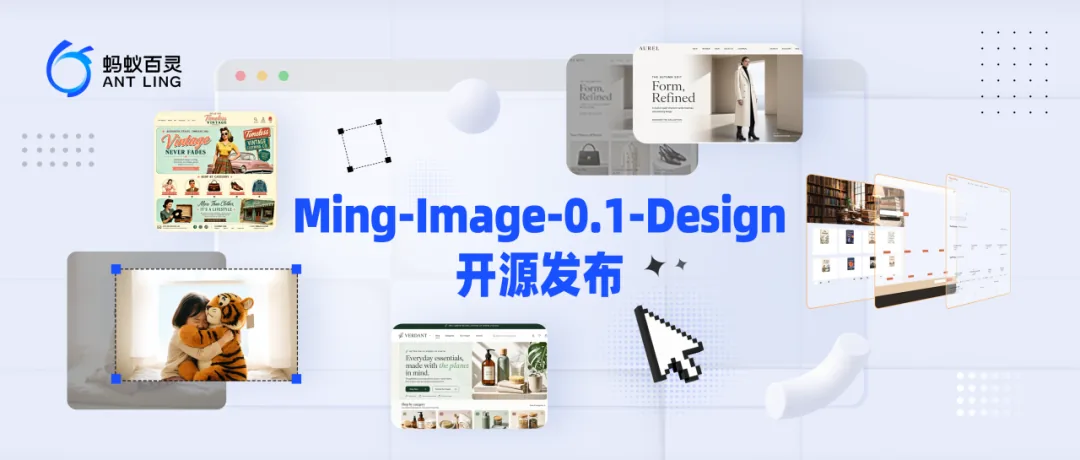
On September 23, AntBubble officially open-sourced the Ming-Image-0.1-Design series, comprising two 6B-parameter models:
- Ming-Image-0.1-Design: Generates UI, infographics, posters, and full visual designs from natural language prompts
- Ming-Image-0.1-Design-Layer: Decomposes designs into independently editable transparent layers
Complementing the models, Design Skill and PPT Skill were also open-sourced, enabling connections to editable frontend pages and presentation files.
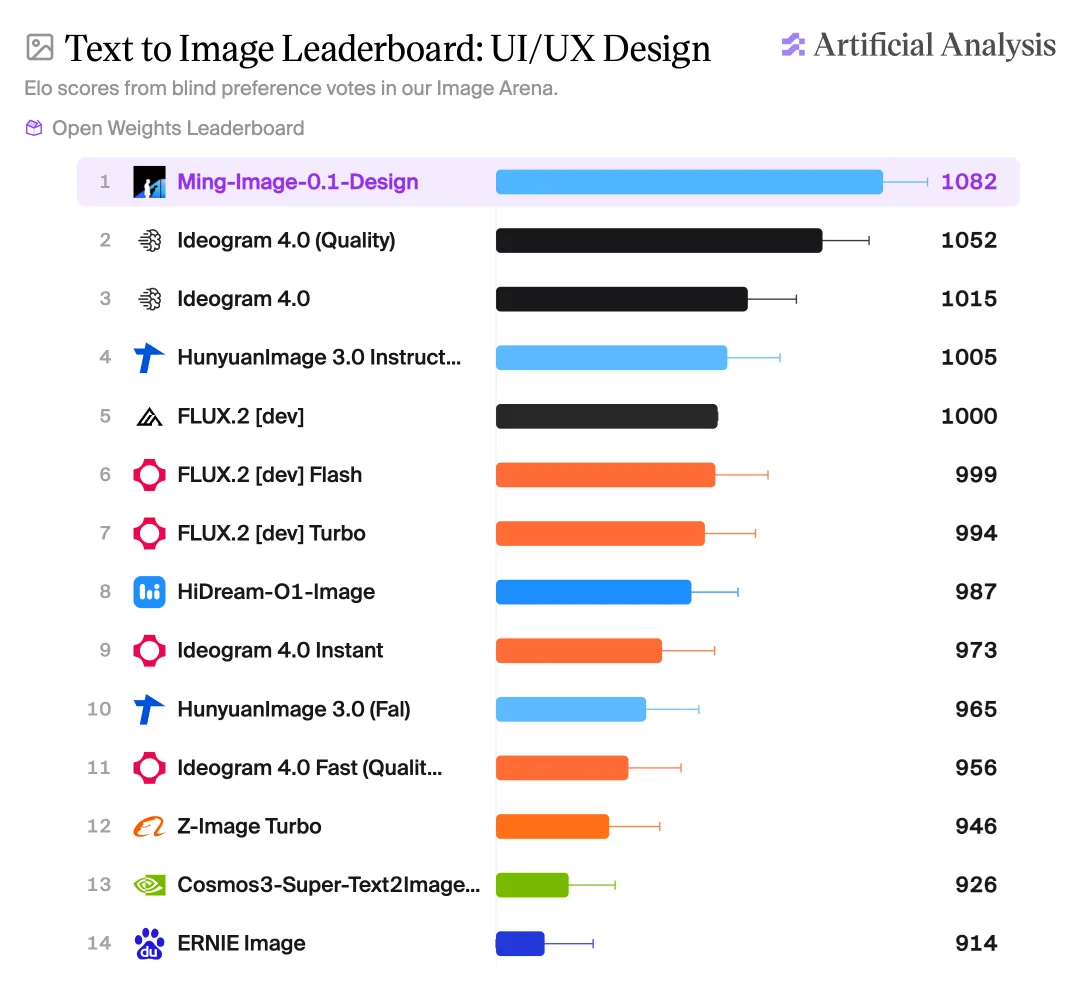
A notable surprise: this 6B open-source model ranks #1 among all open-source competitors in a specialized UI/UX design evaluation—despite Significantly smaller parameter count than most billion-parameter rivals.
Technical Capabilities & Benchmark Results
Ming-Image-0.1-Design claims four key enhancements:
- 8K Long Structured Prompts: Converts natural language needs into structured components of Copy, Modules, Layout, and Visual Style
- Text Rendering Optimization: Improves stability for titles, buttons, cards, and multi-region text layout
- End-to-End Generation: Produces complete designs in a single pass, avoiding color-scheme conflicts and style mismatches common when chaining multiple general image generators
- Native RGBA VAE: Directly generates assets with transparent backgrounds for characters, products, icons, and decorations
According to Artificial Analysis’s September 18, 2026 UI / UX Design专项评测 (specialized evaluation):
- Ming-Image-0.1-Design ranks #1 among open-source models with an Elo score of 1082
- wins rates: 67.4% for layout, 67.0% for complex composition, 66.7% for text rendering (win rate indicates how often human reviewers prefer model output over reference images)
Model Limitations & Trade-Offs
Official documentation explicitly defines current boundaries:
- Stable Strengths: Typography, text layout, and basic material rendering
- Current Weaknesses:
- Complex human hand poses (e.g., fine finger articulation)
- Sequential operation step illustrations
- High-fidelity shadows, reflections, and advanced lighting effects
The Layer model also faces inherent challenges:
- No single correct layer decomposition exists—user expectations vary wildly (some desire only 3 layers while others expect each icon isolated)
- Complex叠加光效 (light-overlay effects), transparent materials, or heavy occlusion may cause edge artifacts or missing layers
Practical Guidance: Who Should Try Now
Ready for immediate adoption:
- Product teams needing rapid UI wireframe or mockup generation
- Frontend engineers requiring self-explanatory component diagrams and documentation illustrations
- Content creators producing infographics or social media promotional posters
- Open-source designers seeking to edit transparent layers in iterative workflows
Wait for future iterations:
- Projects requiring photorealistic product renders with precise shadows/reflections
- Tutorial/documentation workflows depending on step-by-step operation sequences
- Publishing-ready workflows demanding deterministic, multi-level layer separation
Final Thoughts
A 6B-parameter model topping a specialized design leaderboard demonstrates that targeted optimization outperforms raw scaling; open-source models have now matched closed alternatives in UI design, accelerating the industry’s shift from generic to domain-specialized generative AI.