
The Event: Anthropic’s Run-Rate Revenue Reaches $65 Billion
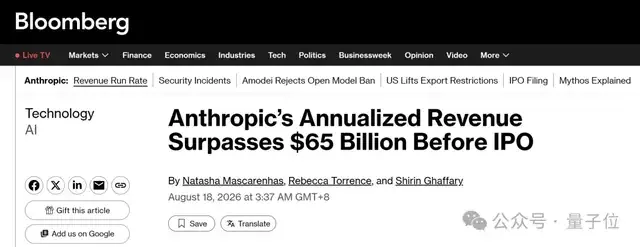
Anthropic has reportedly disclosed a major operating milestone ahead of a potential IPO. According to Bloomberg, three people familiar with the matter said a company founder told investors over the weekend that Anthropic’s latest annualized revenue had reached $65 billion, or about RMB 438.1 billion.
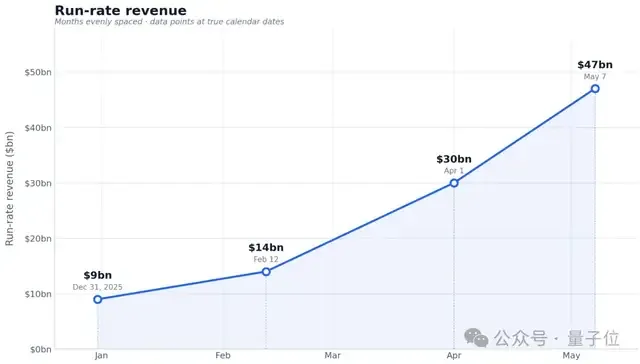
Annualized revenue is a projection based on the current revenue pace, not the same as full-year recognized revenue. Even so, the figure is significant. At the end of 2025, Anthropic’s annualized revenue was just above $9 billion. In roughly eight months, it has increased by more than seven times. OpenAI, by comparison, has just crossed $40 billion in annualized revenue, according to an internal email from President Greg Brockman cited in the original report.
How the Reversal Happened

The change is striking because OpenAI had a clear lead only months earlier. In 2025, OpenAI generated $13.1 billion in actual annual revenue, and its annualized revenue exceeded $20 billion by year-end. Anthropic’s comparable figure was around $9 billion.
By February 2026, OpenAI had reached roughly $25 billion in annualized revenue, while Anthropic had just passed $14 billion. The gap was still more than $10 billion. Then Anthropic’s growth accelerated sharply:
- March: close to $19 billion;
- April: above $30 billion, overtaking OpenAI for the first time;
- May: $47 billion;
- Latest disclosed figure: $65 billion.
OpenAI is still growing quickly, rising from about $25 billion early in the year to more than $40 billion. But Anthropic’s increase of more than $50 billion over the same period has changed the market narrative. For public-market investors, the direction and speed of revenue growth can matter as much as past leadership.
The IPO Race Becomes Central

The rivalry is now moving from model performance and product adoption into capital markets. Anthropic filed confidential IPO documents with the U.S. Securities and Exchange Commission on June 1, one week before OpenAI did the same. Bloomberg reported that Anthropic could list as early as October. OpenAI has filed as well, but the company has said an actual listing may still take time, and other reports suggest it may consider delaying its IPO until 2027.
This is not only about which company rings the bell first. Both firms are competing for the same institutional capital and for the chance to define how top-tier AI model companies should be valued.
Anthropic’s private-market position has also strengthened. In May, it completed a $65 billion Series H financing round, bringing its post-money valuation to $965 billion. OpenAI’s March financing involved $122 billion in committed capital and valued the company at $852 billion. Bloomberg-obtained documents also showed Anthropic’s second-quarter revenue exceeded $11.5 billion, up more than 14 times from $787 million a year earlier, with adjusted operating profit turning positive for the first time. By contrast, The Information reported that OpenAI had about $5.7 billion in first-quarter revenue while burning $3.7 billion in cash.
Business Model: Enterprise Revenue Takes the Spotlight
Anthropic’s recent growth has been driven mainly by enterprise customers and Claude Code. Claude Code is an AI coding assistant for developers. Enterprise customers tend to be more stable than consumer users, and once AI systems are embedded in software development, financial analysis, or other workflows, spending can rise with usage.
As of April, Anthropic had more than 1,000 enterprise customers each spending more than $1 million a year. The company is also trying to manage infrastructure costs. In addition to buying compute from AWS, Google, and Microsoft, it is reportedly discussing a roughly $6 billion acquisition of chip optimization company Decart. If completed, such a deal could help lower inference costs. Inference refers to the compute used when a model generates answers for users.
OpenAI still has broader distribution. ChatGPT is nearing 1 billion weekly active users, enterprise products contribute more than 40% of revenue, Codex has more than 2 million weekly active users, and its advertising experiment crossed $100 million in annualized revenue within less than six weeks. OpenAI’s advantage is a wider ecosystem across consumer products, APIs, developer tools, search, and advertising. The trade-off is higher complexity and greater spending.
One caveat matters: the companies do not report revenue in exactly the same way. Anthropic counts some Claude sales through cloud providers on a gross basis, while OpenAI more often reports net revenue after partner shares. So $65 billion versus $40 billion should not be read as a simple 60%-plus lead in underlying earning power.
What It Means for the AI Industry
The AI race is shifting from model benchmarks to revenue quality, customer mix, profitability signals, and IPO timing. Anthropic currently has the cleaner public-market story: faster growth, a stronger enterprise focus, a higher reported private valuation, and early signs of adjusted operating profitability. OpenAI’s task is different: it must prove that massive consumer reach, heavy compute spending, and a broad product portfolio can become durable revenue and profit.
If Anthropic lists first, it could set the valuation benchmark for the next generation of AI companies. That would make its IPO more than a financing event; it could become the reference point for how investors price the commercial future of large language models.