
Apple Systematically Reveals On-Device AI Capability Thresholds for First Time
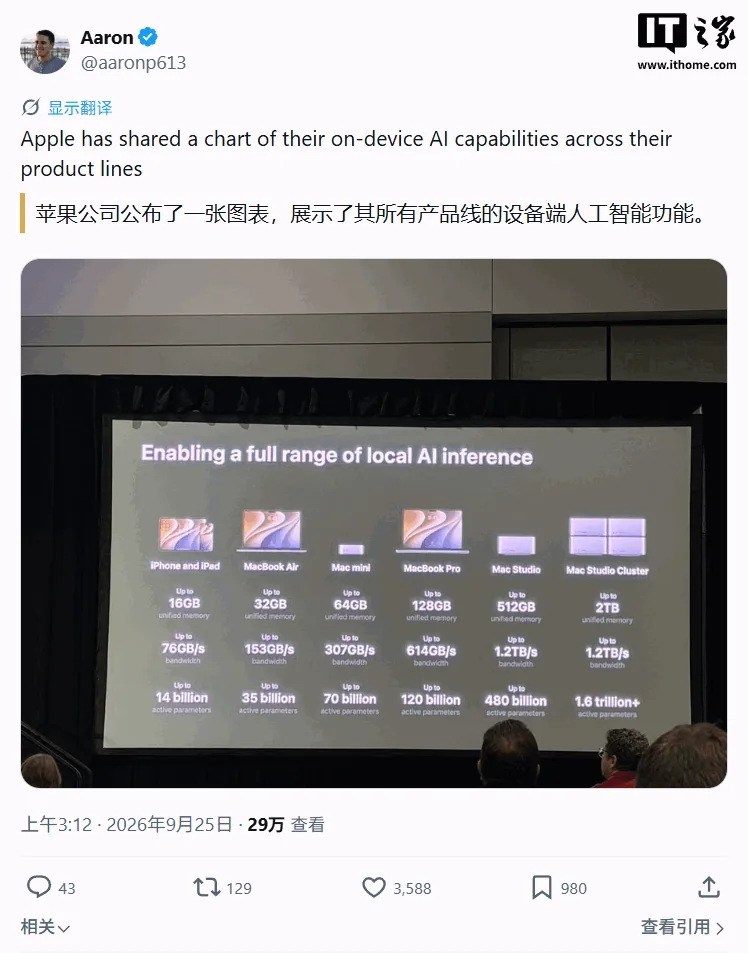
At the Jamf User Conference (JNUC) on September 25, 2026, Apple publicly disclosed, for the first time, the upper limits of on-device AI inference capability across its entire product lineup. According to the comparison chart displayed at the event, the iPhone 18 Pro currently supports the largest parameter count among mobile devices, with inference capabilities up to approximately 14B-parameter; capabilities of other devices decrease proportionally with unified memory capacity.
Key hard facts:
- Announcement date: September 25, 2026 (at JNUC event)
- Affected products: iPhone series, iPad series, Mac Studio, and Mac Studio clusters
- Core architecture: Unified Memory Architecture (UMA)
- Weight availability: Only inference capability limits were shown; no info on weight distribution or openness
- Availability timeline: Chart reflects existing and upcoming device capabilities, expected to align with the 2026 autumn product launch cycle
Unified Memory as the Bottleneck, Hardware Tier Determines AI Potential
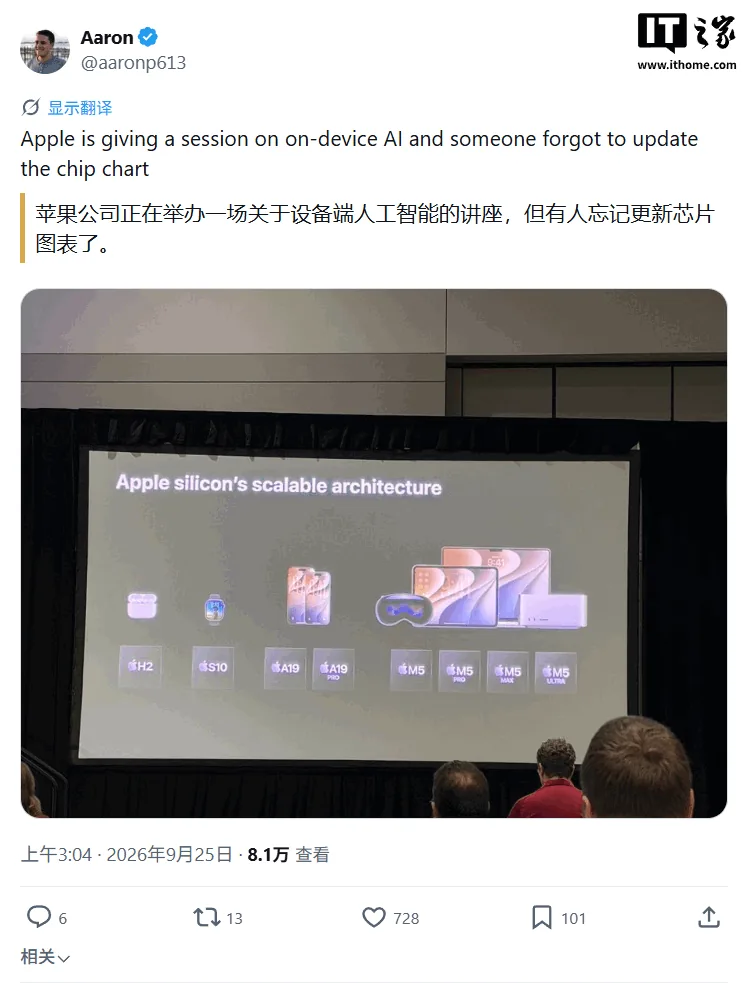
Apple’s on-device AI inference capability is directly governed by the capacity and bandwidth of unified memory. Unified Memory Architecture, Apple’s design for sharing memory resources across CPU, GPU, and Neural Engine, eliminates data copying latency—a critical foundation for running large models on device.
The company has established a clear capability tier based on product positioning:
- High-end mobile devices: iPhone 18 Pro (up to 14B-parameter inference), iPad Pro (10B-parameter class)
- Mainstream mobile devices: iPhone 17 series, iPad Air (parameter counts scale downward per memory configuration)
- Desktop workstations: Mac Studio with M-series chips supports higher parameter counts; Mac Studio cluster deployments enable distributed inference beyond single-device memory limits
A notable counterpoint emerges in the iPad vs. Mac mini comparison: some high-end iPad models exhibit on-device AI capabilities approaching those of entry-level Mac mini units, challenging the traditional assumption that “desktop devices inherently outperform mobile ones” and underscoring Apple’s deep chip architecture integration.
Hardware Capability Comparison
The table below summarizes the on-device AI capacity hierarchy based on the conference materials (parameter upper bounds only, not inference speed):
| Product Line | Max Supported Parameters | Unified Memory Highlights |
|---|---|---|
| iPhone 18 Pro | Up to 14B-parameter inference (based on JNUC chart) | Highest-bandwidth LPDDR5X, largest capacity among iOS devices |
| iPad Pro (M4) | ~10B-parameter models | Shared memory design, bandwidth optimized toward Mac-tier |
| Mac Studio (M3 Max) | >10B-parameter models | Up to 96GB unified memory configurable, supports complex inference |
| Mac Studio Cluster | Distributed inference supported | Multi-device coordination, memory pooling breaks single-unit limits |
| iPhone 17 Series | Mid-to-high parameter models | Dependent on chip variant and memory configuration |
Practical Guidance: Match Device to Use Case
- Users ready to adopt now: Enterprise IT administrators and creative professionals should assess Mac Studio (M-series) for on-device processing of sensitive workloads—such as medical imaging analysis or real-time design generation—where cloud transmission delays and privacy risks are unacceptable.
- Cases warranting patience: General consumers requiring only baseline AI features (e.g., voice assistants, photo editing) can rely on iPhone 15/16 series with iOS 18 updates; unless specifically upgrading to iPhone 18 Pro for heavy reliance on local large models (e.g., offline translation, real-time code generation), immediate upgrades offer limited ROI.
Final Note
Apple’s AI strategy is becoming increasingly hardware-bound—its on-device capabilities are not merely “software upgrades” but require specific chip-and-memory configurations as a physical prerequisite. This hardware-software integration model ensures performance and privacy, yet also means consumers must pay tiered prices for differentiated AI experiences, signaling a new phase of capability-transparent hardware competition ahead.