
Arm Launches CSS for Mobile 2: Restructuring the Mobile AI Compute Stack
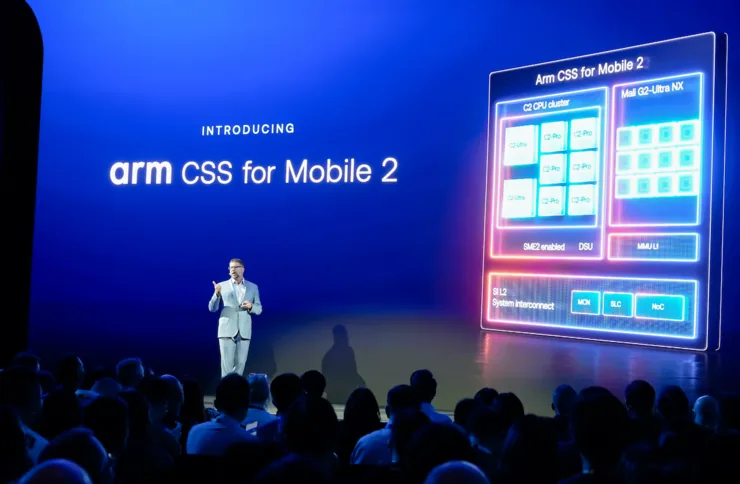
At Arm Everywhere China 2026, Arm unveiled CSS for Mobile 2, its next-generation mobile compute subsystem for personal AI. The platform notably omits Arm’s own NPU, leaving NPU innovation entirely to partners. Key facts:
- Launch date: September 9, 2026
- New versions: CSS for Mobile 2 includes new CPU cluster (C2 Ultra/C2 Pro) and GPU (Mali G2-Ultra NX)
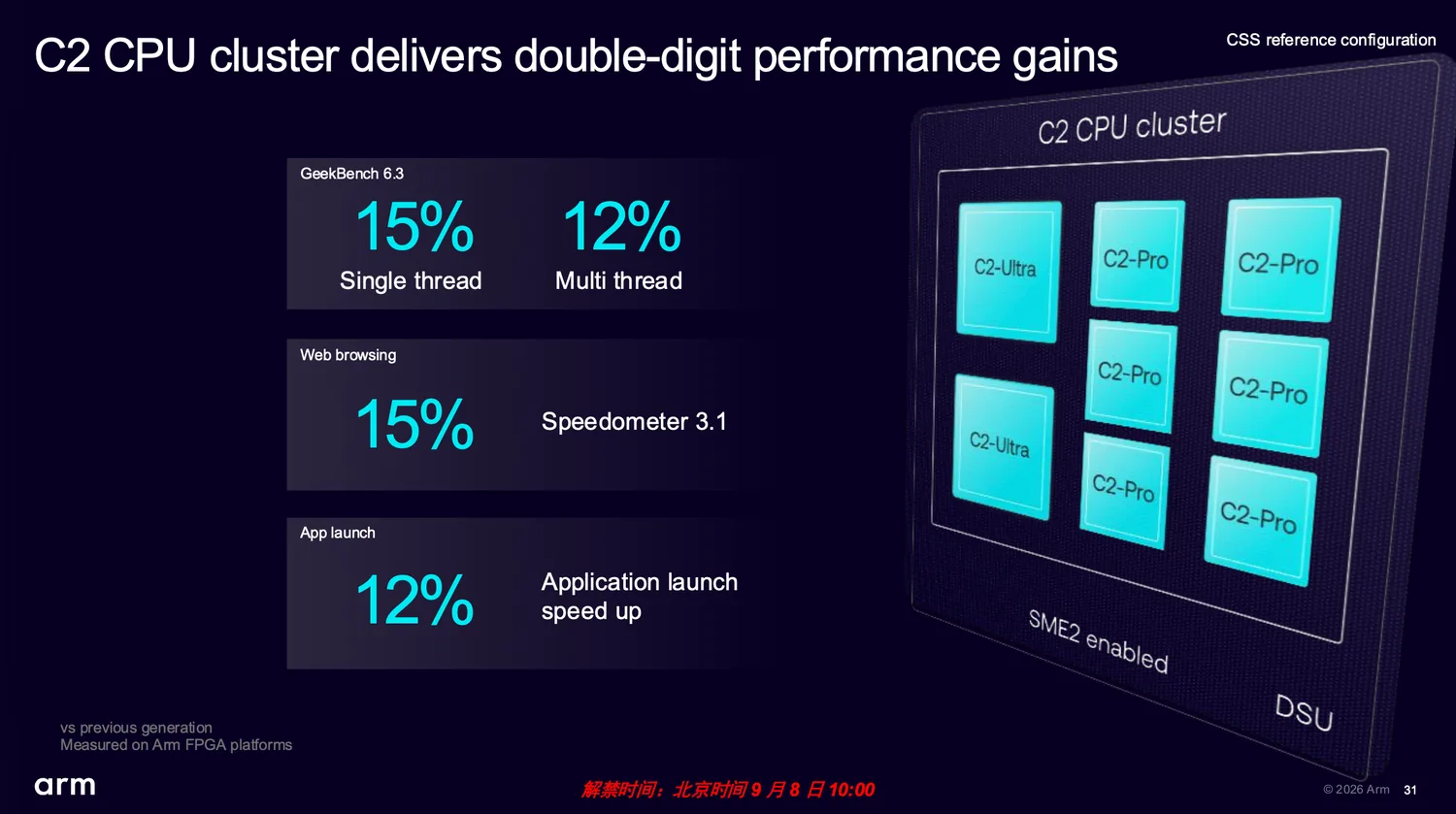
- Configurability: C2 CPU cluster supports up to 14 cores (Ultra+Pro mix); GPU allows configuring shader cores and NX units
- Software suite: KleidiAI, neural graphics SDK, and game engine plugins released
- Pricing/unavailability: No licensing price disclosed; chipmakers customize per product needs
- Adoption: SME2 already in nearly all flagship smartphones (iOS and Android)
CPU: Optimized for Low-Latency AI workloads, SME2 as Mainstream enabler
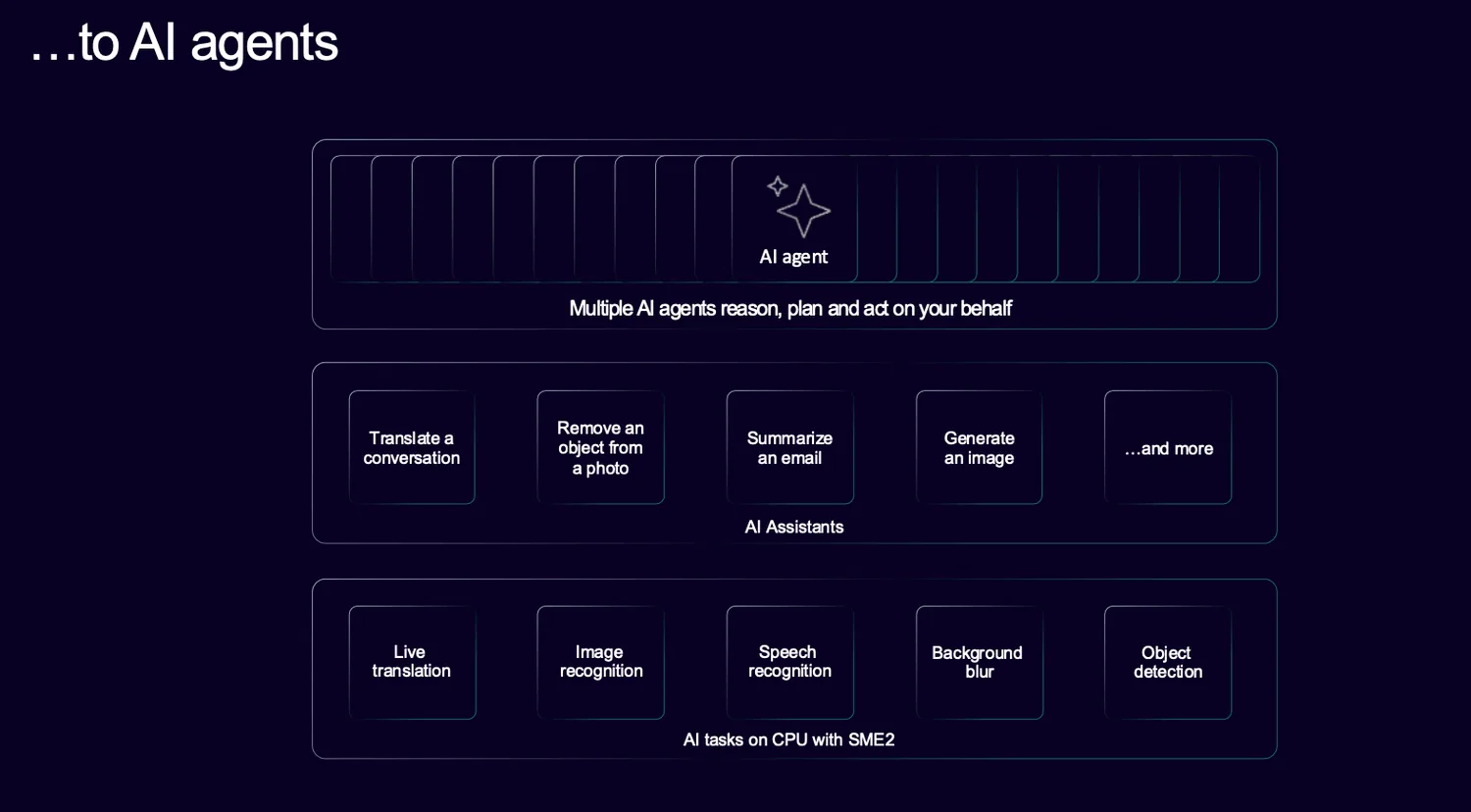
Personal AI tasks—like booking a dinner—require voice recognition, search, calendar/album access, web browsing, and task execution. C2 CPU cluster addresses this with:
- C2 Ultra (burst响应) + C2 Pro (efficient continuous) cores; partners adjust counts per product tier
- 15% faster single-thread and web performance; 12% faster app launch and multi-thread
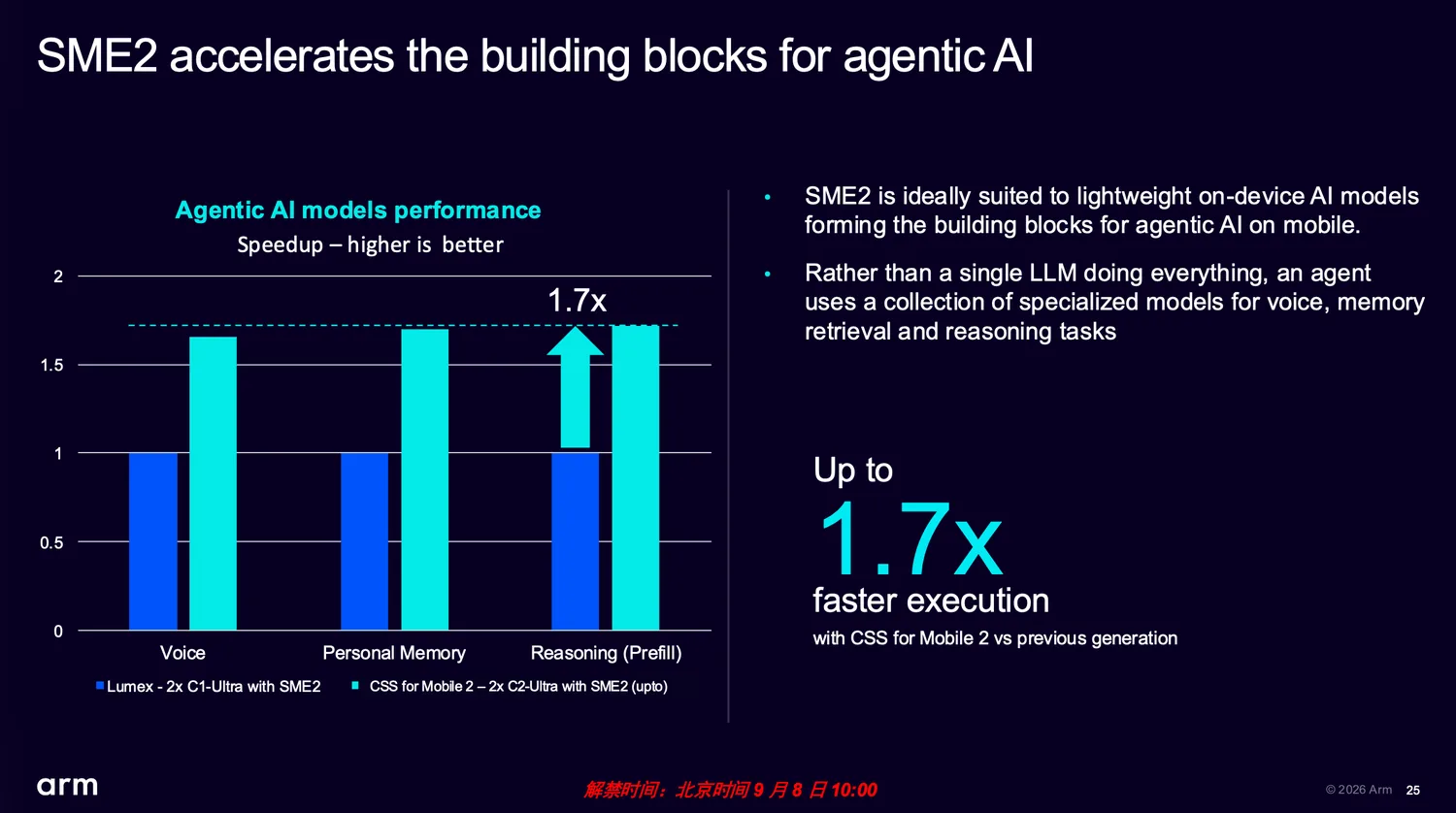
- SME2 matrix acceleration delivers 1.7× performance on specific AI models vs. previous generation
Arm maintains a deliberate boundary: CPU provides ~5-6 TOPS equivalent for low-latency and small models. Large-scale inference suits GPU/NPU. This reflects real-world constraints: when memory bandwidth limits performance, high peak performance often just waits for data. C2 counters this with private L2 and large shared L3 caches, reducing DRAM accesses.
GPU: First NPU Integration, AI Redefines Rendering
Mali G2-Ultra NX is a milestone: first Mali GPU with native neural network accelerator (NX unit)—launching the “neural graphics” era.
Innovations include:
- Neural Super Sampling (NSS): low-res render, AI upscaling
- Neural Super Sampling with Denoising (NSSD): light-trace noise reduction
- Neural Frame Rate Upscaling (NFRU): AI mid-frame insertion, coordinated with Android vsync and game engines to preserve latency
The “Light Rebirth” demo reveals the scale: 7/8 of pixels reconstructed by AI. Result: 4× peak frame rate/efficiency boost, 70% DRAM traffic reduction vs. Mali G1-Ultra. Without AI features, GPU baseline improves 20%—neural graphics provide the leap.
GPU handles INT8-format inference, but Arm focuses on graphics: CPU makes AI accessible; GPU upgrades existing experiences—a dual-path strategy.
Why Partner-Driven NPU?
CSS for Mobile 2 notably lacks Arm NPU. James McNiven (VP, Edge AI, Arm) explains: “Arm’s mobile strategy has always delegated NPU innovation to partners.” Rationale:
| Dimension | Arm CPU/GPU Strategy | Mobile NPU Reality |
|---|---|---|
| Standardization | High, unified dev environment | Fragmented architectures |
| App dev cost | Single integration covers wide coverage | Per-chip NPU tuning required |
| Differentiation | Configurable IPs from Arm | Chipmakers compete on NPU |
Chipmakers bring proprietary NPU designs and OS/model optimizations. Arm’s CSS shortens partner chip timelines; software (e.g., KleidiAI) exposes SME2 to AI frameworks so developers use familiar toolchains.
Real-World Guidance: Match Tech to Use Cases
For developers/partners:
- Lightweight AI (tools, orchestration, small models): leverage SME2+C2 for low latency
- Gaming: try neural graphics SDKs where frame rate and efficiency matter most
- Heavy inference (multi-turn chat, image gen): seek partner NPU solutions
For consumers:
- Prioritize AI responsiveness and battery: target 2026 flagships with C2 Ultra/Pro and SME2
- Mobile gamers: test Mali G2-Ultra NX devices—neural graphics already shipping
- NPU app compatibility critical: wait for broader partner NPU ecosystem maturity
Final Thoughts
Arm’s shift from IP licensor to software-defined systems optimizer crystallizes in CSS for Mobile 2. CPU, GPU, and NPU division reflects not technical saturation, but precision targeting: as AI moves beyond raw compute, system value resides in experience and ecosystem synergy.