
Ascend 950 Super-Node Commercially Launched
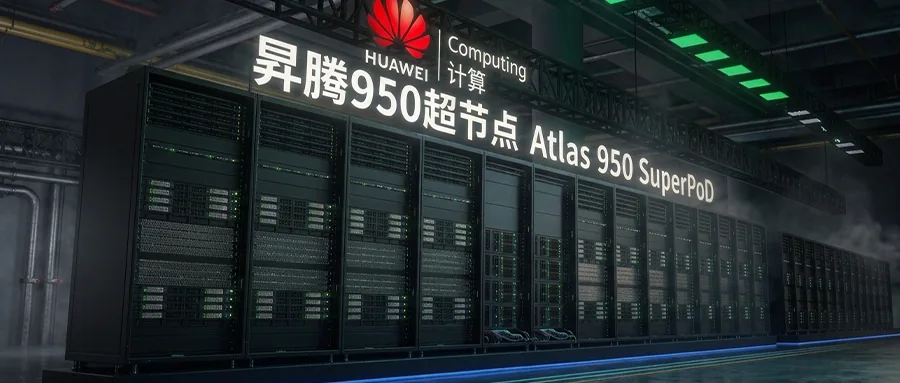
Huawei officially launched the Ascend 950 super-node at HUAWEI CONNECT 2026, marking the industry’s largest-scale commercial super-node deployment. The product family includes two variants:
- Atlas 950 SuperPoD liquid-cooled super-node: 1,024 NPUs, 1,300+ Lingqu interconnection chips, 4,000+ optical modules for liquid-cooled data centers
- Atlas 850E air-cooled super-node: Supports 32 to 768 cards in standard air-cooled racks, requiring no facility modification
- Key capabilities: sub-10ms inference latency, training and inference integrated for trillion-parameter models, the only vendor commercially supporting mxFP8 low-precision training and full-stack mxFP4 inference in China
- Availability: Commercial availability launched at HUAWEI CONNECT 2026, now available for commercial adoption by internet, finance, manufacturing, healthcare, and transportation sectors
Breaking the “Compute-Storage-Communication” Three Walls

The core breakthrough lies in hardware-software co-designed architecture enabling thousands of chips to act as one supercomputer:
- Chip-level innovation: Hardware now handles data transfer, format conversion, communication synchronization, and cache management—simplifying developer workflows
- Lingqu high-speed interconnect: Enables 1,024-card unified memory addressing; remote memory access semantics match local access, with 2.1x higher inter-chip bandwidth vs. previous generation
- System-level reliability: Three-layer reliability (device, network, system) supports month-long stable training on 10,000-card clusters
Engineering milestones make deployment feasible:
- Orthogonal architecture eliminates internal cabinet cabling, reducing 6,000+ cables per cabinet; 50 km copper saved per 1,024-card node
- TPSU power supply modules provide energy storage for training/inference power peaks
- Multi-channel Lingbrake cold plate dissipates 2,000W per unit
- Link-level retransmission and 2+2 optical module protection solve industry flash-failure issues
Unexpected data point: Optical module liquid cooling saves power equivalent to thousands of households’ annual consumption—exceeding industry expectations for energy efficiency targets.
| Product Variant | Cooling Method | Typical Scale | Deployment Requirement | Target Use Case |
|---|---|---|---|---|
| Atlas 950 SuperPoD | Liquid | 1,024 cards | Liquid-cooled data center | Large model training, high-throughput inference |
| Atlas 850E | Air | 32-768 cards | Standard air-cooled rack | Enterprise inference, Agent multi-turn conversations |
Software System: The “Brain” for Unified Resource Management

The software layer enables holistic resource coordination:
- Lingqu system services: Support cross-node unified memory addressing with Load/Store semantics consistent with single-system operation
- Collective communication performance: 1.6x speedup on 1,024-card domains; 1K packet latency drops from 70μs to 8.6μs (8x improvement)
- Ecosystem: CANN and Mind series fully open-sourced; CANN community reaches 5,200+ monthly active developers, ranking #1 in China
Implementation Recommendations

Deploy now if:
- You have liquid-cooled infrastructure and need integrated train-inference for billion-trillion parameter models (Atlas 950 SuperPoD)
- Your facility uses air-cooling and requires sub-10ms Agent inference (Atlas 850E)
- Full-stack mxFP4 inference and mxFP8 training are mandatory requirements
Wait if:
- You depend on GPU ecosystem compatibility (昇腾 ecosystem still maturing)
- Budget is tight and model size is under 100B parameters (node unit cost remains opaque)
Final Thoughts
昇腾 super-node demonstrates that commercial viability hinges on integrating hardware architecture, systems engineering, and software ecosystem. Its dual-cooling approach balances peak performance with deployment flexibility, establishing a reference architecture for trillion-parameter model infrastructure.
The super-node competition has shifted beyond specification sheets to real-world reliability—能否实现"千卡如一机" now defines infrastructure maturity.