
Core Event
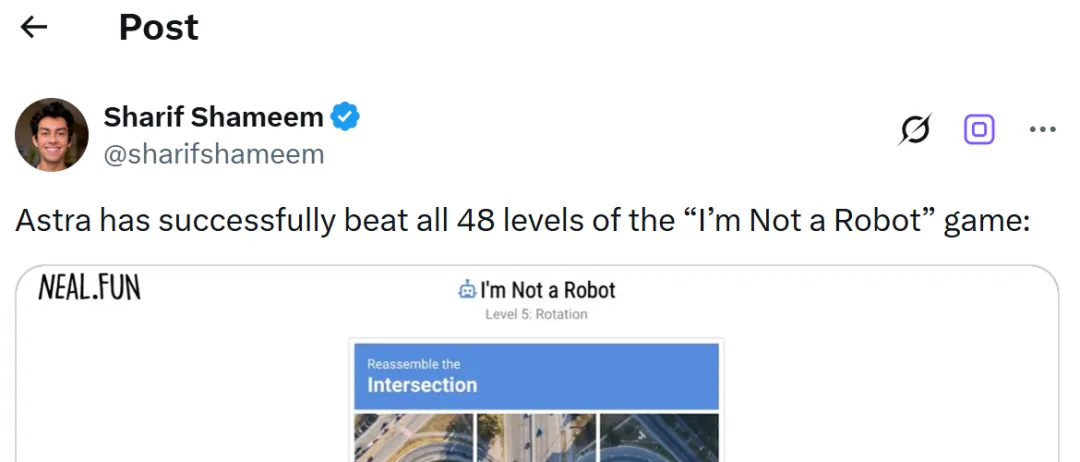
On September 7, 2026, Sharif Shameem of OpenAI Labs demonstrated GPT-6 Astra successfully completing all 48 levels of the ‘I’m Not a Robot’ web challenge. This marks a concrete advancement in GUI Agent capabilities for dynamic interactive environments. The demo used a private harness, and Astra is not publicly available for testing. Official benchmark scores on ScreenSpot-Pro and OSWorld 2.0 are the only publicly comparable metrics.
Key performance metrics:
- ScreenSpot-Pro: 92.7% (GPT-5.6 Sol: 76.9%)
- OSWorld 2.0: 72.6% (GPT-5.6 Sol: 65.7%)
- Simulated task duration: ~40 minutes (GPT-5.6 Sol: ~75 minutes)
Technical Breakthrough and Closed-Loop Architecture
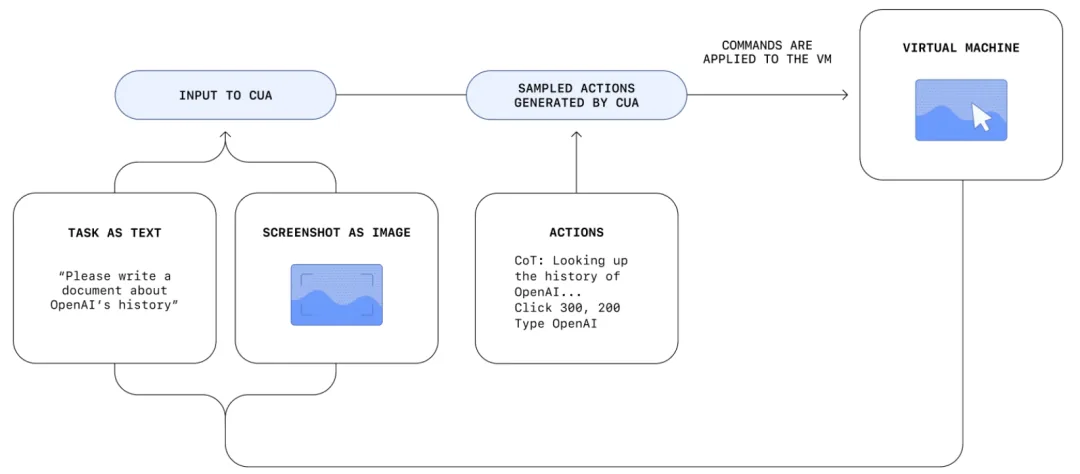
Astra demonstrates a complete perception-action loop rather than isolated image recognition:
- Visual Understanding: Parsing screen content to identify semantic objects (buttons, vehicles)
- Spatial Grounding: Mapping semantic targets to concrete mouse coordinates
- State Estimation: Inferring internal browser state from visual feedback + action history
- Action Execution: Generating clicks, drags, or keyboard inputs
- Failure Verification: Comparing expected vs. actual page state post-action
Specific challenges in the demo combined dynamic elements: parking required maintaining task logic across steps, rhythm control应对 dynamic environments, and visual search integrated multi-frame information.
A counterintuitive insight is the link between speed and stability: Astra’s reduced latency (~40 min vs. 75 min) directly lowers state staleness—the risk that page changes during model inference cause the executed action to act on outdated information.
CAPTCHA Defense Evolution

Astra’s success undermines CAPTCHA’s original premise: visual and GUI manipulation capability is no longer a reliable machine differentiator. Defensive systems are migrating in three directions:
- From visual puzzles → browser signals: Turnstile executes lightweight JavaScript challenges (computational, spatial, API probes)
- From browser signals → server-side validation: Tokens require Siteverify validation, valid for 300 seconds with single-use constraint; frontend modifications are useless
- From human/bot classification → agent identity: Cloudflare Web Bot Auth uses Ed25519 signatures, requiring agents to hold private keys for verifiable authentication
Comparison of CAPTCHA/bot detection approaches:
| Feature | Traditional Image CAPTCHA | reCAPTCHA v3 | Turnstile | Web Bot Auth |
|---|---|---|---|---|
| Validation Method | Image recognition binary | Contextual risk scoring | Client challenge + server verification | Ed25519 request signing |
| Primary Signals | Image complexity | Mouse trajectory, interaction patterns | JavaScript execution | TLS handshake, signature |
| Forgery Resistance | Low (screenshot bypass) | Moderate | High (frontend display useless) | Very high (private key required) |
| Time Control | None | None | 300s expiry | created/expires window |
Practical Recommendations
- Web Developers: Relying solely on visual CAPTCHA for automation mitigation is outdated; migrate to server-side validation or signature-based identity systems
- Security Engineers: Modern bot management requires multi-evidence chains—TLS fingerprints (JA3/JA4), JavaScript environment checks, and behavioral time-series analysis outperform single-point screenshot detection
- End Users: For Agent-based workflows, prioritize permission delegation systems; future Agent Tokens will restrict read/write scope, not merely identify machines
Final Word
Astra’s 48-level clearance isn’t CAPTCHA’s death knell—it’s the dawn of a paradigm shift. As machines achieve stable GUI interaction, web security has shifted from ‘is a robot present?’ to ‘who is authorized, and what are they permitted to do?’. Technology is evolving security from behavioral classification to cryptographic identity and fine-grained authorization infrastructure.