
Core NEWS: Remote MCP Server Goes GA
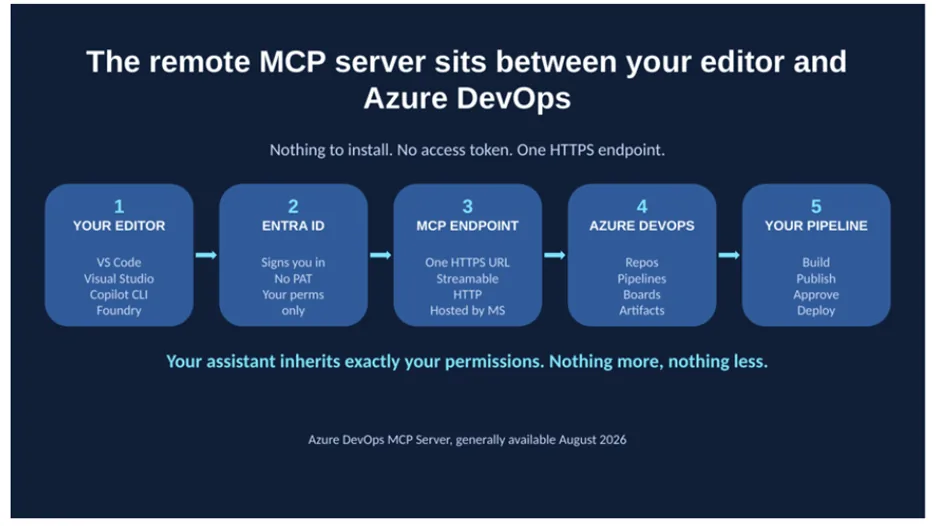
Microsoft has officially launched the Azure DevOps Remote MCP Server, enabling AI assistants to directly access Azure DevOps work items, pull requests, repositories, and pipelines via a hosted endpoint—without installing or running any local services.
Key facts:
- Release date: Late August 2026 (GA)
- Endpoint URL:
https://mcp.dev.azure.com/{organization} - Protocol: HTTP with streaming support
- Authentication: Microsoft Entra ID
- Eligibility: Organizations backed by Entra tenants only; standalone organizations using personal Microsoft accounts are not supported
- Third-party client support: Claude Desktop, Claude Code, ChatGPT, and Cursor are not supported; Microsoft first-party clients work out of the box
Architecture and the Authentication Bottleneck
The remote server follows the Model Context Protocol (MCP) standard. Configuration is minimal—users add a single block to their client’s mcp.json:
| |
Authentication is handled entirely by Entra ID, which yields a key benefit: the AI assistant inherits exactly the same permissions as the developer, no more, no less—aligning perfectly with security teams’ mandate for least-privilege access.
However, this same Entra ID dependency causes the third-party compatibility gap. Dan Hellem, product manager for Azure Boards, Repos, and Wiki, clarified that clients must support dynamic OAuth client registration or client ID metadata discovery via Entra. Claude, ChatGPT, and Cursor currently lack this capability, and Microsoft is working with the Entra team to enable it—though no timeline has been provided.
A critical mismatch emerges: the MCP 2026-07-28 specification has already deprecated dynamic client registration (scheduled for removal after Summer 2027) while prioritizing pre-registered clients and client ID metadata documents. Entra currently supports neither mechanism. Protocol evolution has outpaced identity provider implementation.
Support Status and Local Fallback

Currently supported clients (all Microsoft first-party tools):
- Visual Studio Code + GitHub Copilot
- Microsoft Foundry (via tool catalog)
- Copilot Studio
- Visual Studio
- GitHub Copilot CLI
- GitHub Copilot app
Teams unable to use the hosted service can still run a local MCP server. Microsoft commits to maintaining functional parity between local and remote implementations during Entra’s adaptation period. Recent updates have already aligned local toolsets with the remote API surface.
| Deployment | Advantage | Supported Clients | Operational Cost |
|---|---|---|---|
| Remote MCP Server | No install/configuration, no credential management | VS Code + Copilot, Microsoft Foundry, Copilot Studio, etc. | Minimal |
| Local MCP Server | Broader compatibility, works outside Entra tenant | Third-party clients (Claude Code, Cursor, etc.) | Full ownership required |
Real-World Recommendations
Adopt immediately if:
- Your entity uses Entra ID to manage Azure DevOps organizations
- Your primary tools are VS Code, Visual Studio, or the Copilot suite
- You seek centralized security control and reduced operational overhead
Wait before migrating if:
- Your team relies on Claude Code, Cursor, or other non-Microsoft AI clients
- Your Azure DevOps organization is tied to a personal Microsoft account instead of a corporate/school Entra tenant
- You require self-hosting for compliance or offline scenarios
Final Words
Azure DevOps’ remote MCP server reflects Microsoft’s push toward “zero-config AI integration”—a pragmatic path to lowering adoption friction. Yet it exposes a fundamental truth: standardized protocols cannot override identity-layer vendor lock-in. MCP dictates how tools are discovered and invoked, but cannot compel Entra, Google Identity, or others to open their authentication layers. Microsoft’s continued investment in local server maintenance further confirms the current gap stems from technical readiness—not deliberate strategy—and reinforces that this is a interoperability challenge in progress, not a policy choice.