
Did Chinese Tech Giants Start Regretting Their AI Bets?
On August 19, a question topped Zhihu’s hot list: “Are Chinese tech giants starting to regret going all-in on AI?”
One of the top-voted answers nailed it: “Regret? No. But the pain? Oh, it’s very real.”
Tencent’s Q2 free cash flow turned negative for the first time — minus 13.8 billion yuan. Alibaba posted a full-year free cash flow outflow of 46.6 billion yuan for FY2026. Baidu’s AI revenue now accounts for 50% of its total, yet its stock price dropped 13%.
The numbers on paper are ugly. But I think “regret” is the wrong word. These giants have long since passed the “whether or not to pursue AI” stage. The real question now is: if they don’t, will they even survive in three to five years?
In this article, I’ll first crunch the financial data to lay out the real numbers, then explain where the money actually went and why these companies can’t afford to stop.
1. Laying Out the Ledger
Let’s start with the latest AI-related capital expenditures and cash flow figures from China’s top tech giants:
| Company | Latest CapEx | YoY Change | Free Cash Flow | Notes |
|---|---|---|---|---|
| Tencent (2026 Q2) | 52.78B CNY | +176% | -13.8B CNY (+37.6B after excluding compute prepayments) | First negative in nearly 20 years; H1 cumulative 84.72B |
| Alibaba (FY2026) | 126.063B CNY | +46.63% | Outflow of 46.609B CNY | Previous year was an inflow of 73.87B; cash reserves 520.8B |
| Baidu (2026 Q2) | 11.4B CNY | +199.7% | Outflow of 7.95B CNY | AI revenue accounts for 50%, stock down 13% |
| ByteDance (2026, supply chain estimate) | Up to ~$70B | — | Not disclosed | ~25B in 2025 → potentially $100B by 2027 |
Source: Earnings reports and conference calls from Tencent, Alibaba, and Baidu, as well as Shenzhen Commercial Daily, Blue Whale News, and长江证券 research reports.
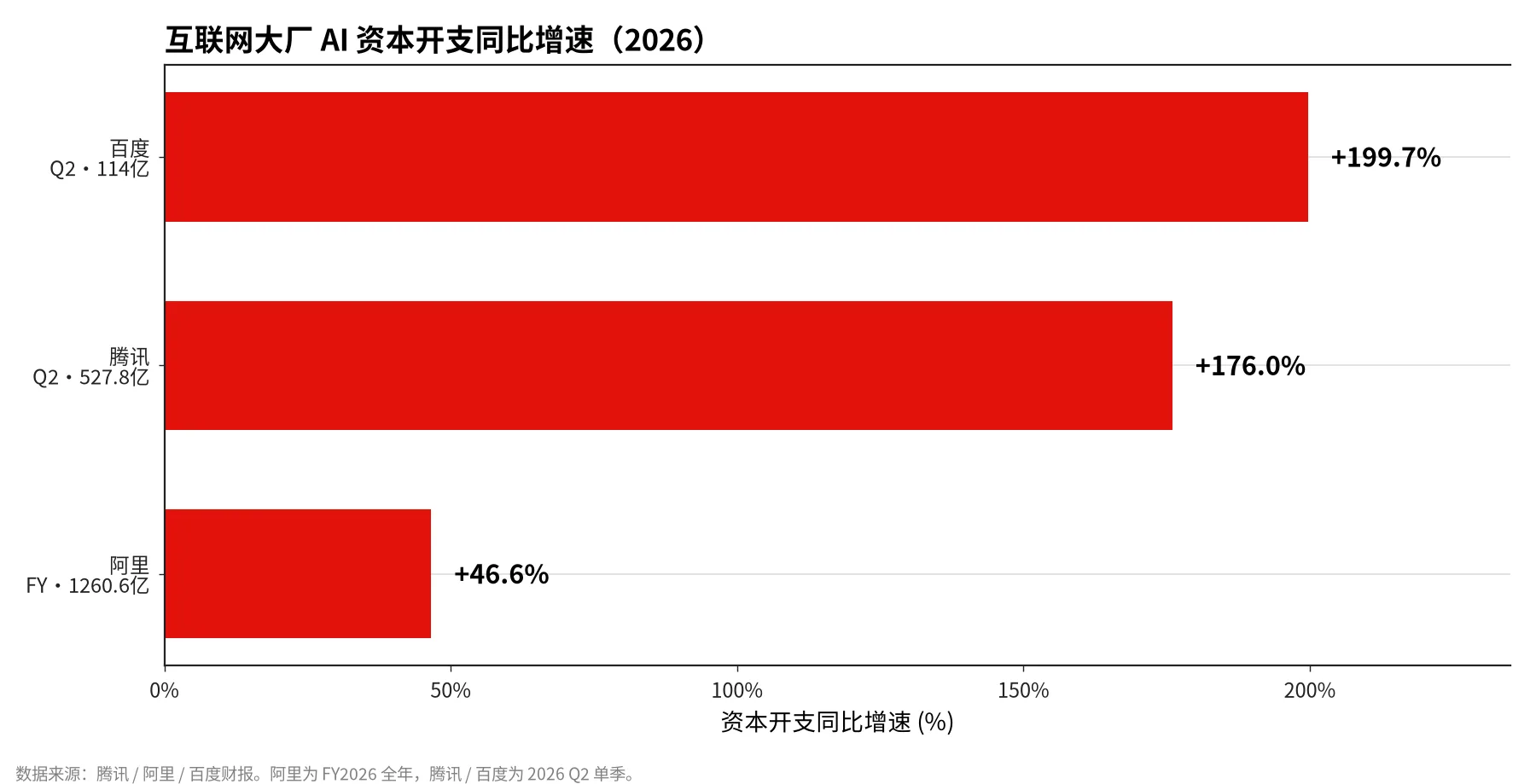
One detail deserves attention: Tencent’s reported free cash flow of -13.8B yuan looks alarming, but if you strip out “compute procurement prepayments,” it’s actually +3.76B. On the balance sheet, non-current prepayments surged from 24.5B at the start of the year to 91.2B — that’s the compute prepayment in plain sight. In other words, the money wasn’t burned; it was parked upfront for compute capacity.
Tencent’s net cash position plummeted from 146.86B at the end of Q1 to 58.2B, which looks like “running out of money,” but total cash reserves still sit at 511.1B, with the additions mainly coming from low-interest RMB borrowings at 0.75%–3.5%. This is deliberate leverage to buy compute — not a broken capital chain.
2. Where Did the Money Go — The Value Chain Is Shifting Upstream
The world’s nine largest cloud providers will collectively burn through roughly $830 billion this year (up 79% year-over-year), with 40%–50% of that increase driven by rising chip prices. North America’s five hyperscalers are expected to spend $785 billion on CapEx in 2026, and their CapEx-to-operating-cash-flow ratio has skyrocketed from 46% in 2024 to over 110% — meaning the entire industry is seeing free cash flow turn negative.
So where did it all go? NVIDIA, TSMC, optical module makers, data centers, power infrastructure, and top-tier researchers. These are all the more certain “selling shovels” businesses. AI scientists command monthly salaries of 130,000 yuan; one company reportedly offered its chief scientist a package worth 124 million. ByteDance was rumored to have offered nearly 100 million to poach talent. The money is flowing upstream along the value chain.
What’s even more uncomfortable is “pouring money in with no visible return.” Meituan CEO Wang Puzhong put it bluntly: many companies have thrown massive sums at AI and ended up with nothing but noise. Token consumption has surged, but the logical link between investment and experience improvement hasn’t yet been established.
But the claim that “all the money went to semiconductors and model companies” is only half true. In Alibaba’s Q4 FY2026, the Cloud Intelligence Group posted revenue of 41.626 billion yuan, up 38% year-over-year, with AI-related product revenue at 8.971 billion yuan — marking 11 consecutive quarters of triple-digit growth. Cloud and model services are genuinely generating revenue.
3. The Most Distinctive Variable: DeepSeek
China has a variable that the US doesn’t — DeepSeek trained competitive models with relatively modest resources, sending a clear signal across the industry: spending more doesn’t automatically mean better results.
That signal is already shaking the “bigger spend = bigger moat” narrative. In late July, DeepSeek slashed the input cache hit price across its entire V4 series to one-tenth of the launch price — V4-Pro went from 1 yuan per million tokens straight down to 0.1. Shortly after, OpenAI dropped the price of its entry-level Luna model by 80% on July 30. The giants have shifted from “mindlessly burning cash” to “running the token math.”
This raises a genuine question: if you can catch up to 90% of the performance at one-tenth the cost, then what exactly are these giants buying by investing hundreds of billions in building their own foundational models — capability, or simply a ticket to enter the game?
4. Valuation Regime Shift: From Light-Asset Platforms to Heavy-Asset Compute Factories
This is the real essence of the “AI capital博弈.” Internet giants are being forced from “light-asset platforms” into “heavy-asset compute factories,” and their valuation logic is shifting from “earning from existing moats” to “betting on incremental growth.”
Here’s a sharp way to put it: AI isn’t the savior of these giants — it’s the catalyst for a valuation reset. The big players are trapped in an “impossible triangle” — they can’t simultaneously maintain a high PE valuation, stable cash flow returns, and AGI-level technological breakthroughs.
Take Zhipu as a reference point: a company with 2025 revenue of 724 million yuan, a net loss of 4.718 billion, and R&D spend of 3.18 billion (4.4× its revenue) briefly saw its market cap touch 1 trillion Hong Kong dollars. Why? Because of its scarce identity as the “first large model stock.” The moment Kimi K3 launched and that scarcity evaporated, 300 billion Hong Kong dollars in market cap vanished in two trading days. When scarcity fades, the market cap finds its true level on its own.
5. So, Do They Regret It?
No. When these giants bet on AI, they weren’t buying current-period revenue. They were buying three things:
- Defense: If you don’t invest and your competitor does, three years from now their search, recommendations, and ad efficiency will be 20% better than yours — and your market share will be quietly eaten away.
- A ticket for cloud business: Enterprise clients now ask about AI capability as their first question when buying cloud services. Without it, you don’t win new orders.
- The next generation’s right to exist: Skip AI, and in three to five years you may not even be around.
The real winners at this stage are the “shovel sellers” and “land rights sellers” — compute providers, semiconductor companies, and model firms. The giants are wagering on one thing: whether they can transition from “buying shovels” to “striking gold.” Until they strike it, the pain is an unavoidable tuition fee.
References
- Gambling on AI: Chinese Internet Giants (Shenzhen Commercial Daily, Tencent earnings breakdown)
- Tencent’s 84.7B CapEx: Opportunities and Risks (Blue Whale News)
- China’s AI Compute Chain: Model Progress × CSP CapEx Acceleration (长江证券 Research)
- Are Internet Giants Regretting AI Bets? (Zhihu · Xiaohézi: Defense/Efficiency/Cloud)
- Are Internet Giants Regretting AI Bets? (Zhihu · Chen Mo: Earnings Clarity)
- How Cash-Strapped Is Zhipu? (Zhihu · Kuaima Financial Media)
- Is Zhipu’s Trillion-Market-Cap a Scarcity Illusion? (Zhihu · Bowang Finance)
- From OpenAI’s Price Cuts to China’s AI Investment Strategy: Efficiency First (Xueqiu)