
The AI Course That Went Viral Overnight
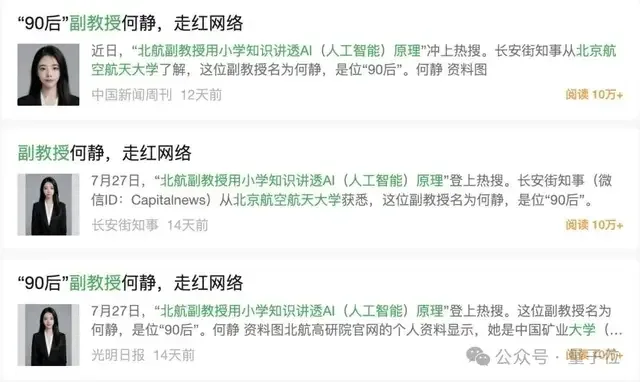
He Jing, a 35-year-old associate professor at Beihang University, rose to fame on Bilibili for explaining AI applications in accessible terms, thrusting a university educator into the crosshairs of public discourse, science communication, and academic evaluation. Her videos cover generative AI principles, AIGC applications, Agent development, AI integration with CAD, AI-powered PPT creation, OpenClaw deployment, and more. She often likens generative AI to a “kitchen” and different large language models to chefs specializing in different cuisines, earning netizens’ praise that “even a three-year-old could understand her.”
What truly ignited the fire was a 2025 October clip from her MOOC, reposted to short-video platforms, racking up over 2 million views almost overnight. He Jing said her highest-viewed video in the previous five years had barely topped one million, making her realize her reach had already spilled beyond the classroom. She then opened a Bilibili account, reorganizing what had been scattered software demos and lecture snippets into AI tutorials designed for the general public.
From Coursework to Credentials Under Scrutiny
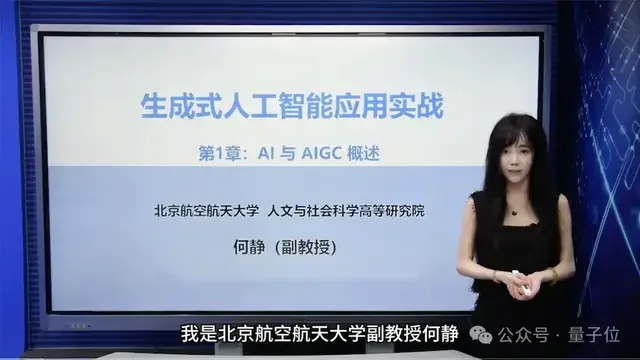
Fame arrived with its share of skepticism. The conversation quickly shifted from teaching quality to her appearance, educational background, and research output. Public records show He Jing earned her bachelor’s degree from Sichuan Agricultural University, her PhD from China University of Mining and Technology (Beijing) in geographic information engineering, and completed a postdoctoral fellowship in journalism and communication at Tsinghua University. Her Beihang University faculty profile lists over 40 papers and more than 20 funded projects.
The key controversies surrounding her center on:
- Interdisciplinary background: Critics call her trajectory a “four-time pivot”; she responds that her pre-PhD studies were largely foundational, and the real跨界 (crossing over) began when she moved from geographic information engineering into journalism and communication.
- Volume of projects and publications: Some question how a young associate professor can shoulder so many projects. He Jing argues that research on public opinion and AI carries strong time sensitivity—subjects can lose relevance as technology evolves rapidly, and some areas indeed demand faster responses to real-world developments.
- Academic evaluation criteria: She stresses that talent cannot be judged solely by the “standard path” of the previous generation; aligning rare research directions with practical needs matters just as much.
“Public opinion” here refers to the formation, diffusion, and evolution of public sentiment on digital platforms, often requiring an interdisciplinary lens drawing on data analytics, communication studies, and governance.
Rewriting AI Science Communication Through a Communication Studies Lens
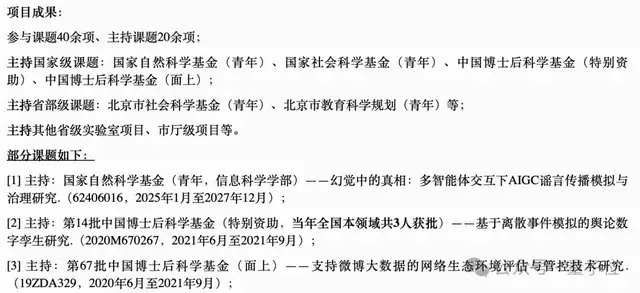
He Jing attributes her approach to science communication to her interdisciplinary background. She says her STEM training taught her to analyze the world, while her journalism and communication studies taught her how to converse with an audience: the starting point of any lecture isn’t “what do I want to say,” but “what does the listener need and what can they actually understand.” This explains her insistence on low-barrier AI instruction.
She recalls being discouraged in 2016 when she first encountered AI and found professional explanations impenetrable—until she stumbled upon a well-made, accessible video that finally made the key concepts click. Since then, she approaches each tutorial assuming her audience is the person she once was: unfamiliar with AI, perhaps even intimidated by it.
Beyond Bilibili, she also wields AI tools to engage with public discourse. In response to online rumors, she produced an AIGC short film titled “Rumors Come True,” writing absurd gossip into the script. AIGC, or “AI-Generated Content,” refers to text, images, audio, or video produced by AI models. She believes that in an algorithm-driven media landscape, fact-checking often can’t outrun more sensational rumors—and AI gives everyday creators new ways to push back.
AI Tools in Content Operations
He Jing doesn’t just talk about AI—she uses it in her own content operations. She revealed that some of the routine replies in her comment sections and direct messages are already handled by agents; OpenClaw assists with replying to certain content. She still logs in periodically to step in personally whenever a question requires a human touch. Agents, in this context, are software proxies capable of executing multi-step tasks autonomously based on instructions.
On the tools front, she tests a variety of options, including Claude Code and Codex; during a Bilibili livestream, she even used Codex to reply to comments in the chat. These practices demonstrate that her AI science communication goes beyond conceptual explanation—it’s embedded in real workflows, platform interactions, and content production.
Looking at her public video topics, the scenarios where everyday users most frequently turn to AI are research, productivity, and creativity: some want help organizing literature and reference materials, others gravitate toward efficiency tools like PPTs and documents, and still others use AI for video and design. For science communicators, the real challenge isn’t merely introducing tools—it’s situating them within concrete tasks so that non-technical users know when to reach for them, how to get started, and how to troubleshoot when things go wrong.
The Next Stop on AI’s Road to Mainstream Adoption
He Jing’s viral moment is more than a personal milestone; it reflects the emerging needs of an audience entering the practical learning phase of AI. Users no longer lack concepts—they lack actionable, transferable, clearly explained pathways.
Across the industry, AI education is shifting from expert-centric narratives to scenario-centric ones. Whoever can translate complex models into workflows that ordinary people can understand and operate will be the one to win attention and trust. The He Jing case also serves as a reminder for universities and platforms alike: AI science communication brings influence, but it also magnifies personal controversy. What will truly matter in the future isn’t just making AI sound exciting—it’s enabling more people to integrate AI stably and affordably into their learning, research, and work.