Today’s GitHub trending champion was suddenly taken by a pure ewriter project — it doesn’t write code, it writes videos.
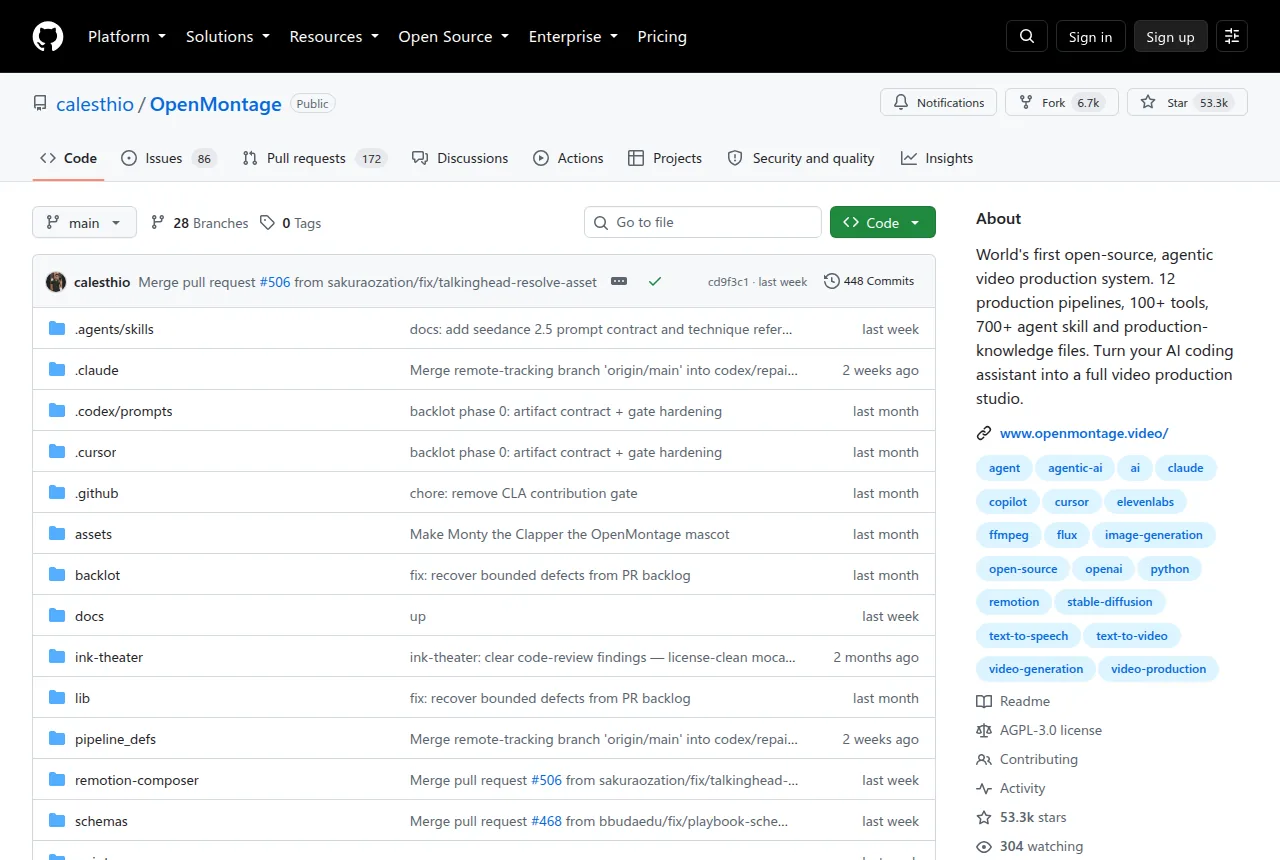
OpenMontage defines itself as “the world’s first open-source agentic video production system.” Instead of just helping you write a few lines of script or touch up a few images, it acts like a real director: from ideation and scriptwriting to asset generation, editing, compositing, scoring, and voiceover — it autonomously completes the entire video end to end. As of press time, the project has earned 53,340 stars, with 1,144 new stars in a single day — a truly explosive surge in popularity.
1. What It Can Do: Not Just “Animated Stills” — Real Video Production
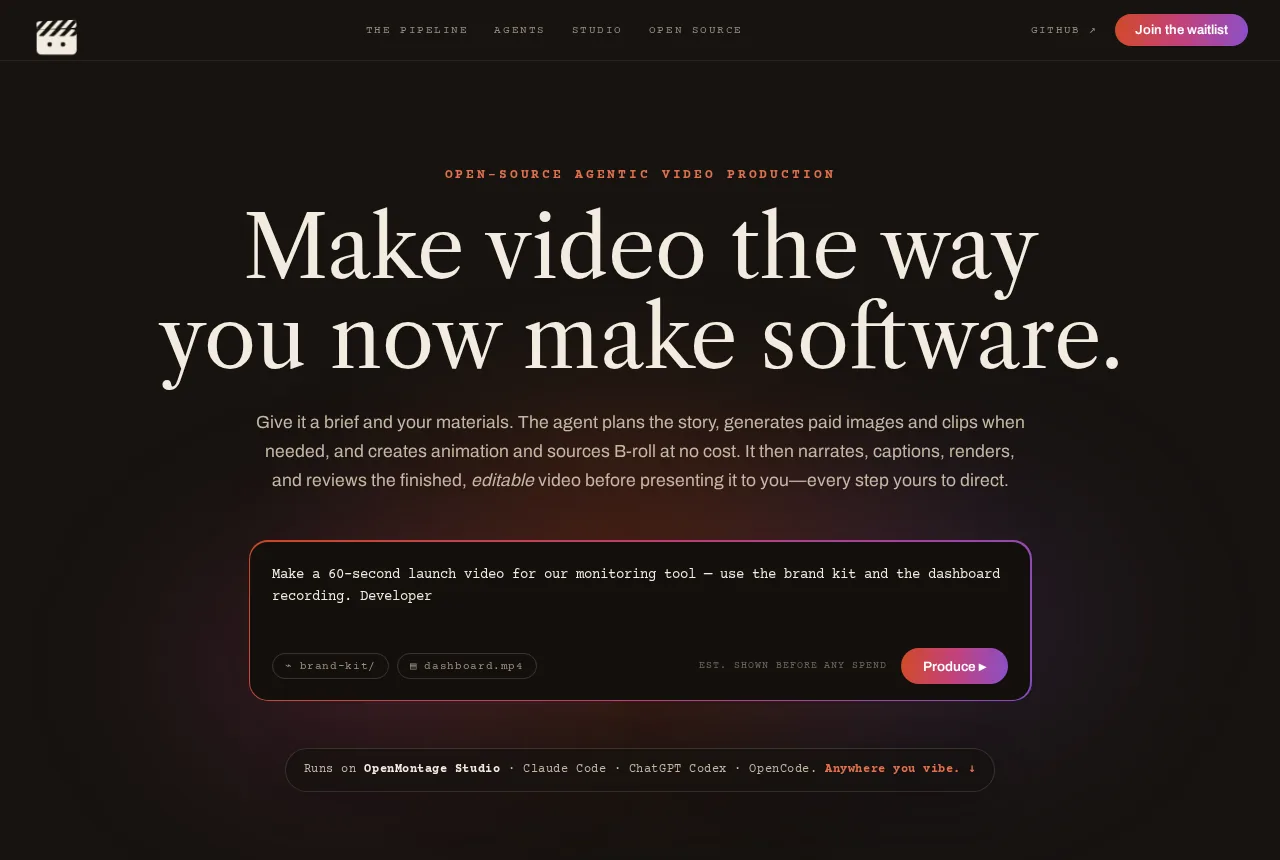
OpenMontage’s key breakthrough is distinguishing between “animated stills” and “video”: it isn’t satisfied with simply interpolating a few static frames into motion. Instead, it actually taps into footage libraries, retrieves real moving clips, and edits them together along a story line — ultimately outputting a finished piece that can actually be published.
It ships with 12 production pipelines, 100+ tools, and 700+ agent skills and production knowledge files. It can automatically extract the pacing and structure of reference videos from platforms like YouTube and TikTok, then reconstruct new works around your topic.
2. Getting Started: Launch a Video Pipeline in Three Steps
Installation is extremely lightweight. The project is written in Python, with main dependencies including remotion (for rendering), ffmpeg (media processing), and various model SDKs. It can be deployed locally or connected to cloud services.
The basic workflow has three steps:
| |
The system returns a complete pipeline report: concept drafts, tool-call paths, estimated costs, and a lead teaser clip. Once confirmed, it proceeds into full production.
3. The Technical Core: Why Can It Act as a “Director”?
Agentic workflow orchestrator: Not the single-turn Q&A of GPT-4 Plus style tools. OpenMontage has a built-in cast of role-based agents — screenwriter, visual effects, editor, voiceover artist — that negotiate with each other to form a clear creative execution chain. For example, once the screenwriter produces a storyboard script, the VFX agent matches available footage from asset libraries or calls generative models to fill in missing segments.
Real footage retrieval and splicing: Unlike the fully generative path, it defaults to searching free stock footage libraries (such as Pixabay) for real motion clips, supplemented by a small amount of generated content. This hybrid strategy dramatically cuts costs: the “Last Banana” case cost only $1.33.
Modular production pipelines: Each pipeline corresponds to a video genre — explainer, advertisement, documentary, animation, and so on — each configured with its own dedicated toolchain and agent combination. The documentary pipeline, for instance, calls specialized tools like speech synthesis, map generation, and time-series visualization, while the animation pipeline emphasizes character motion consistency and soundtrack synchronization.
Deep integration with the Remotion rendering engine: Final compositing uses Remotion (the React video orchestration framework from Facebook), which guarantees code-level editability (change it and it plays) while supporting export to standard MP4.
4. Who Should Use It?
- Content creators: Solo bloggers and small teams can produce professional-quality videos at low cost, skipping the combined time cost of storyboarding, shooting, and editing
- AI experimenters: Tech enthusiasts who want to study multi-agent collaboration and video-generation pipeline architecture get a complete, runnable reference implementation
- Education and science-communication organizations: Video is a highly efficient vehicle for knowledge transfer; this tool enables rapid batch production of teaching materials
Among comparable projects, Runway ML, Pika, and ElevenLabs each excel at generation, animation, and voice respectively — but each only solves a single point. OpenMontage’s advantage is chaining them into a “complete pipeline,” open-sourced under AGPLv3, enabling genuinely free reuse and secondary development.
- Controllable costs: Most videos are completed in the $1–5 range, far below manual outsourcing or commercial subscriptions
- Transparent and auditable: Every tool call, model choice, and cost item is fully traceable
- Extensible: Adding a new agent skill only requires dropping in a knowledge file — no changes to the core engine
5. Final Thoughts
What OpenMontage brings is not just a leap in video production efficiency, but a shift in the paradigm of content creation: from “people adapting to tools” back to “tools serving people.” When a high school student can generate a science documentary with natural language, when a startup can test a short-video concept for $1, the concept of _VIDEO AS CODE** finally has a real-world anchor.
By the time you finish reading this article, it may already have produced its 10,000th video — driven by human instruction, completed without the AI ever being felt.