
Anthropic Announces Autonomous Discovery of ART Enzyme System by Claude
- New Discovery: Array-Related Reverse Transcriptase (ART) system found in bacteriophages
- Key Feature: DNA repeat structure similar to CRISPR but without cas genes, representing a completely novel enzyme family
- Accessibility: Preprint paper published; peer review pending
Multi-Agent System Operation: 949 AI Agents in 21.5 Hours
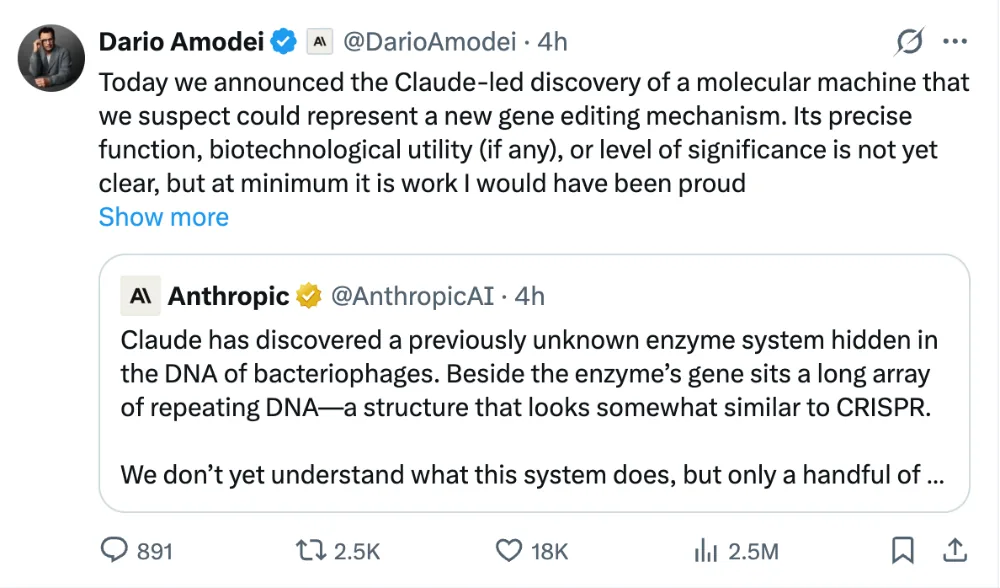
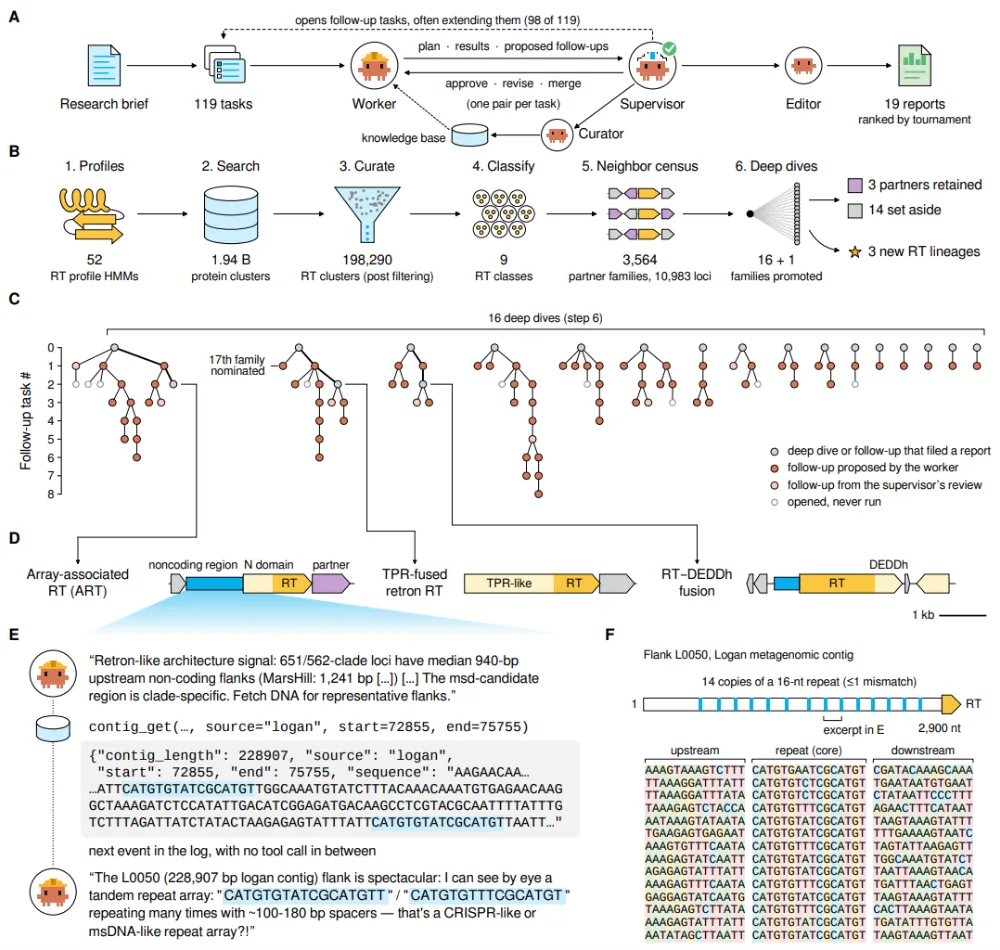
Anthropic’s research team deployed a multi-agent system powered by Mythos 5, with agents assigned roles of executor, reviewer, recorder, and editor. The task included 119 subtasks across 949 agent conversations, consuming 215.6 million tokens over 21.5 hours with no human intervention.
The agents executed 7,578 shell commands, conducted 696 database queries, and performed 131 literature reviews, ultimately producing 19 reports that identified three novel RT-associated systems and three new RT lineages.
The critical unexpected discovery came when an executor agent rejected initially filtered candidate genes and flagged an unusual RT gene for follow-up. The reviewer then instructed checking the upstream non-coding region, where the agent directly ingested DNA sequence and reasoned in natural language about a “tandem repeat array”—demonstrating the model’s so-called genomic vision capability.
The research separated two internal signals (repeat-signal 1 and 2) in Mythos 5 that activate when reading the repeat array. Mythos 5 achieved 96% recognition rate when reading over 2,000 consecutive nucleotides, while weaker models like Sonnet 5 failed to replicate the discovery.
ART System: Unique Structure Potentially Carrying Multiple RNA Templates
ART is a novel RT family primarily found in jumbo phages, with 95 distinct RT clusters identified, 28 containing detectable repeat arrays. The canonical structure includes:
- A 3-to-21 repeat unit array (0.3–4.1 kb) upstream of RT
- Each unit (15–49 nucleotides) containing a palindromic core
- Variable inter-unit spacer sequences
- A dedicated partner gene downstream
The key counterintuitive finding: ART is transcribed into high-abundance RNA, reaching 8% of total phage RNA at 15 minutes post-infection, yet ART loci contain no cas genes—distinguishing it clearly from CRISPR systems.
Researchers hypothesize that ART operates like retrons but carries an RNA “template library”: the same enzyme complex assembles multiple RNA variants to respond to different triggers.
Recommendations for Practitioners
- Who should act: Genome editing and synthetic biology researchers can monitor ART as a potential CRISPR complement; metagenomic mining teams can adopt the multi-agent framework
- Who should wait: Drug development teams should await experimental validation of ART functionality (catalytic activity, substrate specificity, physiological role) until then, evidence remains limited to sequence analysis and transcriptomics
Final Thoughts
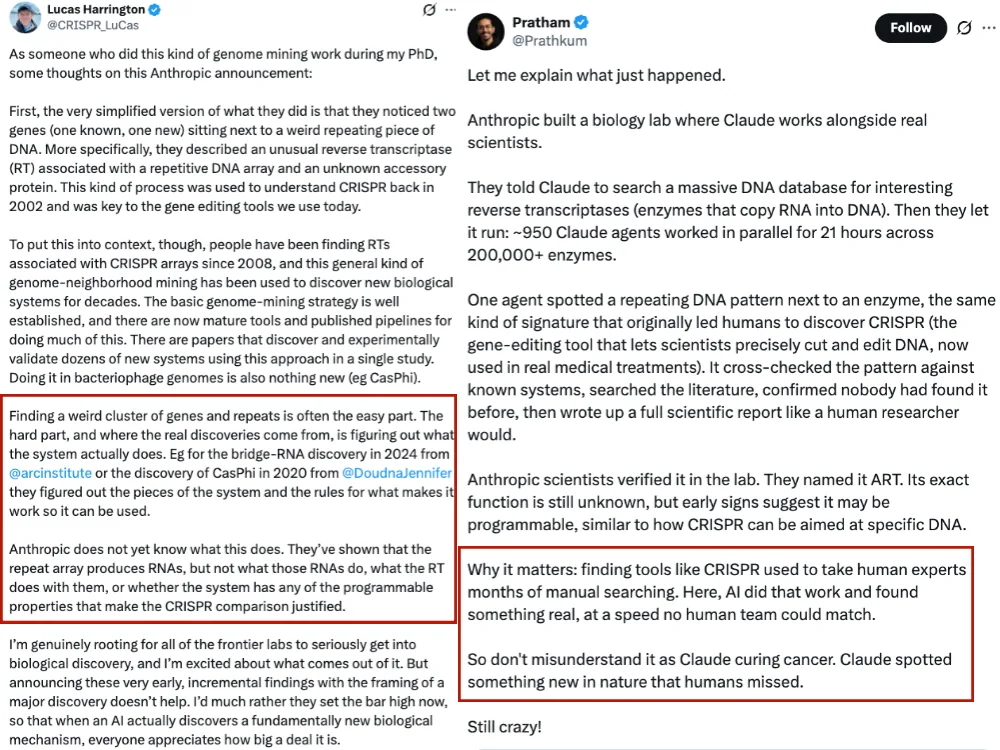
This discovery represents a paradigm shift—AI evolving from task-execution tools toward hypothesis-generation agents. Yet three caveats persist: the discovery relied heavily on stochastic sampling (missed 10/10 re-runs), functional proof remains absent, and the paper has not undergone peer review. The field will await independent replication before assessing true technological potential.