
A suspension dispute turns into a public product fight
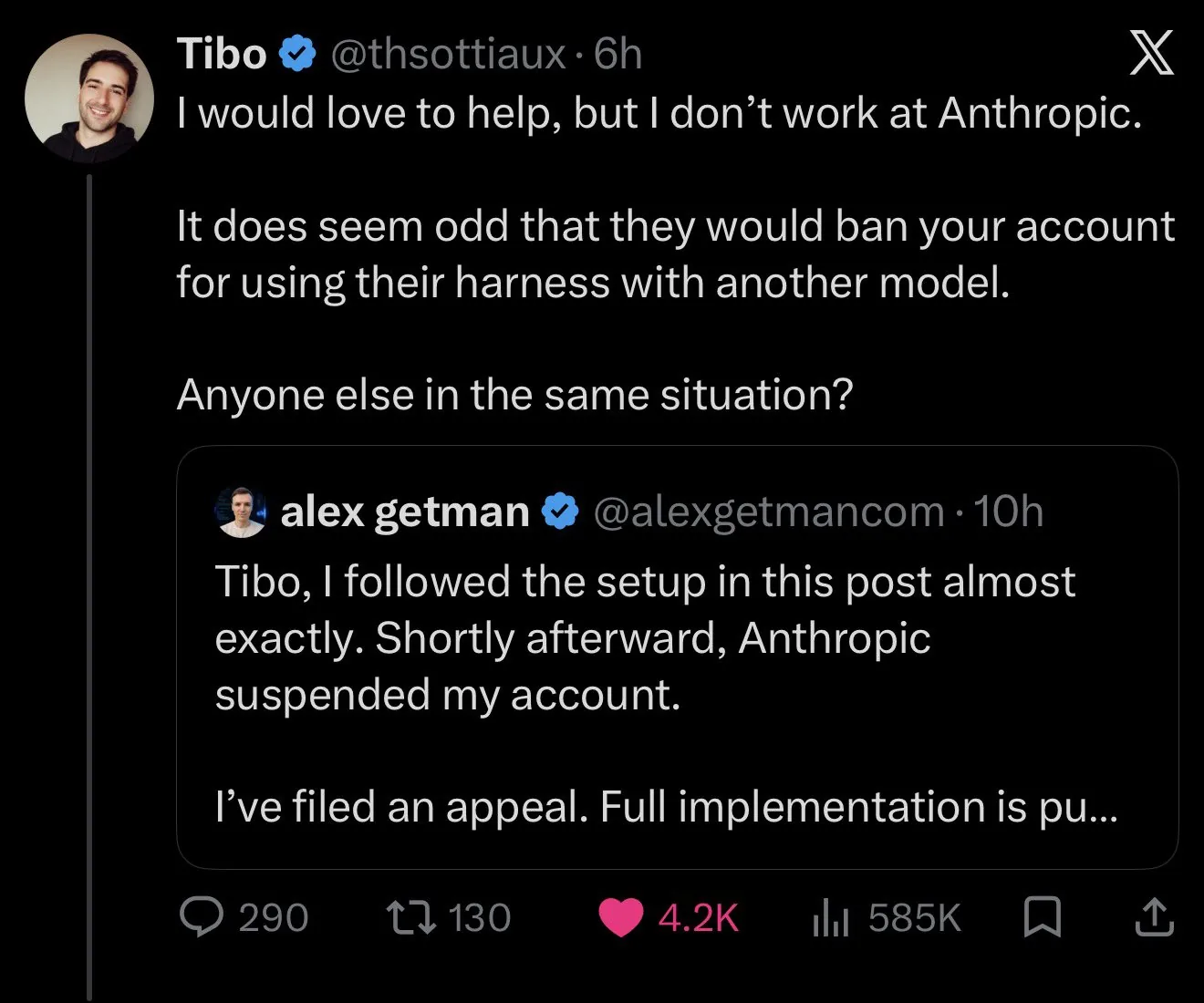
A developer’s Anthropic account suspension after routing GPT-5.6 Sol through Claude Code triggered a public exchange between Thibault “Tibo” Sottiaux, who leads Codex at OpenAI, and Boris Cherny, the lead of Claude Code at Anthropic.
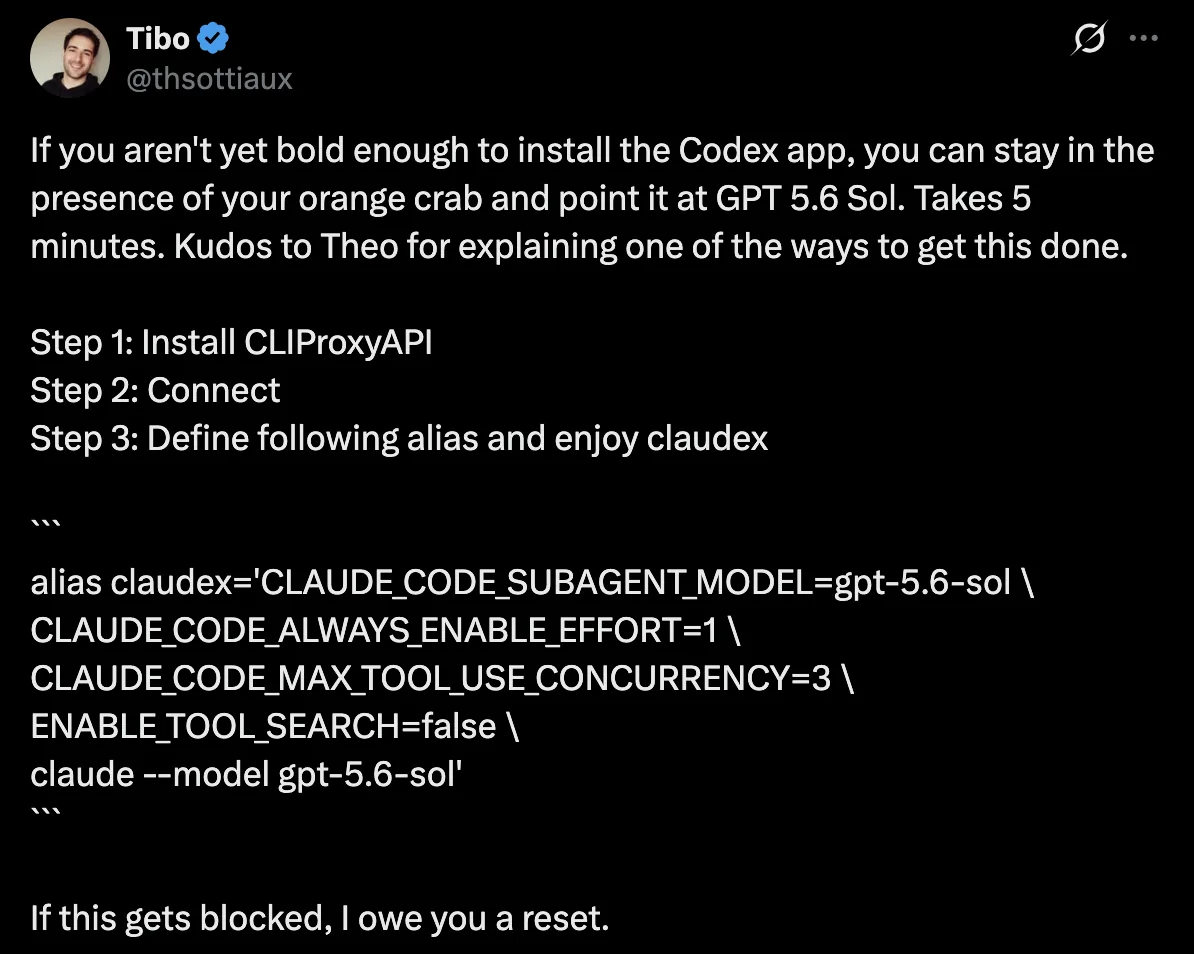
The episode began with a developer discussion on X. On July 12, Theo observed that the same GPT-5.6 Sol model could perform better on some tasks when used inside the Claude Code environment than inside Codex. Tibo then asked about the setup and shared a way to keep using Claude Code while sending model requests to GPT-5.6 Sol. He also joked that if the method led to a ban, he would owe users a reset.
What was actually being modified
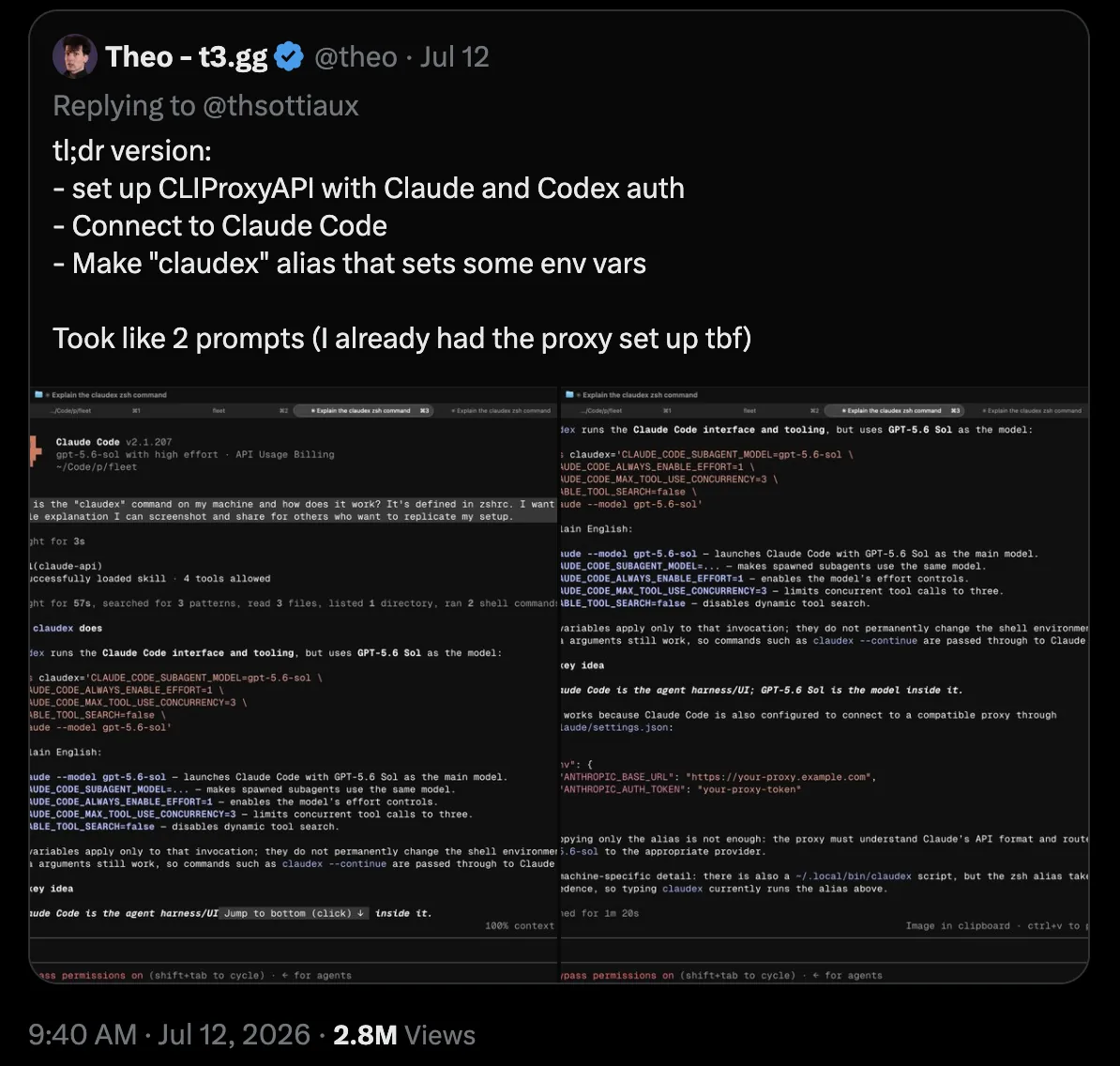
The setup did not alter Claude Code itself. According to Alex Getman’s later GitHub project, the official Claude Code CLI remained in place, while a local CLIProxyAPI running on 127.0.0.1 redirected inference requests to other model providers. The interface, tools, Skills, and permission system of Claude Code stayed intact; the underlying model changed.
That distinction matters because it separates the model from the agent harness. An agent harness is the orchestration layer that connects a model with tools, context, user files, permissions, and the task loop. In simple terms, the model reasons and writes; the harness decides what it can see, which tools it may call, and how work continues across steps.
This is why the dispute became more than a one-off account issue: it raised the question of whether coding agents are mainly competing on model quality or on the surrounding harness.
Anthropic says other models are not the reason
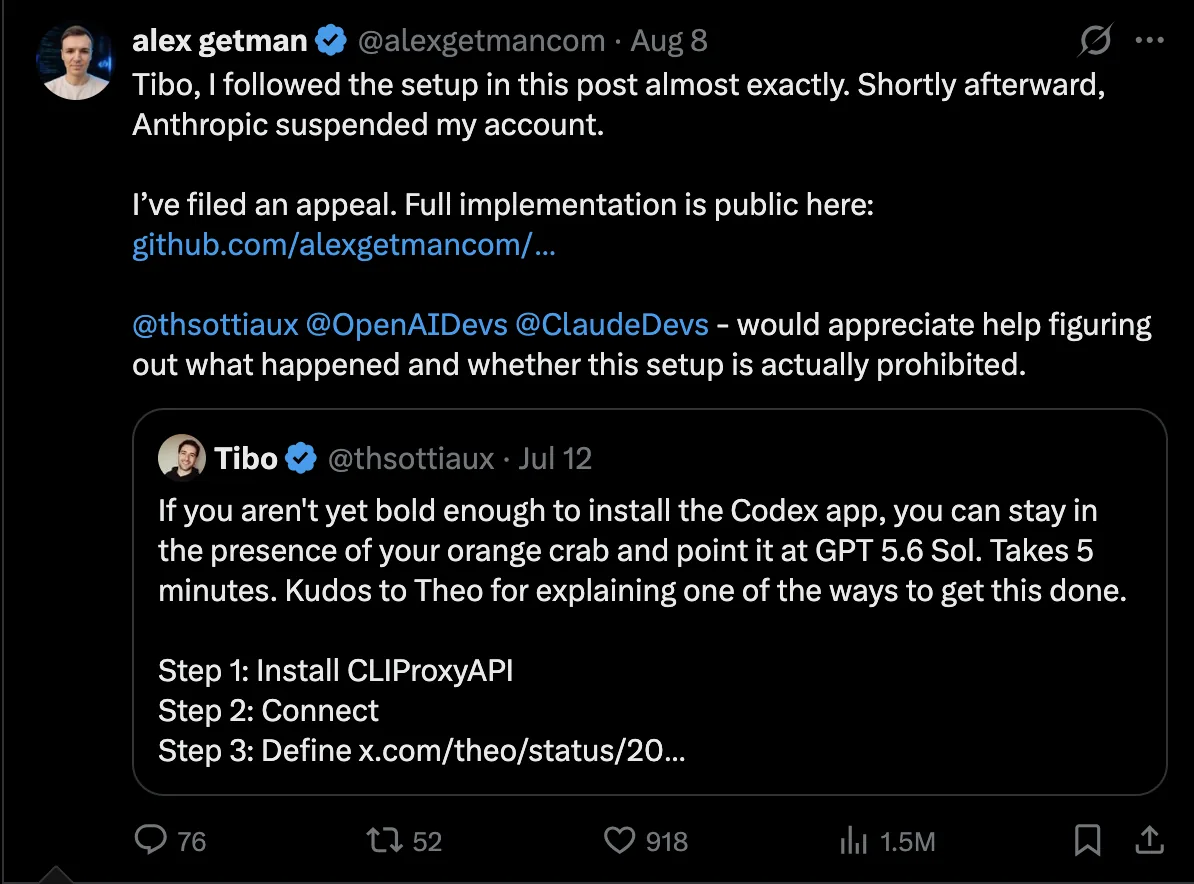
In August, Alex Getman built a similar Claude Code plus GPT-5.6 Sol setup. Soon after testing it, his Anthropic account was suspended with the reason “suspicious signals.” Alex appealed, posted about the case on X, and added a warning to the GitHub project advising others not to copy the setup for the time being. He also made clear that he did not know whether the proxy configuration directly caused the suspension.
Tibo replied that he was willing to help but did not work at Anthropic, adding that it would be strange if users were banned simply for using another model in Anthropic’s harness. Boris Cherny then joined the thread. His first move was a public recruiting jab at Tibo, asking whether he wanted to work at Anthropic, before addressing the actual issue.
Boris said Anthropic does not ban users for running other models in its harness. His initial view was that another account classifier had almost certainly been triggered, and the team was investigating. He later said Alex’s account should be restored and that Anthropic was taking steps to prevent similar cases. The account was subsequently unblocked.
The important facts are limited but clear: Alex’s account was suspended for “suspicious signals”; he did not confirm the proxy setup as the direct cause; Boris denied a policy of banning other models in Claude Code; and the account was restored.
The reset becomes part of the show
After Boris’s recruiting remark, Tibo declined, saying he liked his current team and was looking forward to upcoming releases. He also returned to the product principle behind the exchange: users should be able to choose the model that works best for them, and harness choice should remain open.
Tibo then acted on his earlier promise. Although the case was not confirmed as a deliberate Anthropic ban on third-party models, a user had in fact been blocked. He announced a usage reset for all paid ChatGPT Work and Codex users, framing it as a celebration of GPT-5.6 Sol working across harnesses, including Claude Code, and of his decision to stay at OpenAI.
Sam Altman joined with a light comment on X, but some users were skeptical. Since many weekly quotas had just refreshed on August 8, one user called the reset more “performative” than useful. Tibo replied that he could do another “performative” reset on Monday. Others suggested a more predictable mechanism for storing and using quota recovery instead of surprise resets.
The deeper shift: models and harnesses are separating
The public banter was entertaining, but the strategic signal is more important. Developers are beginning to evaluate models and harnesses as separate layers rather than fixed bundles such as Codex plus GPT or Claude Code plus Claude.
For OpenAI, allowing GPT-5.6 Sol to run in environments such as Claude Code may reduce the lock-in value of its own client, but it also broadens distribution for the model. For Anthropic, if Claude Code’s harness is strong enough that users still want it while using non-Claude models, the harness itself can become a valuable entry point.
The next phase of coding-agent competition will not be only about which model is strongest. It will also be about which harness best turns model capability into real development workflow. Models provide intelligence; harnesses provide the working environment. Once users can mix and match the two, practical productivity will matter more than a single branded stack.