
Release at a glance
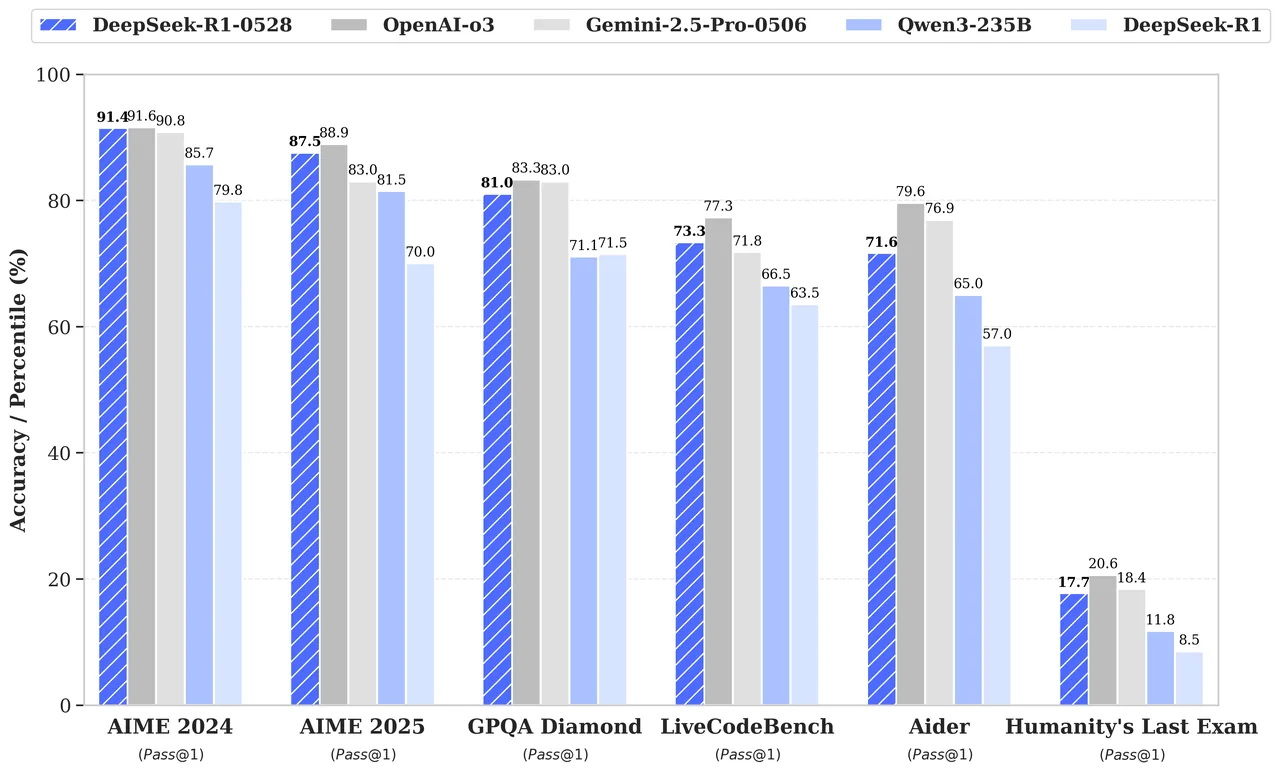
DeepSeek announced DeepSeek-R1-0528 on May 28, 2025, positioning it as an updated R1 model with better benchmark performance, stronger front-end capabilities, fewer hallucinations, and support for JSON output and function calling. The model is available for use at chat.deepseek.com, and DeepSeek says there is no change to API usage. The company also points developers to its Thinking Mode API guide and has published open-source weights for DeepSeek-R1-0528 on Hugging Face.
The announcement is concise and does not include detailed benchmark scores, model size, training data information, inference pricing, or hardware requirements. Even so, the listed changes make the direction of the release clear: R1-0528 is not only a reasoning update, but also an application-readiness update.
What has changed
DeepSeek highlights four improvements in the release:
- Improved benchmark performance: the company says the model performs better on benchmarks, without naming specific test sets or scores.
- Enhanced front-end capabilities: the model is described as stronger in front-end tasks, a category that typically involves interface structure, layout, styling, and interactive code.
- Reduced hallucinations: hallucination refers to a model producing information that sounds plausible but is false, unsupported, or unverifiable.
- JSON output and function calling support: JSON is a common structured data format, while function calling allows a model to trigger external tools or application functions through a defined interface.
Among these, structured output and function calling are especially important for developers. In many real-world AI applications, the challenge is not just whether a model can answer a question, but whether it can produce output that another system can reliably parse. If a model returns inconsistent formats, engineering teams must add extra validation and fallback logic. By adding JSON output and function calling to the R1 release, DeepSeek is moving the model closer to workflow automation and agent-style use cases.
API stability and open weights
DeepSeek states that API usage remains unchanged. For teams already using DeepSeek APIs, this matters because model upgrades can otherwise create integration work: endpoint behavior, request formats, authentication flows, or application logic may need to be revisited. The announcement does not specify migration steps, which suggests that existing users should be able to consult the same API documentation path and test the new model with minimal changes.
The release of open-source weights on Hugging Face is another notable part of the announcement. Open weights allow researchers and developers, subject to the relevant license and platform terms, to inspect, evaluate, and experiment with the model outside the hosted chat interface. In the broader AI ecosystem, open weights often help accelerate independent evaluation and third-party tooling.
However, the announcement itself does not provide deployment requirements, quantization details, context length, or commercial-use conditions. Those details need to be checked in the Hugging Face repository and official DeepSeek documentation rather than inferred from the release note.
A broader iteration pattern
The same news page also links to related DeepSeek releases, including DeepSeek-V3-0324, DeepSeek-V3.1, and DeepSeek-V3.1-Terminus. The page describes V3-0324 as bringing stronger reasoning, front-end development, and tool-use capabilities. V3.1 is described as adding hybrid Think and Non-Think inference, faster thinking, stronger agent skills, Anthropic API support, and 128K context. V3.1-Terminus is described as improving language consistency, reducing Chinese-English mix-ups, and upgrading Code Agent and Search Agent performance.
Taken together, these related notes suggest a consistent product direction: DeepSeek is iterating across reasoning, coding, tool use, agents, API compatibility, and language reliability. R1-0528 fits into that pattern by improving the model’s usefulness in practical developer workflows rather than only emphasizing conversational performance.
Industry outlook
The frontier model market is gradually shifting from headline benchmark competition to practical integration quality. For ordinary users, reduced hallucinations can improve trust in model responses. For developers, JSON output, function calling, and stable API behavior can be more important than abstract capability claims because they determine whether a model can be embedded into production-like systems.
DeepSeek-R1-0528 therefore represents a focused step toward making a reasoning model easier to use in software development and agentic applications. The lack of detailed benchmark numbers means the scale of improvement still needs independent validation. The next test will be real-world usage: whether R1-0528 can generate reliable front-end code, follow structured-output constraints, and coordinate tool calls consistently across practical tasks.