
What happened
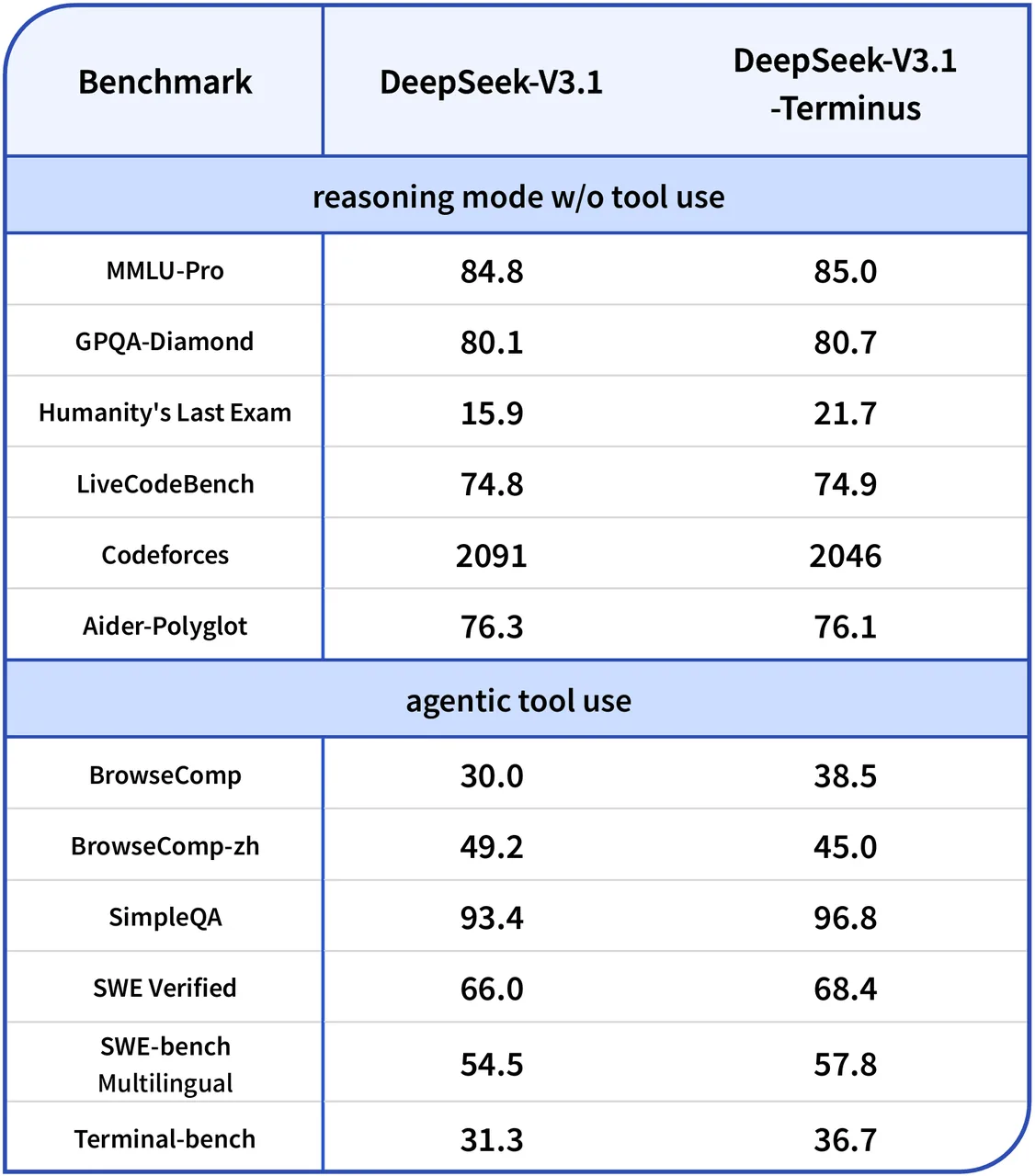
DeepSeek announced on September 22, 2025 that DeepSeek-V3.1 has been updated and renamed DeepSeek-V3.1-Terminus. The version is available through the company’s App, Web interface, and API, and its open-source weights are listed on Hugging Face.
The announcement positions Terminus as an improvement over V3.1 rather than a separate next-generation model. DeepSeek says the update builds on V3.1 while addressing user feedback, with the main focus placed on more consistent language behavior and stronger agent performance.
Main changes
The official note highlights two practical areas of improvement.
- Language consistency: fewer unexpected switches between Chinese and English, and no more random characters in outputs.
- Agent upgrades: improved performance for Code Agent and Search Agent.
An agent, in this context, is a model-driven workflow that can pursue a task across multiple steps and may use tools such as code execution or search. Code Agent refers to programming-related workflows, while Search Agent refers to tasks that rely on retrieving and using external information. For everyday users, mixed-language replies and stray characters are visible quality issues. For developers, agent reliability affects whether a model can be embedded into coding tools, research assistants, and automated workflows without frequent manual correction.
DeepSeek also says V3.1-Terminus delivers more stable and reliable outputs across benchmarks than the previous version. However, the announcement does not name the benchmarks, publish scores, or describe the evaluation method, so the public information confirms the direction of improvement but not its exact scale.
How it connects to V3.1
The same page links back to the original DeepSeek-V3.1 release. According to that earlier description, V3.1 introduced hybrid Think and Non-Think inference, faster thinking, stronger agent skills, Anthropic API support, and a 128K context window.
A context window is the amount of text and conversation history a model can process at once. A 128K context window allows much longer documents or more complex task histories to be included in a single interaction. Hybrid Think and Non-Think inference can be understood as switching between deeper reasoning when needed and more direct answering when the task is simple.
Seen from that background, Terminus looks like a stabilization release inside the V3.1 line. The announcement does not claim a new architecture, new training scale, or a new parameter count. Instead, it emphasizes fixes that matter in daily use: consistent language output, cleaner responses, and more dependable agent behavior.
Availability and developer relevance
The rollout covers DeepSeek’s main access channels: App, Web, and API. For individual users, that means the update can be experienced without managing deployment. For developers and companies, API availability is more important because model behavior can directly affect products built on top of it.
The release of weights on Hugging Face also keeps DeepSeek connected to the open-source model ecosystem. Open weights allow researchers and developers to evaluate, test, and adapt the model within the applicable license and technical constraints. The short announcement does not provide deployment requirements, hardware guidance, or cost details, so those questions need to be checked in the model repository and API documentation.
The page also points readers to later DeepSeek items such as V3.2-Exp and V3.2, but those are separate related announcements. For this update, the central point remains the stability-focused revision of V3.1.
Industry view
The Terminus update reflects a broader shift in large language model competition. Early model releases often emphasized reasoning peaks, benchmark rankings, and headline capabilities. Once models are used through apps, APIs, and agentic workflows, predictable behavior becomes a core feature.
Language mixing, random characters, and inconsistent tool-oriented behavior may not always dominate benchmark discussions, but they are highly visible in real products. A model that is slightly more stable can reduce user friction and lower the amount of exception handling developers need to build around it.
The key question for V3.1-Terminus is therefore not only whether it improves a particular score, but whether users see steadier behavior across multilingual interaction, coding, search, and long-context tasks. For the wider market, capability frontiers will keep moving, but adoption will depend just as much on reliability, transparent iteration, and whether developers can reproduce the promised improvements in their own workflows.