
A Preview Release Centered on Million-Token Context
DeepSeek announced on April 24, 2026 that DeepSeek-V4 Preview is live and open-sourced, positioning the release around cost-effective 1M-token context. The company says 1M context is now the default across official DeepSeek services. Users can try the models on chat.deepseek.com through Expert Mode or Instant Mode, while API access is available from launch day.
Context length refers to the amount of text a model can take into account in a single request. A token is the basic unit a language model processes. A million-token window can reduce the need to split long documents, codebases, conversation histories, or task materials into many separate chunks, which is especially relevant for agents and document-heavy workflows.
Two Models: Pro for Capability, Flash for Efficiency
The release includes DeepSeek-V4-Pro and DeepSeek-V4-Flash. DeepSeek describes the former as the stronger model and the latter as the faster, more economical option.
- DeepSeek-V4-Pro: 1.6T total parameters and 49B active parameters; DeepSeek says its performance rivals leading closed-source models.
- DeepSeek-V4-Flash: 284B total parameters and 13B active parameters; positioned as a fast, efficient, cost-effective choice.
- Both models support 1M context and two modes: Thinking and Non-Thinking.
Active parameters are the portion of a model actually used during a given inference step, a concept commonly associated with mixture-of-experts designs. DeepSeek does not provide a full architecture explanation in the announcement, but the product split is clear: Pro targets harder reasoning, coding, and knowledge-intensive work, while Flash is meant for higher-speed and lower-cost use cases.
Reasoning, Coding, and Agent Workflows
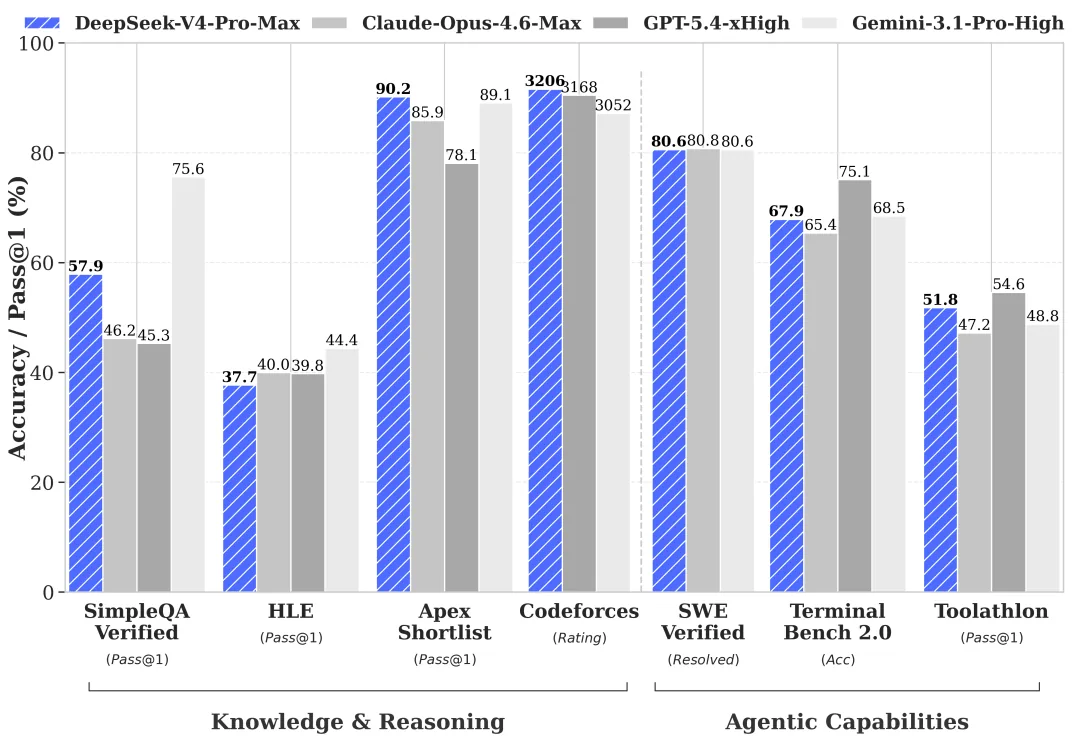
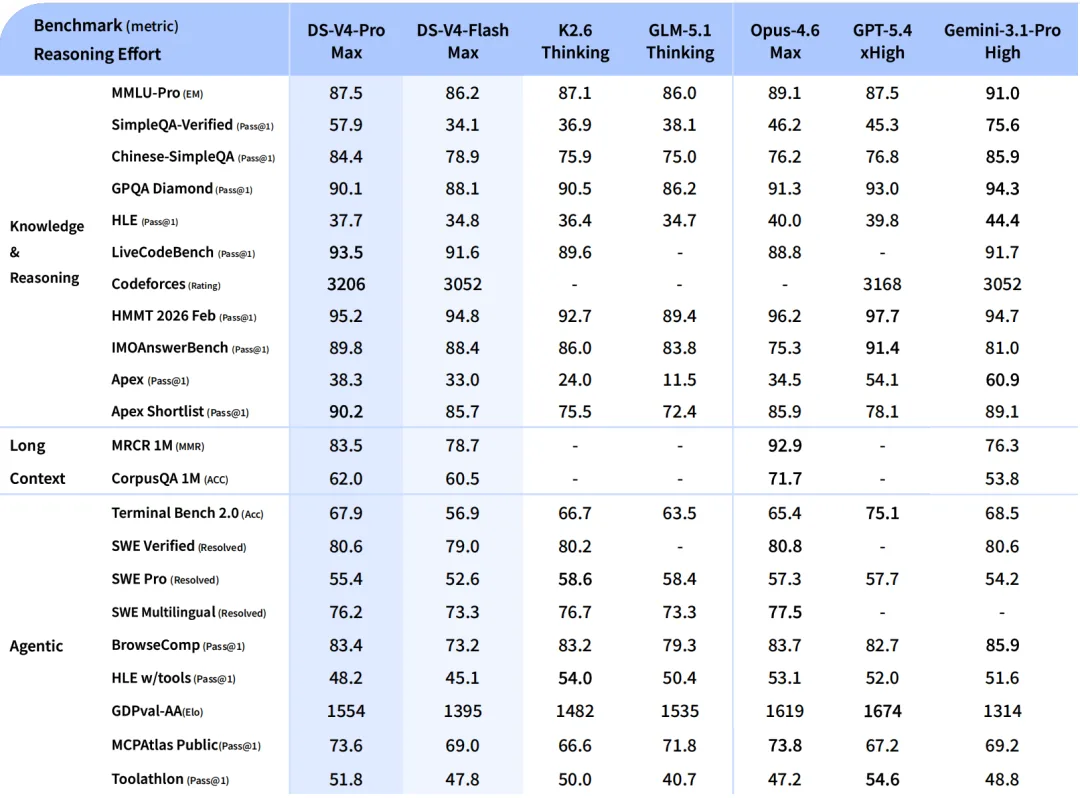
DeepSeek says V4-Pro reaches open-source state of the art on agentic coding benchmarks. Agentic coding means using a model as a software agent that can break down tasks, inspect or edit code, call tools, and carry a development workflow forward. The company also claims V4-Pro leads current open models in world knowledge, trailing only Gemini-3.1-Pro, and beats current open models in Math, STEM, and coding while rivaling top closed-source systems.
V4-Flash is presented as the lightweight counterpart. According to DeepSeek, its reasoning ability closely approaches V4-Pro and it performs on par with V4-Pro on simple agent tasks, while offering smaller parameter size, faster responses, and more cost-effective API pricing. In practical terms, developers may choose Pro for difficult analysis, long code review, and complex reasoning, while trying Flash first for summaries, customer support, routine coding assistance, and batch workloads.
Architecture Claims and API Migration
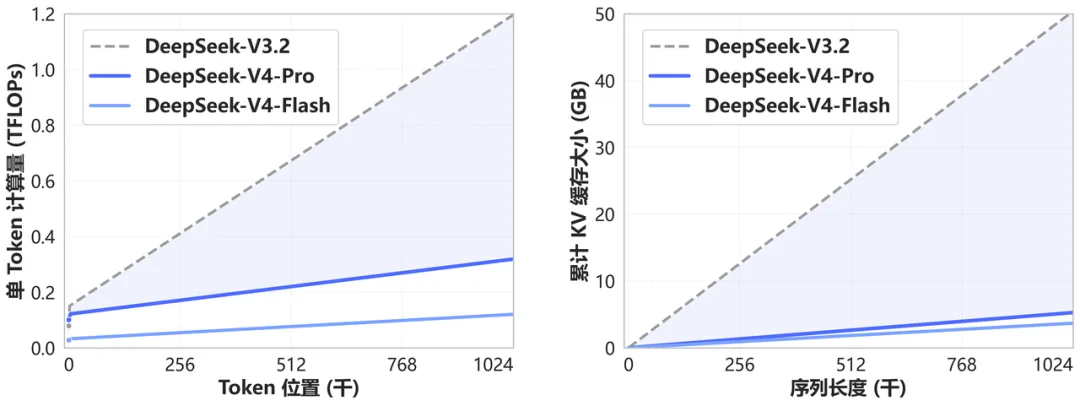
DeepSeek attributes the long-context efficiency of V4 to a new attention approach combining token-wise compression with DSA, or DeepSeek Sparse Attention. Attention is the mechanism that helps language models decide which parts of the input are relevant to one another. Sparse attention reduces unnecessary full-context computation, which can lower compute and memory costs when processing very long inputs.
On the ecosystem side, DeepSeek says V4 is integrated with AI agents including Claude Code, OpenClaw, and OpenCode, and is already used in the company’s internal agentic coding. For API users, DeepSeek says they can keep the same base_url and change the model name to deepseek-v4-pro or deepseek-v4-flash. The API supports OpenAI ChatCompletions and Anthropic APIs. The company also notes that deepseek-chat and deepseek-reasoner will be fully retired and inaccessible after July 24, 2026, 15:59 UTC; they are currently routed to deepseek-v4-flash non-thinking and thinking modes.
Why It Matters
The broader signal is that long context is moving from a premium feature toward a default infrastructure layer. If million-token context can be delivered at sustainable cost, applications may rely less on aggressive document chunking and more on direct, large-scale context ingestion. That could reshape enterprise knowledge bases, coding agents, legal review, research workflows, and other document-heavy systems.
Still, a larger window does not automatically mean better answers. Models must remain accurate in retrieval, reasoning, citation, and tool use across very long inputs. DeepSeek’s simultaneous push on Pro, Flash, API compatibility, and agent integration shows where model competition is heading: not only raw benchmark scores, but the combined economics of capability, context length, latency, and developer adoption.