
The key update
DeepSeek announced DeepSeek-V3.2-Exp on September 29, 2025, positioning it as a new experimental model that is now available through the DeepSeek App, Web interface, and API.
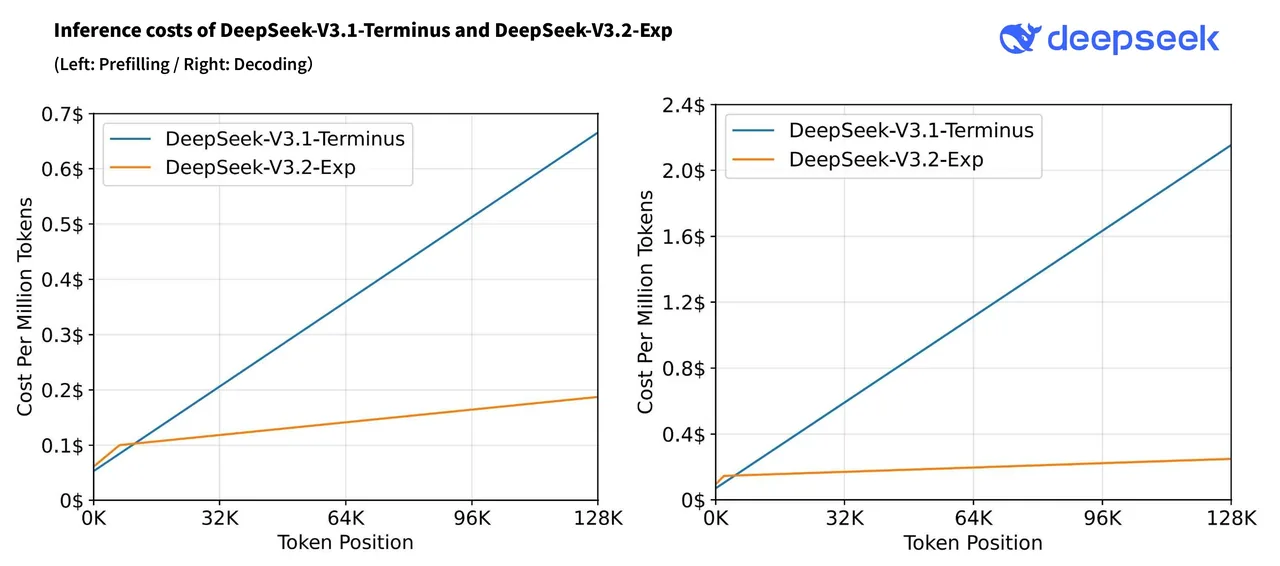
The most important technical change is the introduction of DeepSeek Sparse Attention, or DSA. In large language models, attention is the mechanism that helps the model decide which parts of the input are relevant to each generated token. As context length grows, standard attention can become expensive. DSA is designed to make long-context training and inference faster and more efficient by applying fine-grained sparse attention, reducing unnecessary computation while aiming to preserve output quality.
Built on V3.1-Terminus
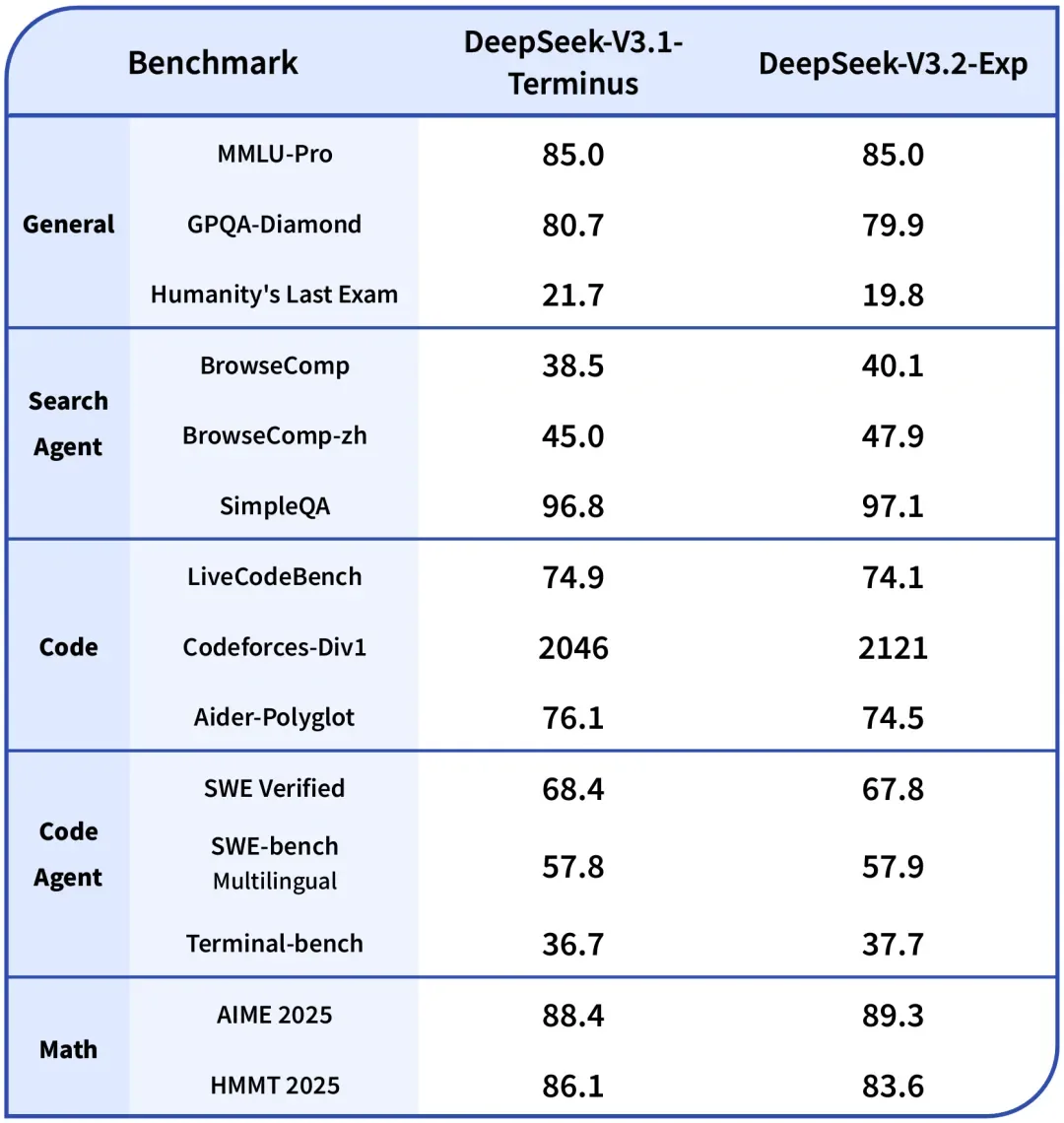
According to DeepSeek, V3.2-Exp is built on V3.1-Terminus. The earlier V3.1-Terminus release focused on improving language consistency, reducing Chinese-English mix-ups, and upgrading Code Agent and Search Agent performance. V3.2-Exp shifts the emphasis toward efficiency in long-context workloads.
DeepSeek says DSA has minimal impact on output quality while improving long-context performance and lowering compute costs. The company also states that benchmarks show V3.2-Exp performs on par with V3.1-Terminus. That wording is important: this release is framed less as a broad capability leap and more as an efficiency-oriented experiment that tries to keep model quality stable while changing the underlying computation pattern.
Key facts from the announcement include:
- Release date: September 29, 2025;
- Model: DeepSeek-V3.2-Exp;
- Core technique: DeepSeek Sparse Attention;
- Availability: App, Web, and API;
- Pricing: DeepSeek API prices reduced by more than 50%, effective immediately;
- Comparison window: V3.1-Terminus remains available through a temporary API until October 15, 2025, 15:59 UTC.
API pricing and migration testing
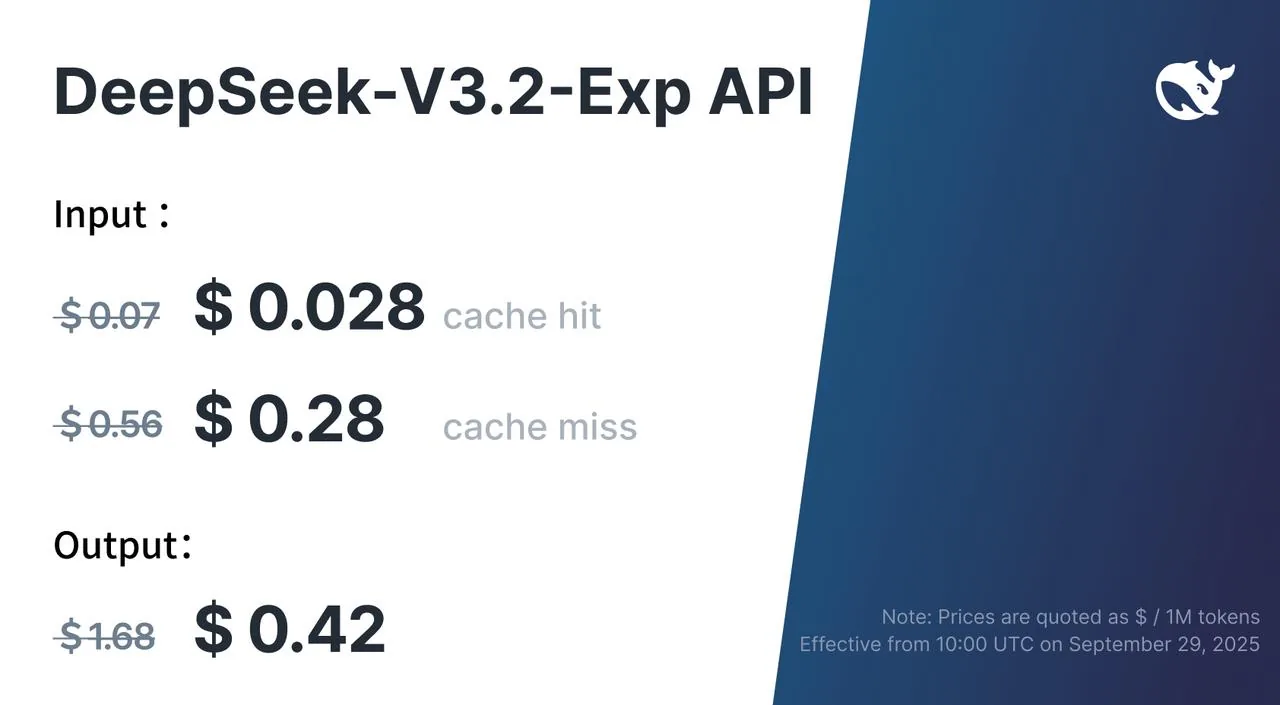
For developers, the API pricing change may be the most immediate practical update. DeepSeek describes the change as lower cost with the same access, and says the reduction takes effect immediately. The announcement does not provide a detailed price table for different usage categories, so the exact billing impact for each workload still needs to be checked against the API pricing page. Even so, a cut of more than 50% signals that the company wants to pass some efficiency gains on to users.
DeepSeek is also keeping V3.1-Terminus available through a temporary API until October 15, 2025, 15:59 UTC, specifically to support comparison testing. This matters because model migration is not only about benchmark scores. Teams usually need to compare response style, long-document behavior, coding results, and agent workflows using their own prompts and data. A short overlap period gives developers a safer way to evaluate whether V3.2-Exp can replace or complement the previous model in real applications.
Open-source materials and GPU kernels
DeepSeek says it has released V3.2-Exp on Hugging Face, published the V3.2 technical report on GitHub, and made key GPU kernels available in TileLang and CUDA. A GPU kernel is a low-level program that runs directly on a graphics processor and affects how efficiently specific model operations execute. CUDA is the widely used NVIDIA GPU computing platform, while TileLang is highlighted by DeepSeek as useful for rapid research prototyping.
These releases serve different audiences. Researchers can study how DSA balances sparse computation and output quality. Engineering teams can examine the kernels and technical report to evaluate reproducibility, deployment implications, or potential integration ideas for their own inference stacks. However, the announcement does not include model size, maximum context length, detailed benchmark scores, or hardware settings, so independent testing remains necessary.
Why this matters
The long-context race is increasingly becoming a cost-efficiency race. Longer context can support tasks such as codebase analysis, document review, multi-turn assistant memory, and retrieval-heavy workflows, but the compute burden has been a major constraint. By combining sparse attention, an API price cut, and open-source technical materials in one release, DeepSeek is emphasizing that long-context capability has to be paired with affordable inference and developer access.
V3.2-Exp is still labeled experimental, so it should be evaluated carefully before replacing production systems. The main questions now are how stable DSA is in real long-context use, whether output behavior changes compared with V3.1-Terminus, and how the lower-priced API performs under practical workloads. If DeepSeek can maintain quality while reducing long-context costs, its open-model ecosystem could become more attractive to developers and applied AI teams.