
Tech Insight: DeepSeek Unveils V4.1-Flash, Setting New Benchmark for Efficient Inference
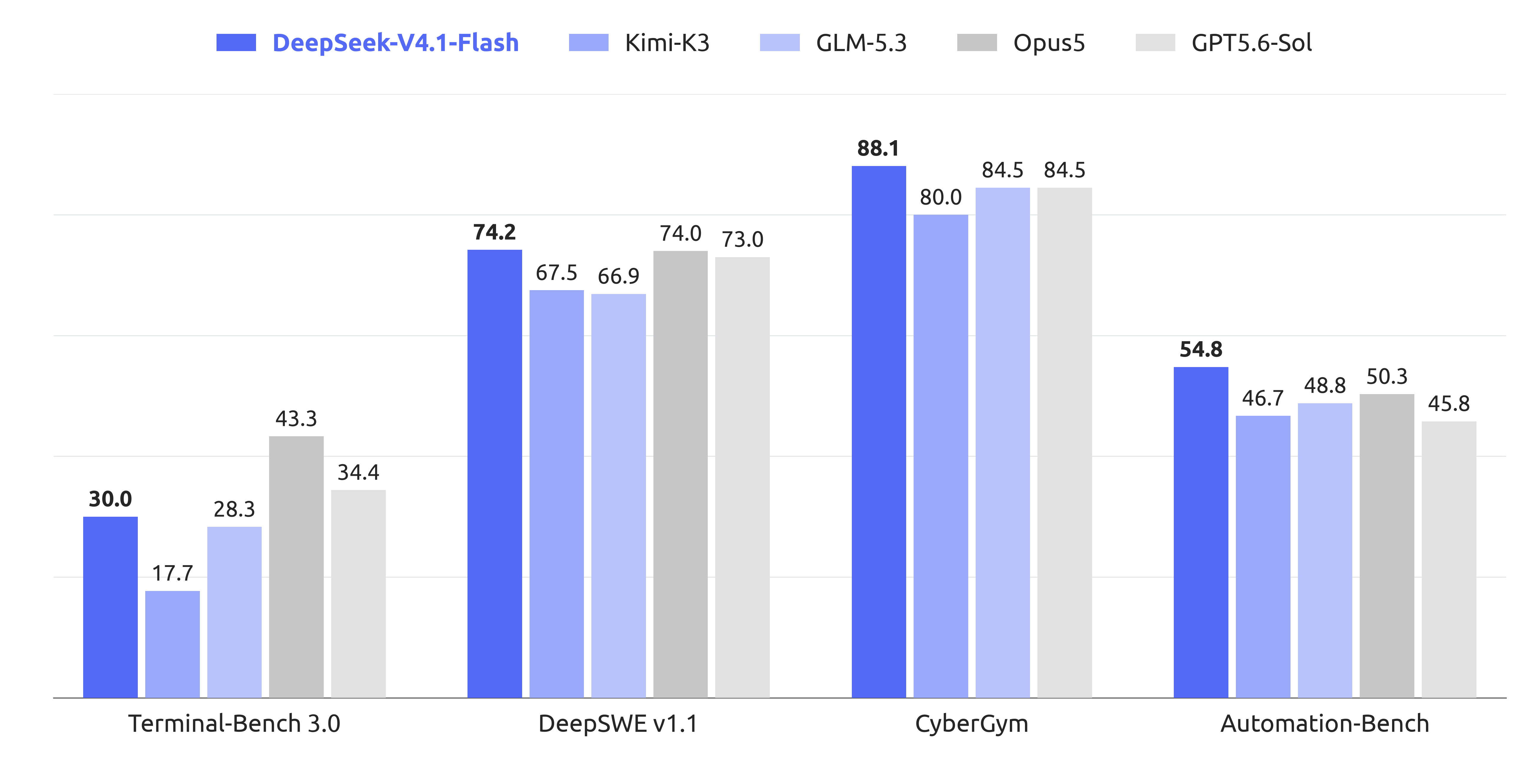
On September 10, 2026, DeepSeek officially launched DeepSeek-V4.1-Flash, its newest lightweight large language model. As the smallest member of the new architecture family, it features native multimodal understanding capabilities, emphasizing higher performance, faster inference, and greater efficiency.
- Release Date: September 10, 2026 (UTC+8)
- New Product: DeepSeek-V4.1-Flash
- Pricing Effective: September 10, 04:00 UTC; V4-Pro to fully route to V4.1-Flash on September 14, 04:00 UTC
- Availability: Live on DeepSeek API with multimodal input support
- Weight Opening: Not explicitly disclosed; collaboration with open-source community on inference support announced
Model parameters: 552B MoE (Mixture-of-Experts)—a design where only a subset of parameters is activated per inference, maintaining high capacity while controlling computational cost.
Asymmetric Architecture: Efficiency Leap via Rethinking Inference Paths
The most striking innovation of V4.1-Flash is its asymmetric encoder-decoder architecture:
- Input path activates just 8B parameters
- Output path activates 16B parameters
- Full model capacity: 552B parameters
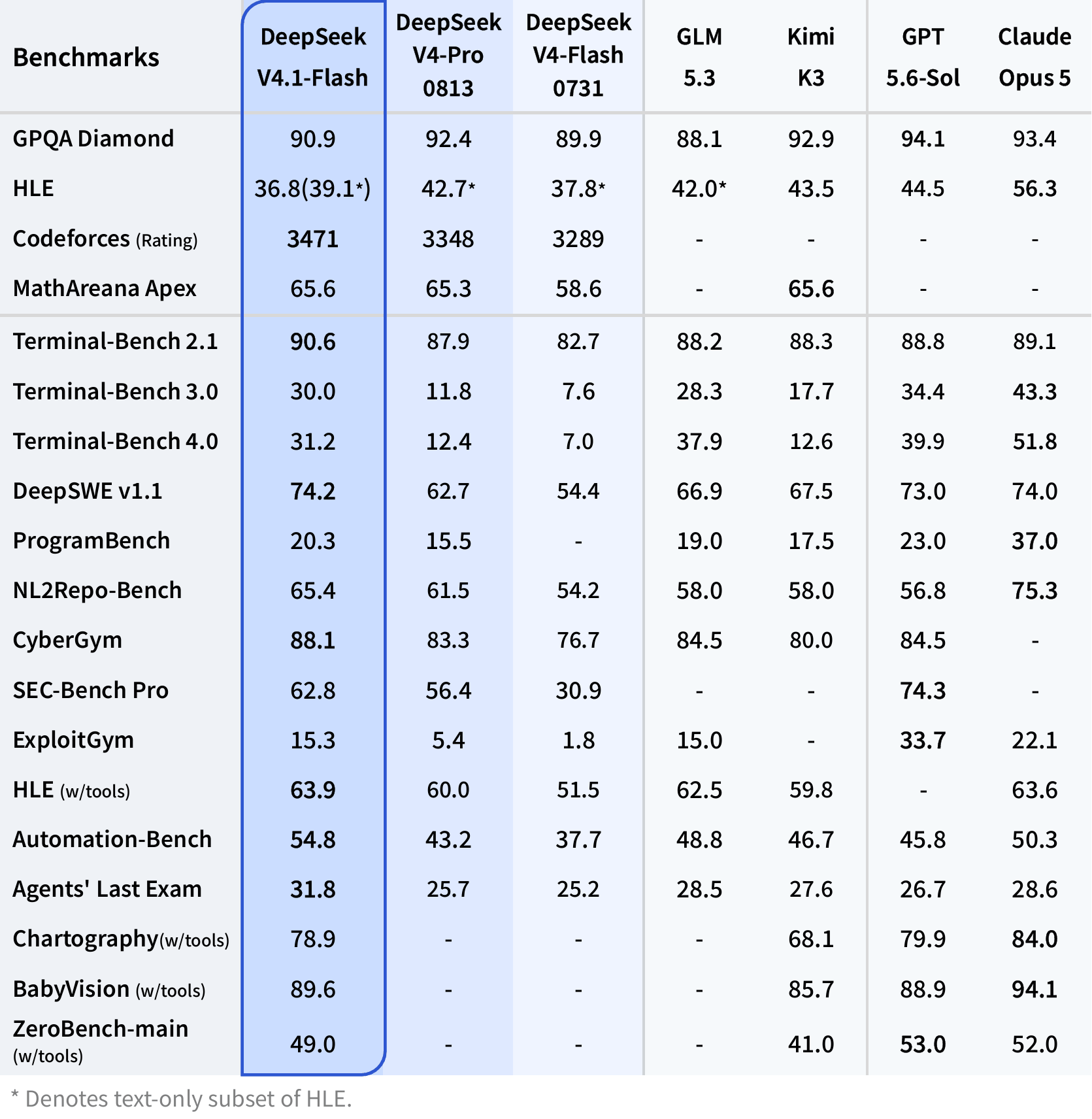
This means large model capacity coexists with narrow, efficient inference pathways—significantly reducing latency and operational cost. Counterintuitively, independent tests placed V4.1-Flash ahead of the prior flagship V4-Pro across performance, cost, speed, and total runtime, a rare outcome where a smaller model outperforms its larger predecessor.
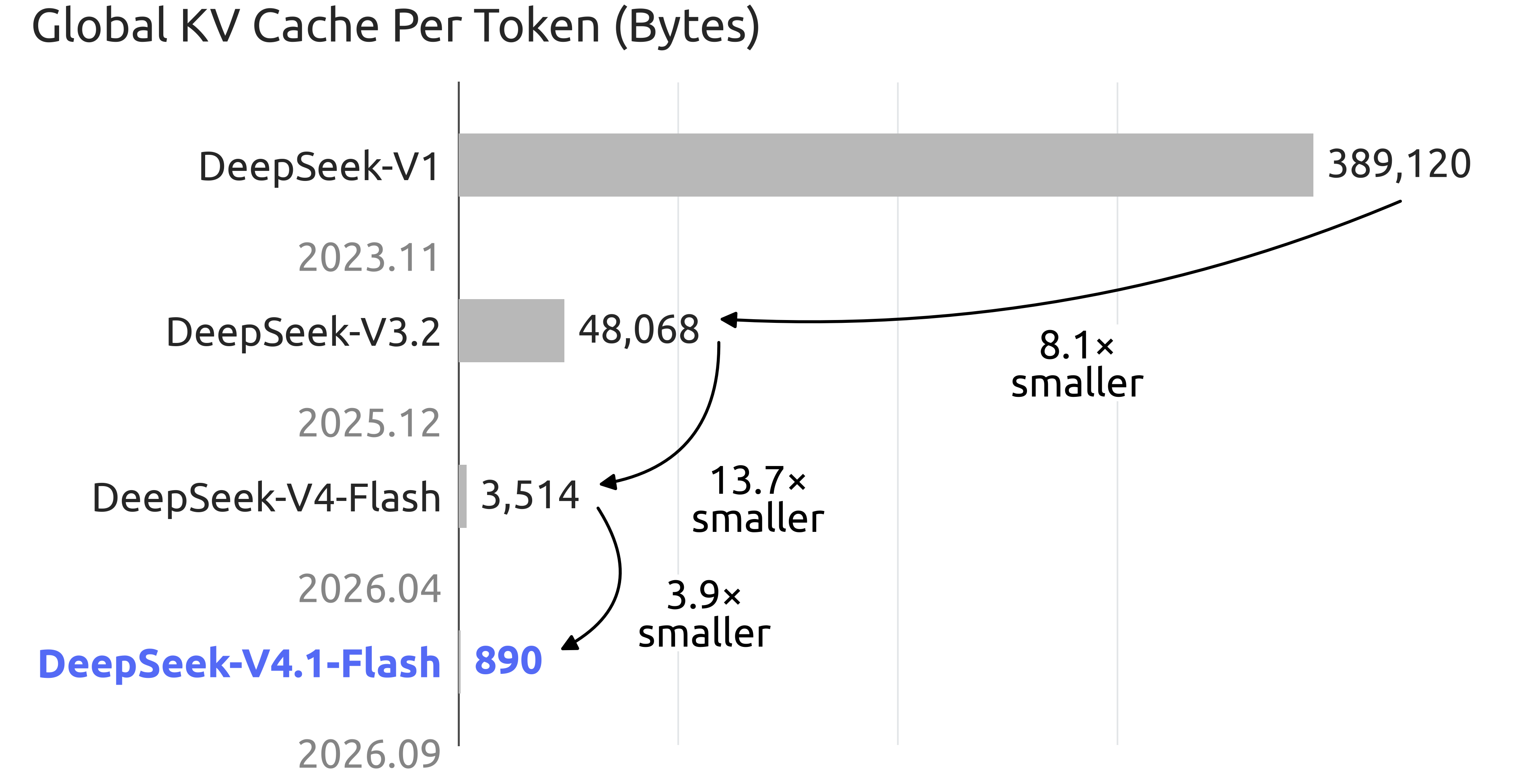
KV cache compression is another key breakthrough. KV cache stores intermediate key-value states during text generation, often constituting a major share of GPU memory and storage overhead. V4.1-Flash slashes these needs to:
- 1/4 HBM (high-bandwidth memory) vs. previous generation
- 1/8 SSD storage vs. previous generation
Cache costs frequently dominate total runtime expenses for agent applications, so compression delivers direct savings.
specifications Comparison
| Metric | DeepSeek-V4.1-Flash | DeepSeek-V4-Pro (old flagship) | DeepSeek-V4-Flash (old) |
|---|---|---|---|
| Status | Live Sept 10, 2026 | To be phased out | Retired |
| Parameter Structure | 552B MoE (8B input / 16B output active) | Not disclosed | Retired |
| Multimodal Support | Native | Not specified | Native (Exp variant) |
| Routing Policy | Primary model | Transfers to V4.1-Flash Sept 14 | Routes to V4.1-Flash temporarily |
| API Name | deepseek-flash | deepseek-v4-pro | deepseek-v4-flash, deepseek-v4-flash-vision-exp |
Note: Legacy API names are temporarily forwarded to the new model for compatibility, but billing uses V4.1-Flash rates.
Practical Guidance: Who Should Adopt Now?
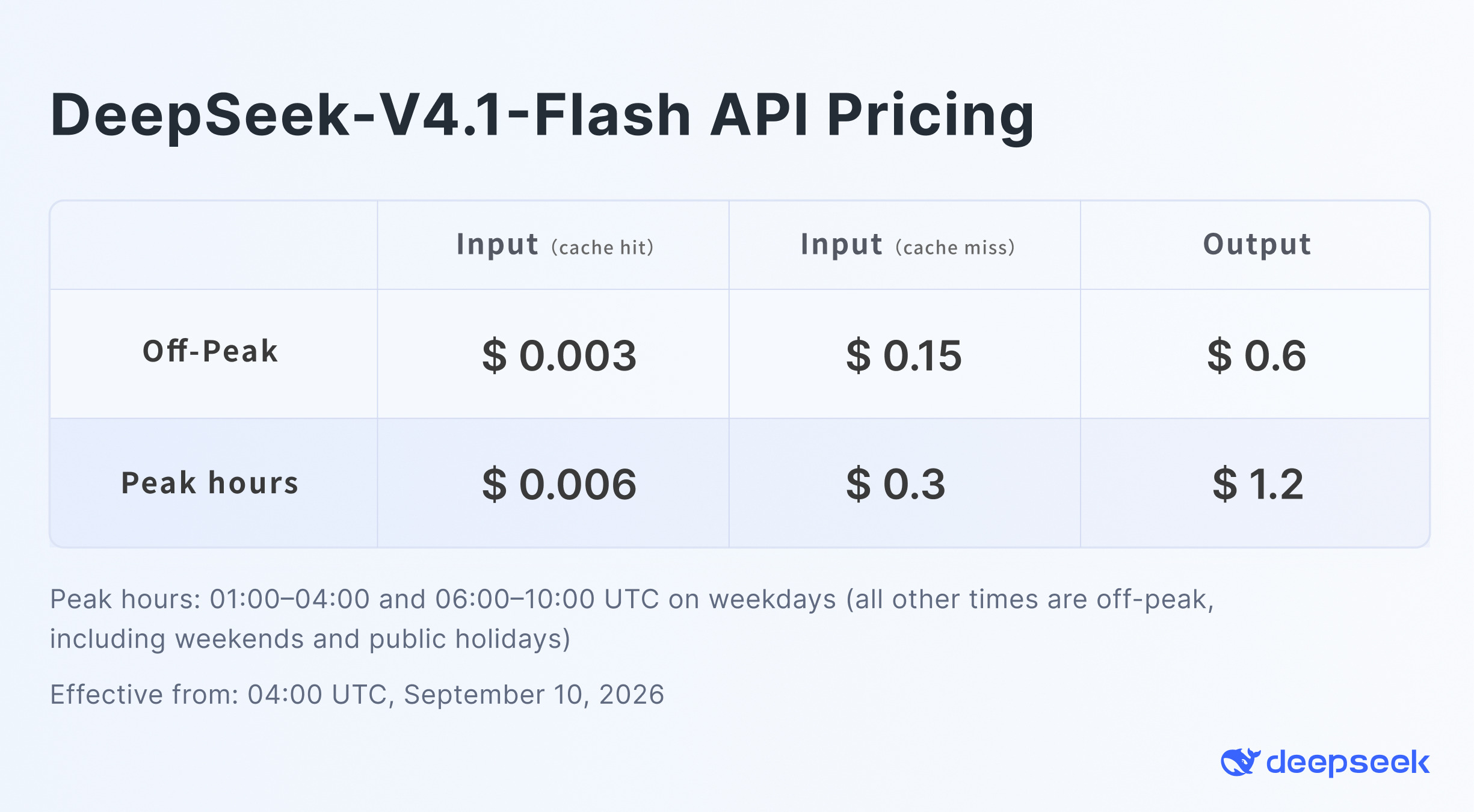
- Adopt Immediately If: You run cost-sensitive agent workloads, batch processing requiring high throughput, or latency-sensitive real-time interactions. Lower API pricing plus improved performance makes V4.1-Flash the clear choice for routine inference tasks.
- Consider Waiting If: Your use case demands highest-authority reasoning or complex long-chain logic (e.g., scientific proof generation). Await the upcoming V4.1-Pro (officially announced), as flagship-level capability on highly complex tasks needs further ecosystem validation.
V4.1-Flash also supports peak/off-peak pricing: off-peak rates are 50% of peak rates. Schedule non-urgent workloads during off-peak windows to cut service costs by half.
Final Thoughts
DeepSeek’s V4.1-Flash validates the viability of ‘large-capacity, narrow-activation’ design—a promising path for the industry. As models grow ever larger, the new priority is making the right parameters work efficiently on critical paths. This trend may push more vendors to abandon the outdated equation that bigger equals better.