
Core Announcement & Key Facts
DeepSeek V4.1-Flash officially launched in September 2026 as a full architectural rewrite targeting long-context scenarios. Key facts:
- Release Date: September 2026
- Model Version: DeepSeek V4.1-Flash
- Core Parameters: 552B main backbone + 196B Engram memory module
- Active Parameters: 8B during prefill, 16B during decoding
- Context Capacity: Up to 1M tokens
- Weights: Open-sourced via Hugging Face
Despite using only 24B activated parameters—far fewer than its 1.6T-parameter V4-Pro flagship—it matches or exceeds V4-Pro on core knowledge, reasoning, and coding benchmarks. In public Agent benchmarks like DeepSWE v1.1 (74.2% pass rate) and CyberGym, it outperforms industry fixtures such as Opus-5.0 and GPT-5.6-Sol.
Architecture Breakthrough: CED and CSA2
The system rests on two innovations: Causal-Encoder-Decoder (CED) and Compressed Sparse Attention 2 (CSA2).
CED reconfigures the 40-layer network: the first 20 layers form a causal encoder that reads the entire context once and outputs a compact隐 state summary; the remaining 20 layers act as a decoder, generating global KV caches directly from that summary via projection matrices—halving prefill compute. To preserve local fidelity, sliding window attention (SWA) and a “limited replay” mechanism detail only a minimal subset of tokens at high precision.
CSA2 revolutionizes storage by eliminating layer-wise redundancy. Previous CSA+HCA kept full KV caches per layer (40× replicas); CSA2 enables cross-layer KV sharing and Top-K index reuse. Layers operate in three modes:
- Full: full scan, KV & Top-K index generation
- Reindex: reuses Full’s output, re-filters重点
- Reuse: skips computation entirely, uses results directly
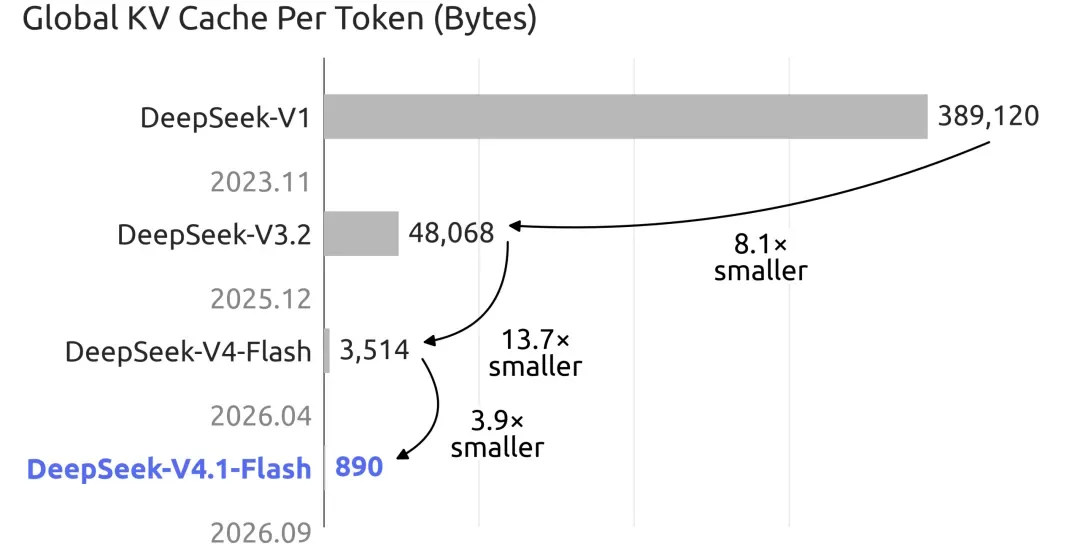
Only a few layers run Full mode; others delegate or reuse. Combined with FP4 quantization—FP4 for long-term core caches, FP8 for short-term SWA caches—and quantization-aware training (QAT), per-token KV volume drops to one-fourth of V4-Flash.
Performance & Cost Metrics

| Metric | V4-Flash | V4.1-Flash | Reduction |
|---|---|---|---|
| Global token KV size | baseline | 1/4 | 4× |
| Persistent KV on disk | baseline | 1/8 | 8× |
| Prefill compute | baseline | 1/2 | 2× |
| Decoding overhead (4K→1M tokens) | — | ~25% | nearly flat |
The headline “437× KV cache reduction” reflects the cumulative system-level gain across compute, storage, and the “use-and-discard” nature of short-term memory (50% contribution) plus long-term compression (50%).
Implementation Guidance

- Adopt now: API-based AI service providers and enterprise Agent developers handling high-frequency, long-context tasks (code review, legal text processing, security operations). Costs fall from ~$10 to $1–2 per complex job.
- Wait: Applications requiring zero-tolerance local fidelity (e.g., sensitive medical certificate verification). SWA+limited replay may miss edge cases—use for drafting or summarization, with human oversight for critical passages.
Final Note
V4.1-Flash demonstrates that architectural innovation—not just scale—can redefine long-context capabilities. The CED+CSA2 blueprint suggests future LLMs will be built from sparse, reusable, and carefully approximated components rather than monolithic dense Transformers.