
DeepSeek Unveils New MoE Model, Underdog Surpasses Flagship
On September 10, 2026, DeepSeek officially released DeepSeek V4.1 Flash, a 552B-parameter Mixture-of-Experts (MoE) model. As the smallest member of DeepSeek’s new architecture family, this model surpasses the flagship DeepSeek V4 Pro across multiple benchmarks.
Key facts:
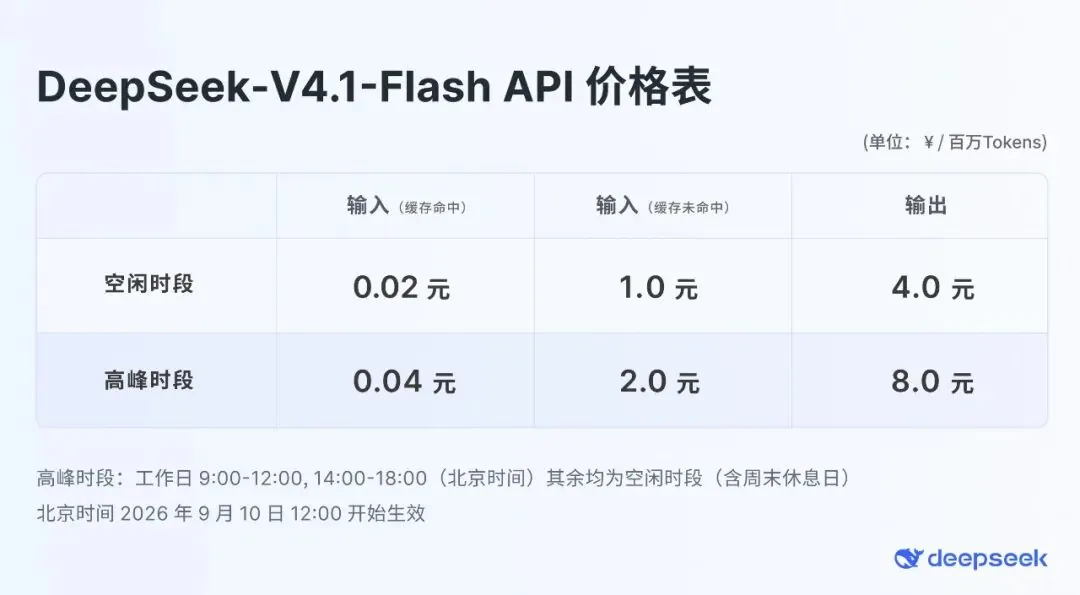
- Release time: September 10, 2026, 12:00 (pricing effective immediately)
- New version: DeepSeek V4.1 Flash (552B MoE)
- API access: replace model name with
deepseek-flash - Open source: fully available on HuggingFace (link)
- Architecture: native multimodal vision understanding; CSA2 compressed sparse attention; FP4 global KV cache precision
Architecture Innovation: Triple Collaboration Enables 8x Cache Efficiency
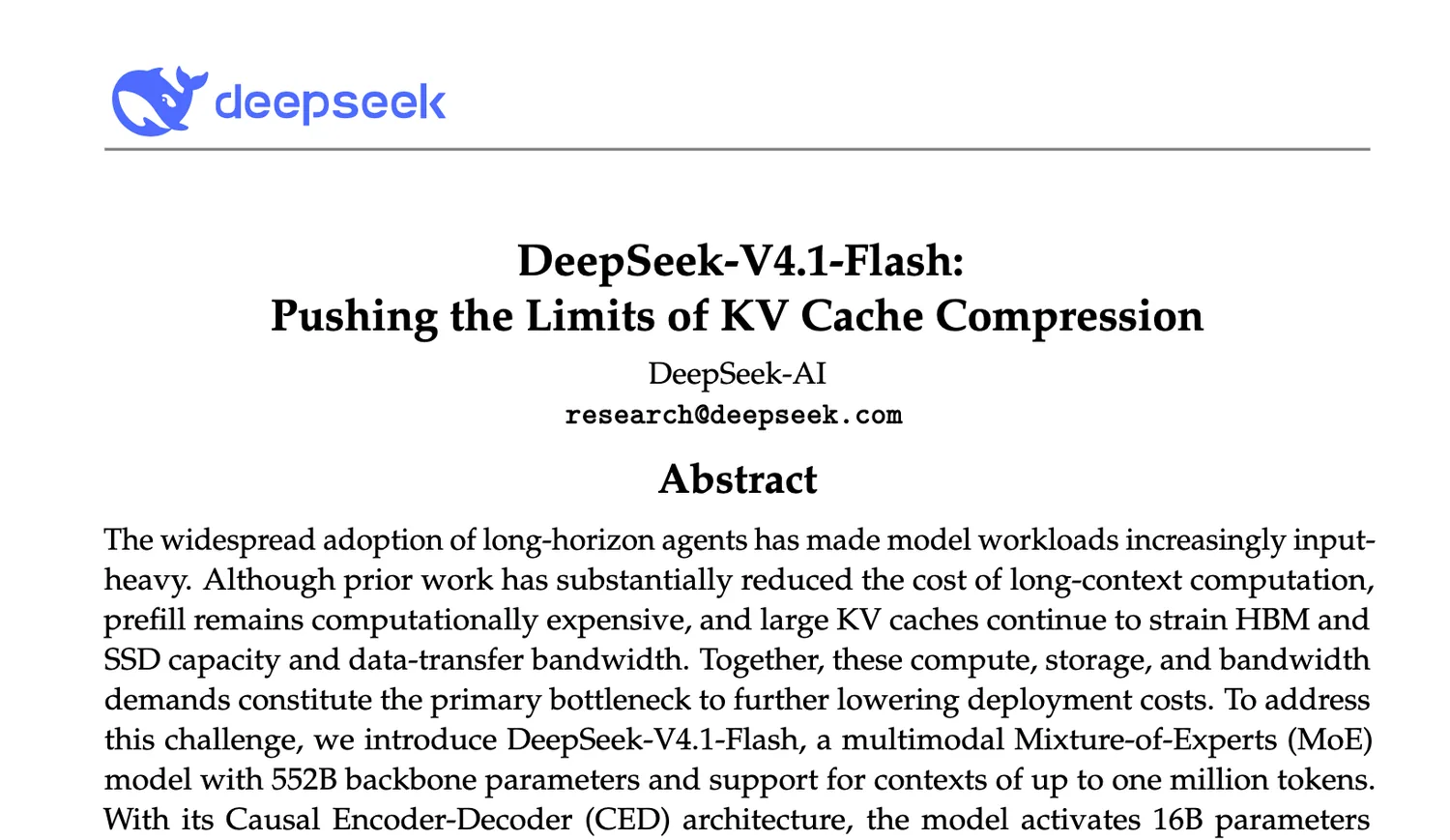
Compared to DeepSeek V4 Flash, V4.1 Flash reduces HBM (high-bandwidth memory) demand to 1/4 and SSD-persisted cache to 1/8; against the original V1, cache demand drops to 1/437.
This breakthrough stems from coordinated improvements in architecture, precision, and deployment:
- Architecture: CSA2 compressed sparse attention — global KV cache and Top-K indices are cross-layer reused; each layer retains only its query vectors and local attention cache
- Precision: FP4 training-time storage — global KV cache uses 4-bit floating-point format from training, with negligible performance loss per official statements
- Deployment: SWA bounded replay — only last n tokens need replay to reconstruct sliding window attention state, eliminating SWA cache writes to SSD
This design extends context length from 4K to 1M tokens, increasing per-token decode FLOPs by only ~25%, resolving the industry challenge of cost explosion with longer contexts.
Pricing and Performance: Smaller Size, Higher Capability
| Model | Parameters | Active Parameters | Cache Efficiency vs. V4 Flash | Context Length | Pricing (off-peak/peak) |
|---|---|---|---|---|---|
| V4.1 Flash | 552B MoE | Input 8B / Output 16B | HBM 1/4, SSD 1/8 | 1M | Input (hit) 0.02/0.04 RMB, Output 4.0/8.0 RMB |
| V4 Flash | Undisclosed | Undisclosed | Baseline | Undisclosed | Discontinued |
In Agent benchmarks, this “small model” achieves comprehensive superiority over V4 Pro, GLM5.3, and Kimi-K3. Official documentation states the new architecture aims for: higher capability ceiling, faster inference, and larger throughput, with scalability to larger parameter scales.
Business Impact and Adoption Advice

For frequent Agent users, cache compression and price reduction create compounding savings. In hit-rate scenarios, cache costs constitute a significantly lower share of total spend—same budget enables more tasks.
Ideal for immediate integration:
- Long-context (>32K tokens) document analysis and multi-turn对话 Agents
- Cost-sensitive workflow automation requiring frequent suspend/resume
- Localized multimodal capabilities (native vision understanding)
Consider delaying integration:
- Real-time systems with extreme latency sensitivity (end-to-end latency data not disclosed)
- Workloads relying on V4 Pro-specific capabilities (V4 Pro fully retired on September 14, 12:00 UTC+8, requests auto-routed to V4.1 Flash)
Ecosystem Synergy and Open Source
DeepSeek simultaneously released Harness v0.1.5, supporting system prompt updates while preserving KV Cache. Tencent’s WorkBuddy, CodeBuddy, and OpenCode are fully integrated, with OpenCode Go套餐 offering 4x usage quota; Tencent Cloud TokenHub, ima, and Marvis also compatible.
Open-sourced jointly, DeepSeek Harness and DeepJIT (a lightweight xPU kernel JIT compiler supporting NVIDIA CUDA and Huawei Ascend NPU) provide infrastructure for large-scale deployments.
Final Thoughts
The gap between parameter scale and actual capability, coupled with exponential cache efficiency gains, reveals the synergistic potential of MoE architecture and cache optimization. As inference cost curves are redefined by hardware constraints, the economics of AI applications are undergoing structural transformation.