
Core Announcement
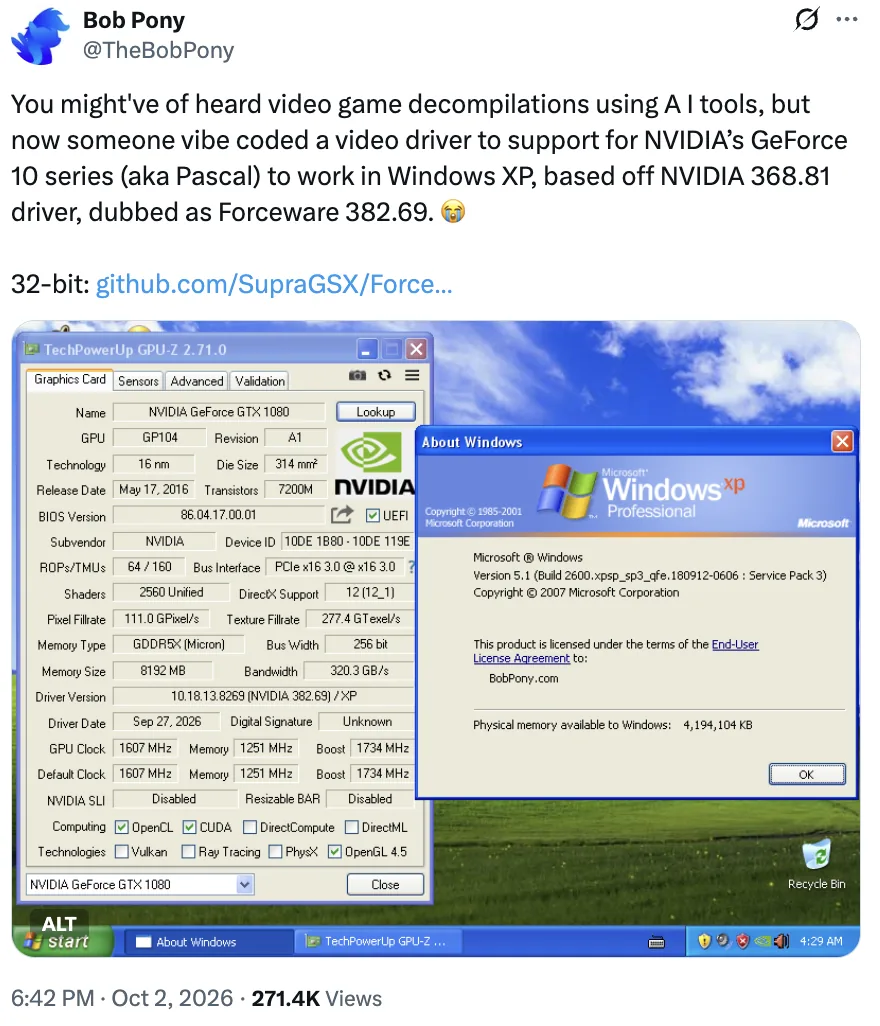
On October 5, IT之家 reported that developer SupraGSX released the unofficial ForceWare 382.69 driver, enabling 32-bit Windows XP to natively support NVIDIA’s Pascal architecture GPUs. This driver is not from NVIDIA but derived from ForceWare 368.81, heavily modified and ported to the XP platform.
Key factual highlights:
- Driver version: ForceWare 382.69
- Target OS: 32-bit Windows XP
- Supported GPU architecture: NVIDIA Pascal (GTX 10 Series)
- Confirmed GPU models: GTX 1060 / 1070 / 1080 / 1080 Ti, TITAN X / TITAN XP
- Base driver: ForceWare 368.81
- Developer: SupraGSX
- Distribution status: Unofficial, community experimental
Technical Implementation and Functional Enhancements
The core challenge of ForceWare 382.69 lies in bridging a 15-year gap: Windows XP (released 2001) and Pascal architecture (launched 2016) differ fundamentally in kernel interfaces, driver models (XP uses WDDM 1.1, while Pascal requires WDDM 2.x), and hardware power management mechanisms.
User reports indicate the driver extends beyond basic 3D acceleration, introducing modern display features previously unavailable on XP:
- DisplayPort 1.4 HBR3 support (High Bit Rate 3, 8.1 Gbps theoretical)
- HDMI 2.0 support (up to 18 Gbps bandwidth)
- High-resolution/high-refresh displays achieved: some users report stable 3840×1080 @ 144Hz output
A striking paradox emerges: the GTX 1080 Ti, a flagship Pascal card (2017, ~$999 MSRP) with complex geometry shader workloads, runs on XP—a kernel designed in 2001—circumventing NVIDIA’s official XP support limit, which ended after Kepler (GTX 600/700 series) with the 34x driver branch.
Supported Models Summary
| GPU Model | Pascal Architecture | XP Port Difficulty | Driver Support |
|---|---|---|---|
| GTX 1060 | Yes | Medium | Supported (most common) |
| GTX 1070 | Yes | Medium | Supported |
| GTX 1080 | Yes | High | Supported |
| GTX 1080 Ti | Yes | Very High | Supported |
| TITAN X | Yes | Very High | Supported |
| TITAN XP | Yes | Very High | Supported |
Note: Data sourced strictly from the original report; no additional models tested.
Crucially, this driver lacks NVIDIA WHQL certification and is distributed outside official channels. Reports indicate ForceWare 382.69 was developed using AI “Vibe Coding”, and users must assess potential risks, including the possibility of irreparable hardware damage to the GPU.
Practical Recommendations
- Ideal for: Tech enthusiasts, XP legacy system maintainers, retro-gaming compatibility testers. Requires manual driver signature override and kernel-level adjustments—not suitable for general users.
- Wait longer if: You rely on daily productivity, professional graphics, or consistent gaming. Lack of safety nets means no vendor-supported recovery if the driver misbehaves.
- Better alternatives: For legacy gaming only, consider GTX 600/700 series paired with NVIDIA’s certified XP drivers for proven stability.
Final Thoughts
This case pushes the boundaries of reverse-engineered driver compatibility but underscores that “running” and “usable” remain worlds apart. While hardware potential exploration deserves technical appreciation, users must internalize that every convenience generated by such experiments shifts risk—and responsibility—entirely onto their own shoulders.