DoorDash Unveils SMS-Interactive AI Ordering Assistant
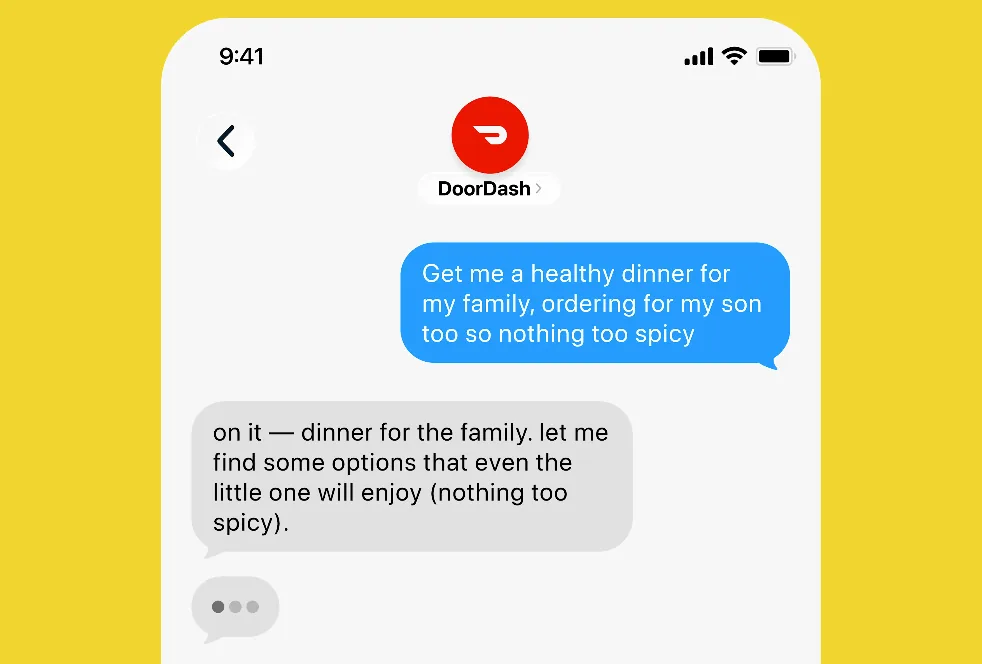
DoorDash announced on September 30 the launch of an AI ordering agent accessible via text message on Apple Messages, allowing users to place food orders through conversational interactions. The feature is currently available for U.S. users to join a waitlist for early access.
Key details:
- Launch date: September 30, 2026
- Available on: Apple Messages (iOS users only)
- Access method: Waitlist registration required
- Capabilities: Personalized recommendations, group order handling, and local restaurant search
Conversational Ordering: From “My Usual” to Mixed-Diet Orders

The core innovation lies in contextual understanding of natural-language requests. Users can simply text “order my usual,” and the AI will recognize and repeat their Friday night ordering pattern without requiring app navigation.
DoorDash highlights that users may request specific dishes or ask for local recommendations. The agent then performs three actions: searches nearby qualifying restaurants, generates a recommended menu based on context, and sends photos of suggested dishes directly via SMS.
For group ordering, the system handles complex requirements in a single exchange. Users can specify: “Zhang wants vegetarian spring rolls, Li wants double-spicy burritos, I’ll have the classic burger,” and the agent will consolidate preferences and quantities into one order.
Competitive Strategy: Dual Tracks of AI and Delivery Innovation
This AI assistant release directly responds to competitive pressure from Uber Eats and Grubhub. Industry analysis has consistently noted rising customer acquisition costs in food delivery, prompting DoorDash to reduce user effort barriers—the traditional path requires open app → search restaurant → navigate menu → select items → confirm order, while the new flow reduces to single-turn conversation.
Notably, the AI agent requires no separate app installation, running within users’ existing Apple Messages. This “zero-install” design eliminates onboarding friction but faces cross-platform challenges. DoorDash has not disclosed Android availability timelines.
Coinciding with the AI launch, DoorDash announced drone delivery testing with select Northern California restaurants. This represents the second phase of its autonomous delivery rollout—following earlier ground-robot testing in confined communities, aerial services will target suburban multistory residential areas.
Technology primer: What makes an “AI Agent”?
Here, “agent” refers to an AI system capable of goal decomposition and tool invocation. Unlike passive chatbots, agents actively:
- Parse semantic commands and extract components (time, location, cuisine type)
- Query order history for personalized pattern matching
- Call external APIs to search for nearby restaurants and retrieve menu items
- Execute multi-step plans with ongoing feedback monitoring
Recommendations for Users
Suitable for immediate trial:
- iOS users in urban areas (depends on local restaurant density)
- Frequent repeat-order customers (“usual” recognition requires extensive order history)
- Those tolerant of non-real-time responses (SMS processing introduces delays)
Advised to wait:
- Users seeking niche restaurants (small or unaffiliated venues may lack coverage)
- Those with strict time requirements (both AI and drone services are in testing)
- Android users (no explicit timeline for support)
Final Thoughts
The food delivery industry has shifted from price wars to operational efficiency competition. AI agents elevate ordering from “app navigation” to “conversation-as-service,” potentially reshaping mobile interaction paradigms. Long-term success hinges on two factors: local merchant network depth (determining coverage breadth) and photo-realism fidelity (affecting user trust).