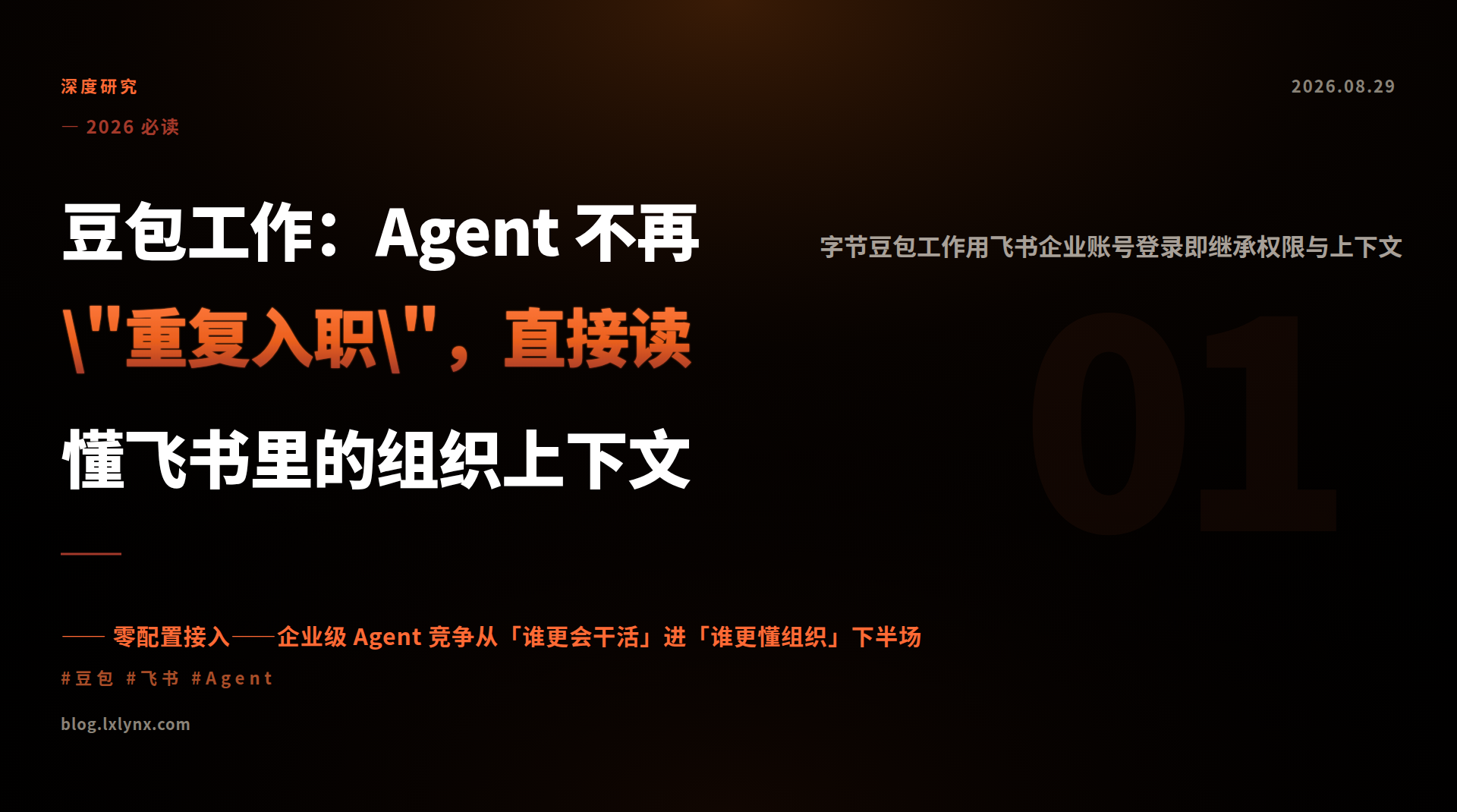
Every mainstream office Agent can do the work — process files, generate web pages, build spreadsheets — but nearly all of them first need you to “explain the background.” ByteDance’s Doubao Work (released August 26, 2026, covered by QbitAI, TechNode, and Caixin) flips that around: log in with your Feishu enterprise account, and it reads your group chats and cloud docs directly, no re-explaining required.
What it’s going after is the “zero-config context access” slot.
1. What It Is
The hard facts:
- Launch: August 26, 2026 — the first release explicitly aimed at enterprise office scenarios (distinct from the consumer-facing “Doubao”);
- Access: one-click login with a Feishu enterprise account — no plugins to install, no permissions to configure;
- Offer: download the desktop app and get a free 30-day subscription; existing subscriptions are extended by 30 days;
- Form factor: a standalone desktop app with a three-column layout (task management | execution process | deliverable preview/editing); the mobile app lets you assign and review work remotely, while background tasks keep running on a cloud desktop;
- Permissions: directly reuses Feishu’s organizational identity and permission system.
One piece of background (per Caixin / EastIsRead): ByteDance is folding the Feishu team into Doubao and Volcano Engine to build an enterprise AI task chain — Doubao Work is the product landing point of that chain.
2. Why Organizational Context Is the New Fault Line
The original coverage flagged the “fault line” without digging all the way in. Let’s break it into three layers.
1. Baseline capabilities have converged. File parsing, tool calling, and web page generation are now table stakes for office Agents — differentiation is increasingly not about “whether it can do the work.”
2. Organizational context is the real fault line. In hands-on testing, after an editorial team logged in with their Feishu accounts, Doubao directly pulled recent group chat history and cloud docs around “embodied AI” and the “World Robot Conference,” organized them into three buckets — “this week’s focus / keep watching / watch pool” — and tagged owners, items needing verification, and reasons for passing on a lead. No re-uploading, no re-briefing, start to finish. The Agent shifts from “tool” to “something that knows the org.”
3. Zero configuration is a dividend of the Feishu ecosystem. Feishu has already accumulated chats, meeting minutes, multi-dimensional tables, approvals, and collaborative documents — Doubao inherits all of it on connection. Compare that to CLI Agents that require installing plugins and configuring identities separately (OpenClaw-style tools): Doubao skips the whole upfront process of creating an app, requesting permissions, and binding an identity. The context isn’t about “uploading things again”; it’s about “naturally continuing an existing workflow.”
3. Who It Stacks Up Against
| Dimension | Traditional Agent Integration | Doubao Work + Feishu |
|---|---|---|
| Identity & auth | Create an extra app, configure permissions separately | Log in directly with a Feishu enterprise account |
| Permission sync | Manually map org structure and data permissions | Automatically inherit the Feishu user permission system |
| Context loading | Manually upload or prompt-supply background | Directly read existing group chats, docs, and tables |
The contrast: while mainstream Agents are still at “install plugins + configure identity + bind permissions,” Doubao piggybacks on Feishu’s native integration and becomes one of the first products with “zero-config context access.”
4. What It Means for You
- Enterprise teams already deep into Feishu: watch for scenarios that “cut the cost of context resets” — ongoing project management, cross-department collaboration, content topic tracking. Small and mid-sized teams that do frequent visual generation and web page building but lack design resources are also a good fit.
- Hold off for now: companies not on Feishu that already have a full Slack/DingTalk workflow need to weigh migration cost against the depth of Agent integration; organizations in finance or government with strong compliance requirements around data sovereignty and third-party access to internal information should wait.
5. Verdict
The enterprise Agent race has moved from “who works better” into the second half: “who knows the org better.” The deep integration of Doubao Work with Feishu marks AI’s evolution from an assistive tool toward the role of an “org member” — and only when an Agent can naturally continue existing workflows instead of re-onboarding every time does a step change in enterprise collaboration efficiency become truly deliverable.