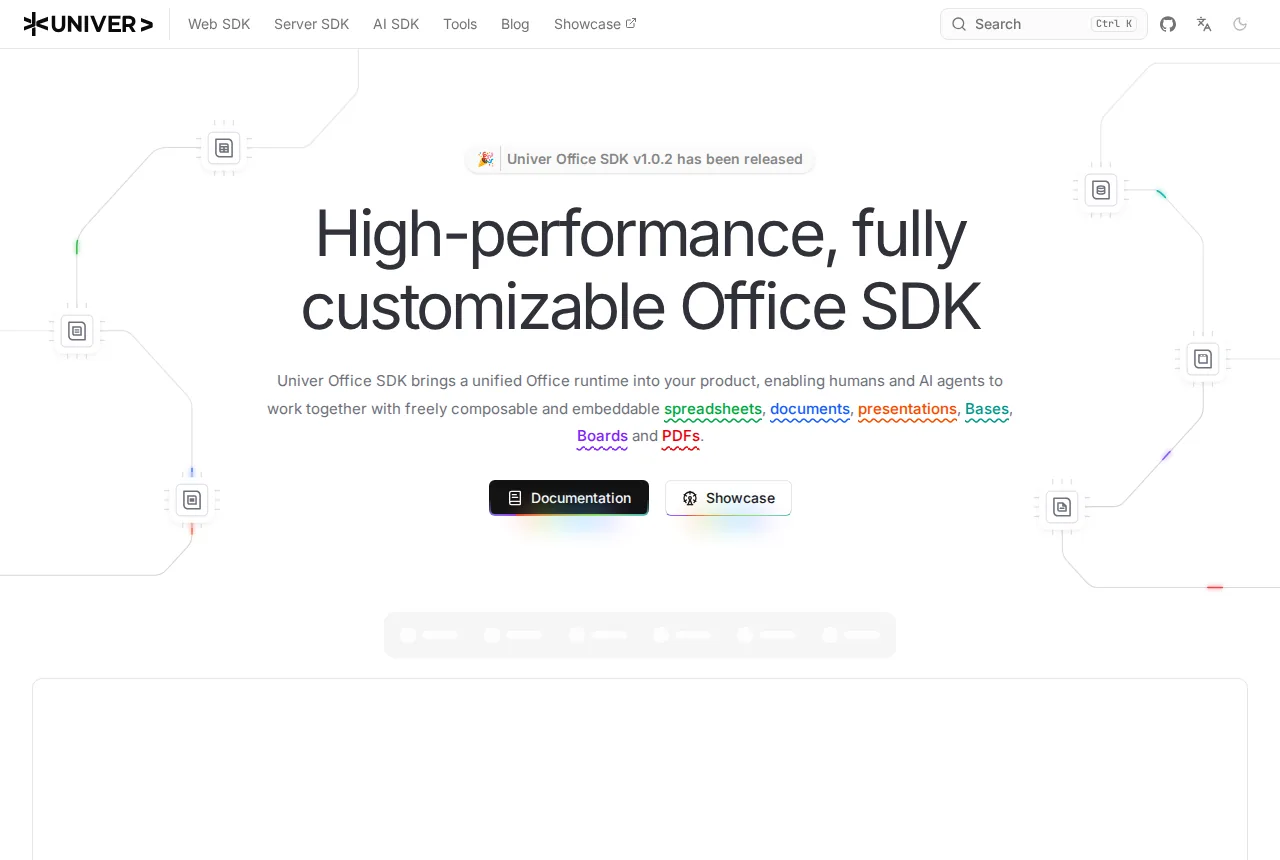
Today, a project called Univer shot up the GitHub trends, snagging 849 stars in a single day and quickly climbing to the top. It’s not just another online Office clone—it’s “office infrastructure” that lets AI agents actually read and understand spreadsheets, documents, and presentations. You can embed a full Excel-like experience in the browser, generate reports from a Node.js backend, or let AI draft content in an isolated workspace for humans to review and merge.
Core Capabilities: A Unified Language for Office Work
Univer unifies spreadsheets, documents, presentations, boards, relational tables, and even PDFs under a single programming interface. You don’t need to learn Excel JS, a PDF library, and a PPT generator separately—just master one facade API.

Its most obvious value lies in:
- AI can edit Office content. Agents can read and write cells, insert charts, adjust styles, and generate formula-driven mini-applications.
- Isomorphic execution across frontend and backend. Formulas edited in the browser and executed on the Node.js backend follow the exact same logic—no data drift.
- Plugin-based composition. Load the spreadsheet plugin when you need tables, bundle only the document plugin when that’s all you need, and keep your package size lean.
Getting Started: Generate a Report in 12 Lines
After installing the dependencies, you can create a workbook and write data with code this short:
| |
If you want to embed the editor in React, just a few lines of configuration:
| |
Technical Design: Engineering Trade-offs Made for AI
- Canvas rendering engine. Tables are drawn on Canvas rather than the DOM, keeping things smooth even with hundreds of thousands of cells—the trade-off is that custom styling isn’t as flexible as HTML.
- Isolated edit branches. Every AI edit happens on a separate branch, so humans can compare changes and approve merges cell by cell, eliminating the risk of accidental overwrites.
- Headless backend execution. Formulas can be computed on the Node.js backend without a browser, which is critical for automated report generation.
Its framework adapters support React, Vue, Web Components, and other mainstream UI stacks. UI components are decoupled from the rendering layer, making deep integration possible.
Ideal For These Use Cases
- Embedding office capabilities into SaaS products. Add pivot tables to BI tools, provide spreadsheet components to low-code platforms, without dragging in heavy frontend dependencies.
- Upgrading internal enterprise tools. Expense systems auto-generate PDF vouchers; approval workflows embed collaborative spreadsheets.
- As the output layer for AI applications. A reception bot turns consultation records into a PPT outline; an analysis agent generates Excel files from scraped data.
Compared to traditional solutions, it’s distinct from online Office viewers that only support read-only display, and it’s not a full rewrite of a major office suite. Think of it as the “frontend compiler” for Office—focused on making content programmable.
Final Thoughts
As AI takes on writing, coding, and design work, Office documents have become the default proving ground for demonstrating capability. Univer opens a path from “generating text” to “generating meaningful content”—after all, delivering a properly formatted report with correct formula calculations is far more persuasive than printing out source code.