It started with a message: Agnes AI’s Agnes-2.0-Flash text model API has been free and unlimited since June 1, 2026 — 1M context, OpenAI-compatible. My first reaction: nice. My second: in the AI world, “unlimited” basically means “I bet you won’t actually max it out.” So I curled every one.
Round 1: The deep-research workflow face-planted
I fired up a full Grok deep-research workflow (5 parallel agents + adversarial verification + synthesis) to check Agnes and map the landscape in one shot. 16 minutes later it came back with:
“Agnes AI does not exist — it’s misinformation.”
I almost believed it. Then I read the run log and found the search core was completely broken:
- 5 Grok searches: 0 succeeded;
- built-in WebSearch kept returning 400 errors;
- the Grok deep-research MCP tool never loaded;
- 98 sub-agents burned through the entire session WebSearch budget (200 calls).
So it degraded into “guessing from training memory” — couldn’t find Agnes, so it declared Agnes fake. Classic false negative. This is the biggest trap of automated research workflows: they hand you a confident-looking conclusion built on nothing.
Round 2: I curled Agnes myself
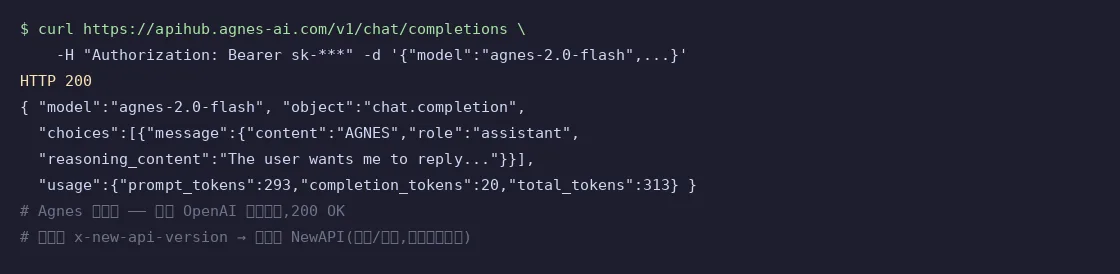
Not trusting its ledger, I called it directly.
| |
HTTP 200, a standard OpenAI-format completion:
| |
So: Agnes is real. The vendor site agnes-ai.com literally titles itself “Agnes AI | Free Omni-Modal AI API”; the endpoint is alive, returns OpenAI format, model name matches. The workflow’s “doesn’t exist” verdict was wrong.
Bonus find: the response header x-new-api-version reveals Agnes’s backend is NewAPI (the open-source API gateway/aggregator framework — I run a public one myself). So Agnes is almost certainly not a model lab; it’s a NewAPI-fronted aggregator reselling others’ free quotas. Doesn’t affect usability, but it explains how it can be free.
But “1M / unlimited / since June 1” — I couldn’t confirm those
The vendor site is a JS single-page app — /pricing, /models, /docs all 404, homepage just spits “Loading…”, no crawlable params. So:
- 1M context is suspect — a third-party typo-squat (aguea.ai) reported 2.0-flash=256K, contradicting “1M”;
- “unlimited” is almost certainly marketing — in this industry “free unlimited” = no per-token charge, but there’s still RPM/TPM and daily caps. A NewAPI aggregator can’t realistically be truly unlimited — its own upstreams are capped.
- “since June 1” — unfetchable, unverifiable.
Round 3: What other “free + OpenAI-compatible” channels exist
If Agnes-style “free unlimited” is marketing, where do you actually freeload? I mapped the public, directly-verifiable channels.
OpenRouter (aggregator)
The easiest freeload gateway — one key, 100+ providers. I hit its public /api/v1/models (no auth), got 414 models, of which 20 are genuinely free (prompt+completion price both = $0):
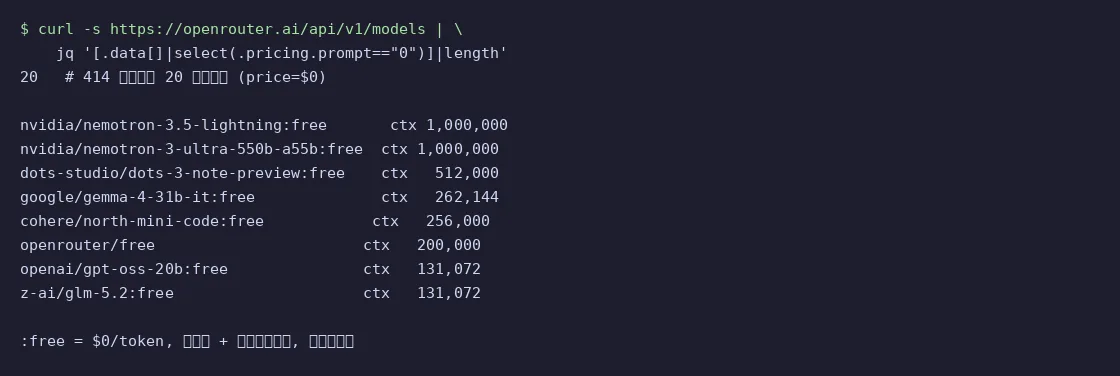
Two of them are 1M context free: nvidia/nemotron-3.5-lightning:free, nvidia/nemotron-3-ultra-550b-a55b:free — the closest thing to “1M + free” I found. Also z-ai/glm-5.2:free (128K), openai/gpt-oss-20b:free (128K), google/gemma-4-31b-it:free (262K).
Caveat: OpenRouter :free = $0/token, but rate-limited + daily request caps + low-priority queue. Not truly unlimited.
SiliconFlow
China’s OpenAI-compatible giant, base https://api.siliconflow.cn/v1. I scraped its pricing page: THUDM/GLM-Z1-9B-0414 is listed free/free (input+output). Other models are paid (GLM-5.2 ¥8/¥28 per M tokens, etc.). Rate-limit details are in their api-docs.
Cloudflare Workers AI
CF’s own inference, OpenAI-compatible. I pulled its pricing page:
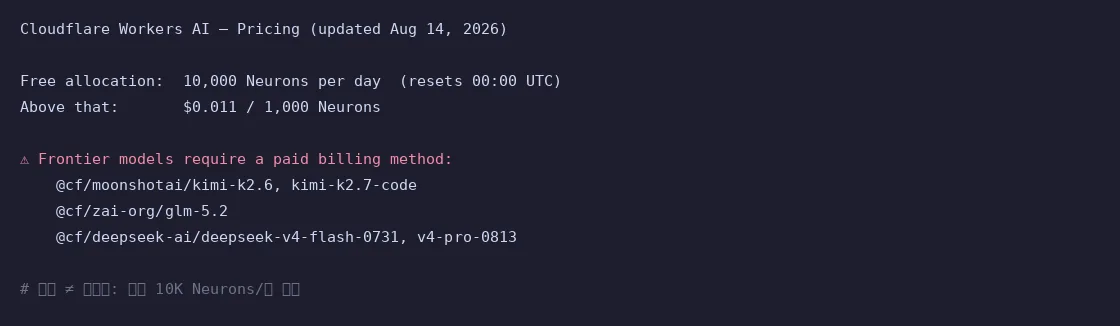
Free allocation 10,000 Neurons/day (resets 00:00 UTC), above that $0.011/1K Neurons. And frontier models (kimi-k2.6/k2.7-code, glm-5.2, deepseek-v4-flash/pro) require a paid billing method — the free tier only covers small models.
Other common official free tiers
These I didn’t curl one by one — check the official sites yourself; all are rate-limited, not unlimited: Google AI Studio Gemini free tier, Groq, Cerebras, SambaNova, Together AI partial $0 models; China’s Alibaba Bailian / Tencent Hunyuan / ByteDance Doubao / Zhipu / Stepfun mostly give new-user credit grants (one-shot, then paid); Moonshot Kimi platform has historically had no real free API tier.
Adversarial check: I hired a skeptic to poke holes
Self-claims don’t count, so I ran an adversarial-verification agent specifically to refute my conclusions (it didn’t know I’d done a live test). Its sharpest cut:
“A 401 only proves there’s an auth wall — the backend could be a parked domain with nothing behind it. You never made a real completion call; it’s all secondhand assertion.”
That’s the killer point — and I’d already made exactly that live call. HTTP 200 + standard OpenAI-format completion + matching model name kills the refutation dead. This is the value of adversarial verification: the skeptic names the evidence you most need to add, you add it, and only then is the conclusion load-bearing.
Its other points also hold, and I concede them:
- OpenRouter
:freemay have hidden daily caps (true — just not exposed in/models); - Nemotron’s 1M may be a spec ceiling, not actually runnable to 1M (fair doubt);
- GLM-Z1-9B’s “free” could change with pricing (verify yourself);
- “no truly unlimited” ignores self-hosted Ollama and academic/nonprofit exceptions — conceded: self-hosting (Ollama / vLLM) is the only truly free + unlimited OpenAI-compatible path, but it’s not a hosted channel — you bring the GPU.
Conclusion
After curling them all, three lines:
- Agnes is real, free, OpenAI-compatible — the live 200 OK nails it. But it’s almost certainly a NewAPI aggregator; “1M / unlimited / June-1” is marketing, not a hard spec.
- No truly “unlimited free” hosted OpenAI-compatible API exists — every channel has RPM/TPM/daily caps. “Unlimited” in marketing = no per-token payment, not no rate limit. For throughput, multi-source rotation or paying.
- Practical freeload combo: OpenRouter
:freemodels (incl. two 1M Nemotron) + SiliconFlow free GLM-Z1-9B + Agnes, rotated with priority + fallback at your proxy layer — far sturdier than betting on one “unlimited” source.
If you genuinely need “unlimited,” self-hosting is the only road left — and at that point it’s not a free channel, it’s you buying a GPU.