
Google DeepMind has released Gemini 3.7 Flash only three weeks after Gemini 3.6 Flash, positioning the model as its smartest “workhorse” model so far and focusing the update on coding, agents, and lower operating costs.
A Faster Release Cadence After Leadership Changes
The timing is notable. On August 5, Demis Hassabis stepped down as CEO of Google DeepMind and became chairman of Google DeepMind and Alphabet’s chief scientist. Koray Kavukcuoglu, previously DeepMind CTO and Alphabet’s chief AI architect, took over day-to-day control as senior vice president. He now oversees Gemini model development, frontier AI research, the Gemini app, and developer teams, reporting directly to Sundar Pichai. Reuters also reported that Koray will have final say over major DeepMind decisions.
Eight days later, Gemini 3.7 Flash arrived. Google said the release was shaped by developer feedback and algorithmic innovation. The short gap between versions suggests that DeepMind is trying to move faster, especially in areas where real product usage is now concentrated.
Coding and Agents Drive the Upgrade
The model’s improvements are concentrated in coding and agentic workflows. An AI agent is a system that can plan, call tools, inspect results, and continue working across multiple steps rather than simply returning a single answer.
Google’s reported benchmark gains include:
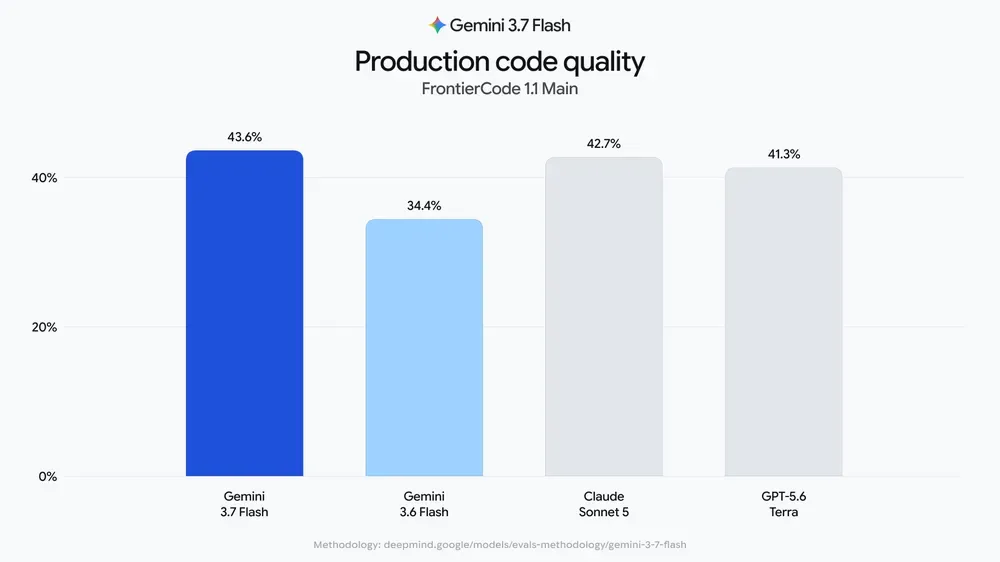
- FrontierCode 1.1 Main: 43.6%, up from 34.4% for Gemini 3.6 Flash.
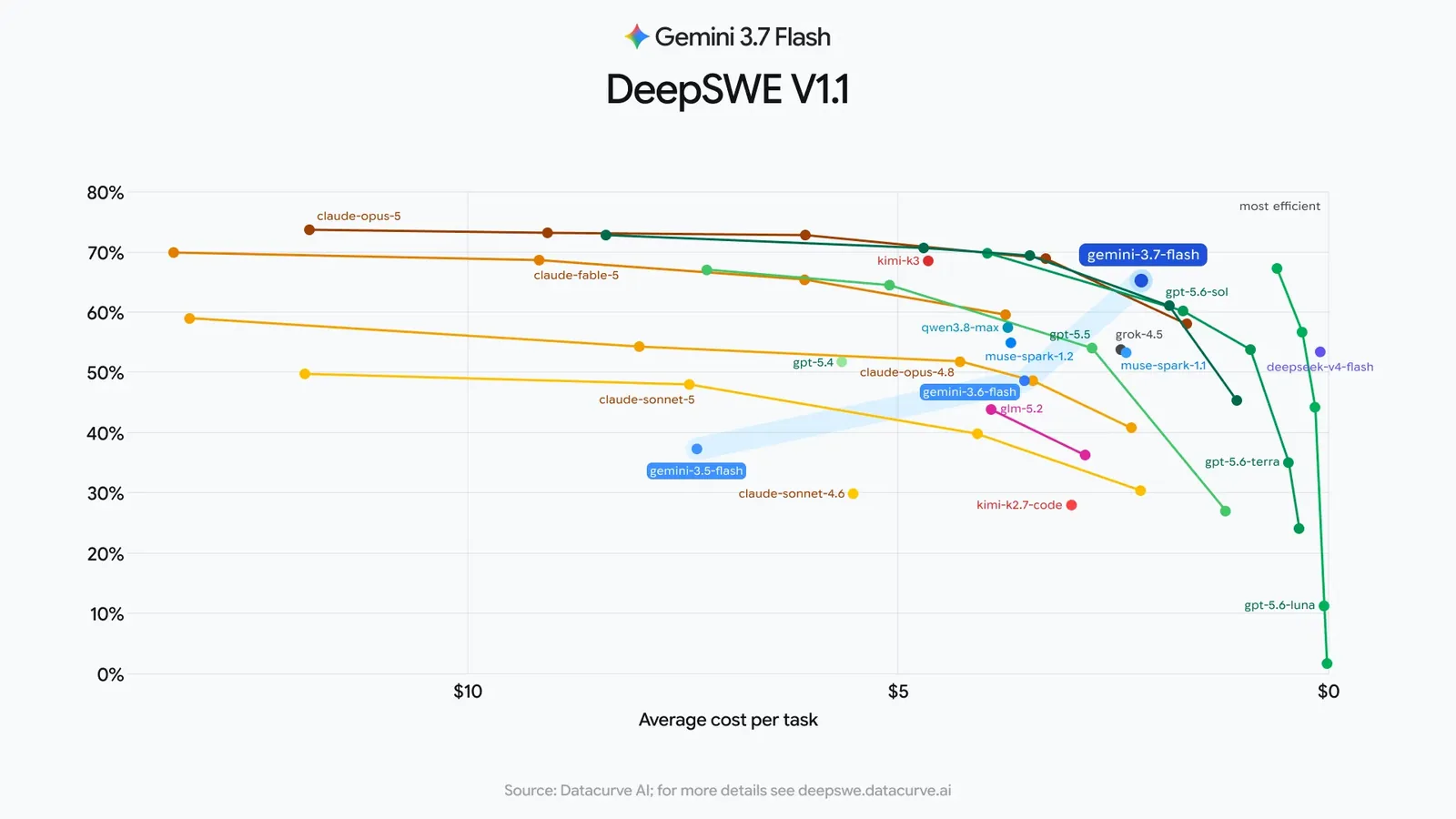
- DeepSWE v1.1: 65.3%, up from about 49%.
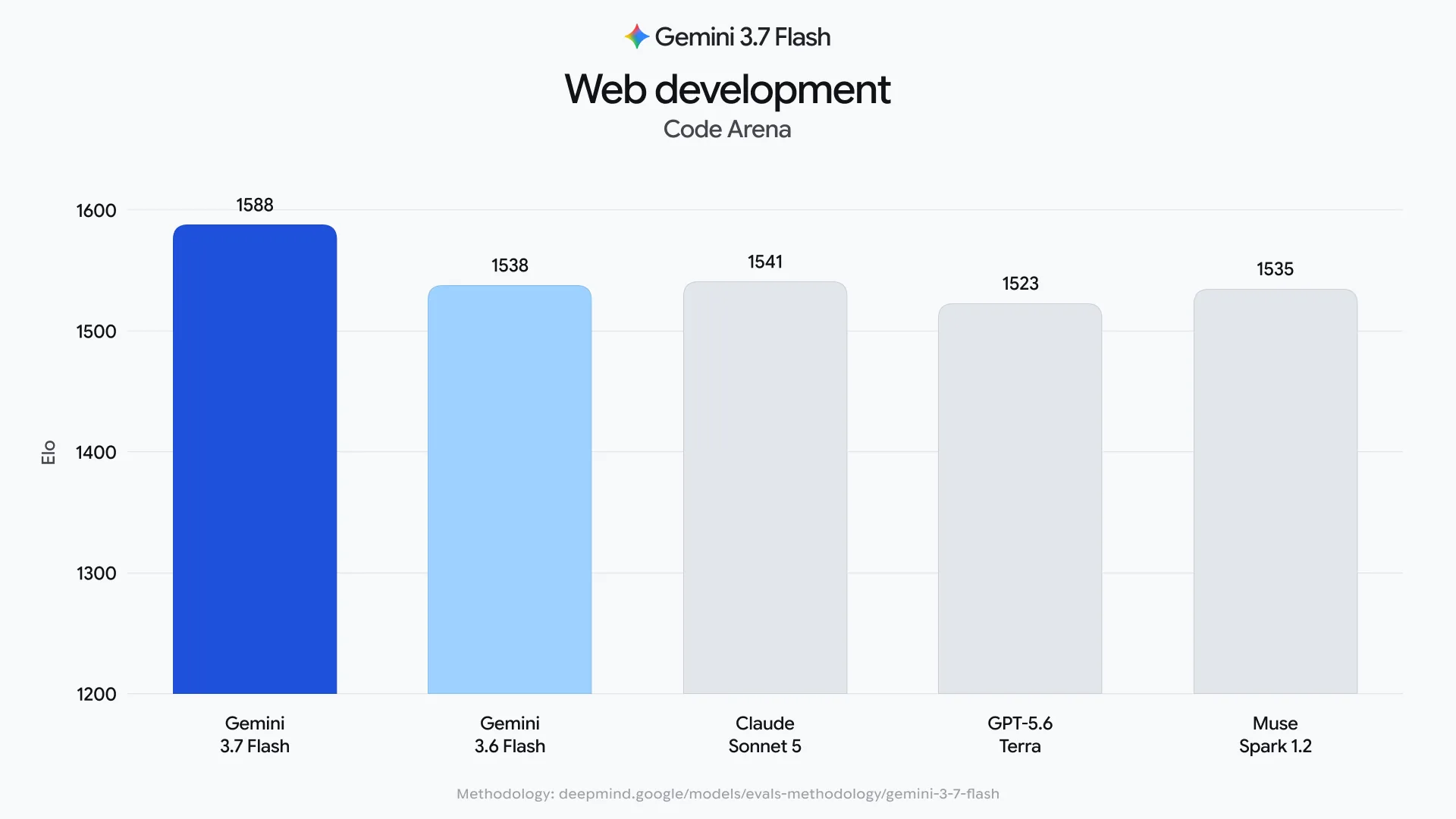
- WebDev Arena: Elo score up from 1538 to 1588.
- Terminal-bench 2.1: 85.8%, up from 78.0%.
- Terminal-bench 3.0: 14.9%, up from 5.4%.
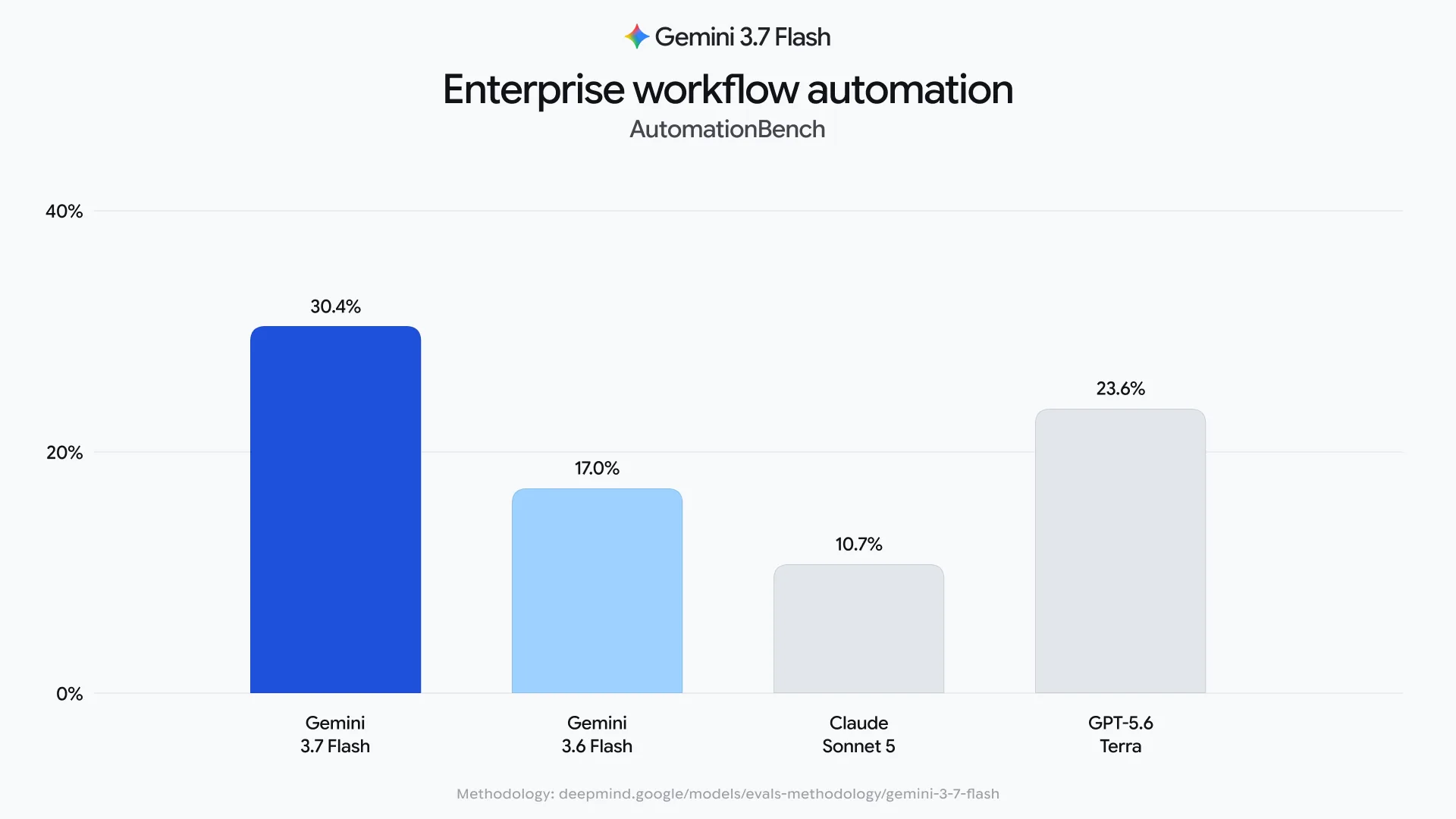
- AutomationBench: 30.4%, up from 17.0%.
- OSWorld 2.0: 47.9%, up from 33.8%.
These tests span production code quality, long software engineering tasks, terminal-based coding, enterprise workflow automation, and computer use, which refers to models operating software environments or interfaces to complete tasks. Google also says the new Flash model is better at adjusting strategy when blocked, clarifying user intent when needed, and following instructions more strictly.
Near-Frontier Performance, Lower Introductory Pricing
Gemini 3.7 Flash is not presented as a universal flagship replacement, but its benchmark profile narrows the gap with more expensive models. On the Artificial Analysis Intelligence Index, Gemini 3.7 Flash scores 56, compared with 55 for Claude Sonnet 5 and 57 for GPT-5.6 Terra. In FrontierCode 1.1, its 43.6% is above the figures listed for Claude Sonnet 5 and GPT-5.6 Terra in Google’s model card.
There are still areas where rivals lead. GPT-5.6 Terra reaches 69.6% on DeepSWE v1.1 and 20.8% on Terminal-bench 3.0, ahead of Gemini 3.7 Flash. The message is therefore less about absolute dominance and more about offering near-frontier capability at a price point suited to heavy workloads.
Pricing is central to the launch. Through December 31, 2026, the introductory price is $0.75 per million input tokens and $3.75 per million output tokens. Google says this is half the original price of Gemini 3.6 Flash. According to the model card, the promotional price ends on December 31, 2026; from January 1, 2027, pricing returns to $1.5 per million input tokens and $7.5 per million output tokens.
For agents, cost matters more than in simple chat. A useful agent may plan, read files, call several tools, fail, retry, and feed results back into the model many times. That makes token economics a core competitive lever.
From Benchmarks to Google Products
Gemini 3.7 Flash was deployed to Gemini Spark on launch day. Spark, introduced at Google I/O, is a personal AI agent for Google AI Pro and Ultra users and is available in more than 160 countries and regions. Google describes it as an agent that can run continuously under user control and take actions on the user’s behalf.
With 3.7 Flash, Spark will use the new model for tool use across products such as Google Workspace. Google’s examples include combining multiple files, drafting emails, and updating project status documents. Developers can access the model through the Gemini API, Google AI Studio, Android Studio, and Google Antigravity, while enterprise users can call it through products such as the Gemini Enterprise Agent Platform.
The missing piece remains Gemini 3.5 Pro, which has not been formally released. Google previously said on July 21 that Gemini 3.5 Pro was being tested with partners, while Gemini 4 was undergoing the company’s most ambitious pretraining effort to date. Reuters reported that Google’s next flagship Gemini had been delayed by about two months and that internal testing showed weakness in key areas such as coding.
Outlook: The Agent Cost War Is Arriving
Gemini 3.7 Flash shows where the reorganized DeepMind is applying pressure first: faster releases, stronger coding, better agent execution, and more direct product deployment. Instead of waiting for a flagship-only narrative, Google is using Flash to compete for real workloads.
In the near term, that could make Gemini more attractive to developers and enterprises building agents. In the longer term, Google’s frontier standing will still depend on the unreleased Pro model and later Gemini generations. But as agents consume more tokens and tool calls, the winning model may be the one that is not merely the smartest, but smart enough, fast enough, and cheap enough to run at scale.