Google Launches Gemini 4 Argon, Focused on Enterprise Workloads
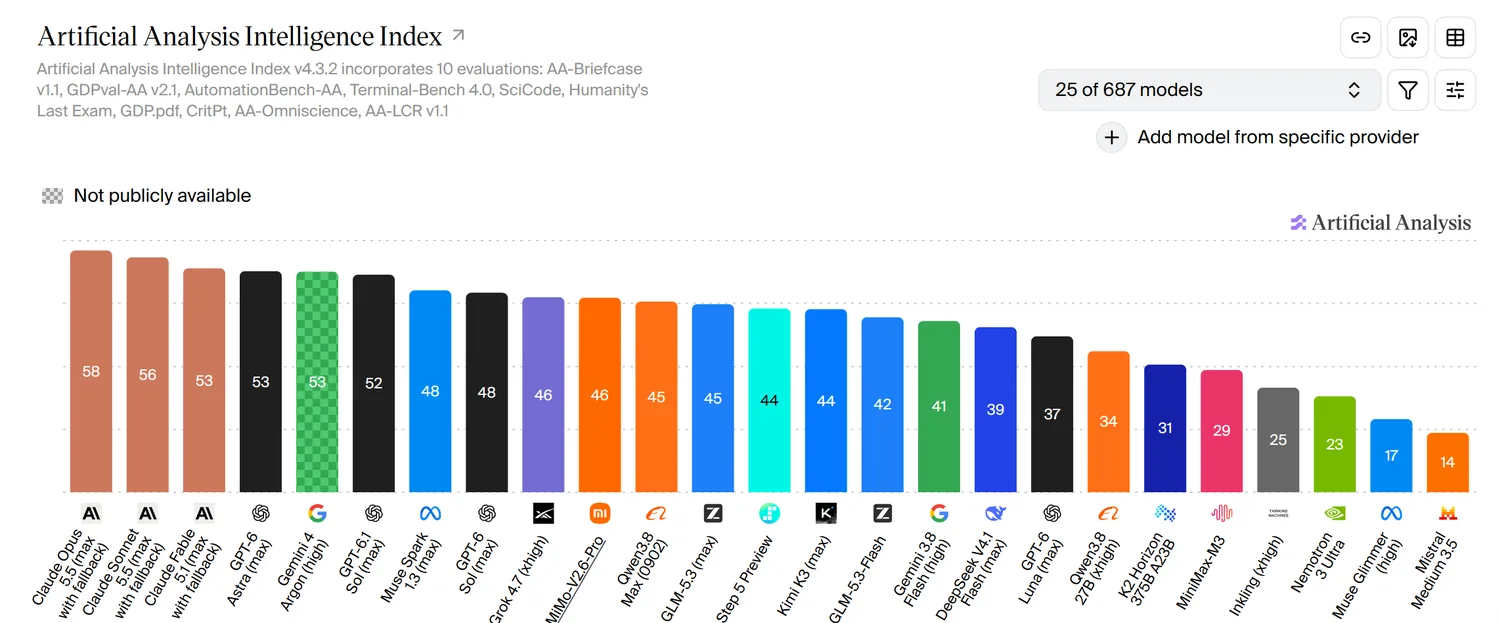
Google officially released its new flagship model, Gemini 4 Argon, on October 1, 2026. The model is designed specifically for software engineering, legal and financial workflows, and cybersecurity defense tasks involving long, complex reasoning chains. Key facts:
- Release date: October 1, 2026
- New version: Gemini 4 Argon (includes High-tier variant)
- Initial pricing: $2 per million input tokens, $10 per million output tokens; cached input tokens at $0.1 per million
- Availability: Through the “Fairwind” program to vetted cybersecurity teams; early access for API customers and Google AI Ultra subscribers
- Weight openness: Internal Google staff use it widely; no-safety-barrier versions provided to certified security teams for deep vulnerability analysis
Enterprise Benchmark Superiority and Technical Reach
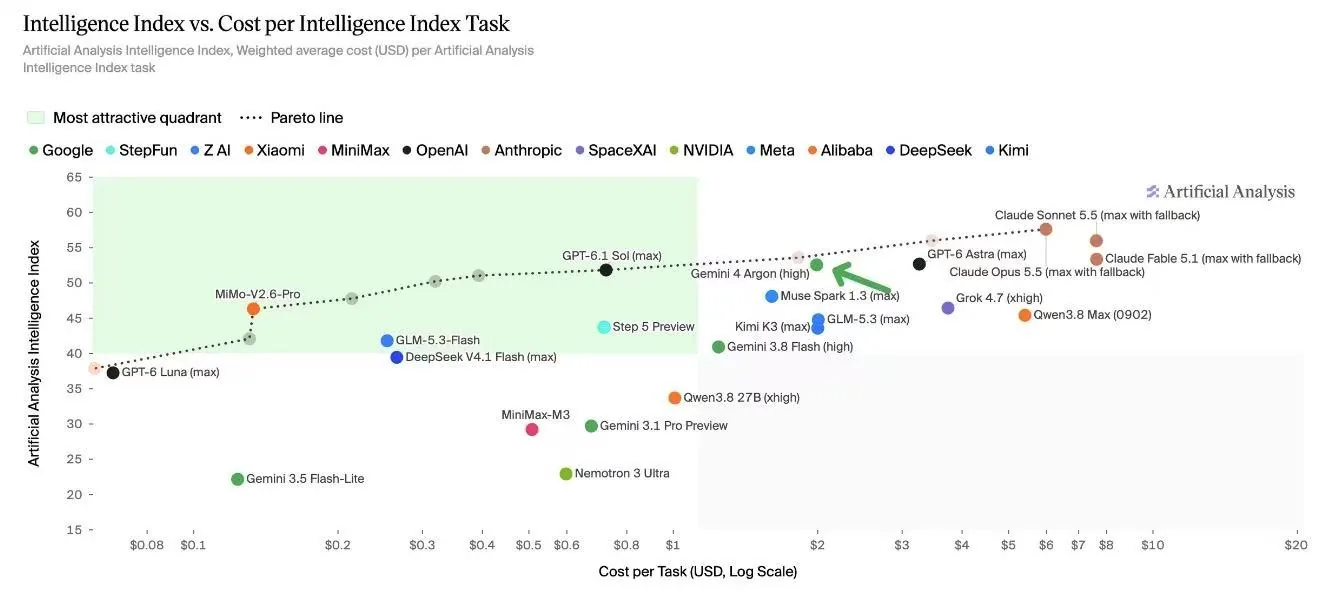
Gemini 4 Argon demonstrates leadership across multiple professional benchmarks. Its most notable upgrade extends output capacity to 1 million tokens, positioning it among the highest-output models available and enabling deep reasoning across large codebases or multi-step business processes in a single call.
Critical benchmark results:
- DeepSWE v1.1 (long-term software engineering): 77.9%, setting a new record
- Vals Index (comprehensive financial, coding, legal, and tax assessment): ranked #1
- AutomationBench (end-to-end enterprise automation): 51.3%, clearly ahead of competitors
- LVBench (long-video understanding): 91.7%, current state-of-the-art
- CWE-bench v1 (vulnerability remediation): 68%, tied with GPT-6 Astra
A notable discrepancy emerges between benchmarks and real-world usage: internal feedback contradicts test results. Bloomberg, citing insiders, reports some Google employees find Argon still struggles with certain coding tasks despite strong benchmark scores, highlighting a gap between controlled evaluation and production-grade reliability.
Cost and Performance Trade-offs
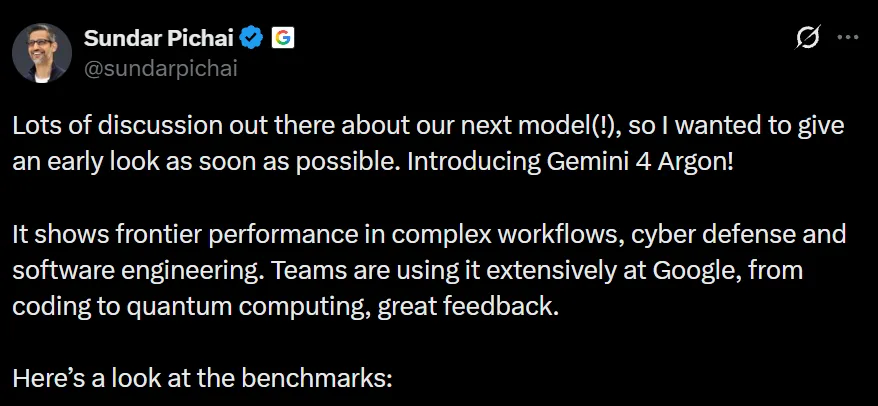
Artificial Analysis data shows Gemini 4 Argon delivers strong cost-performance ratios. Its discounted per-task cost is $1.99, 40% lower than GPT-6 Astra (max mode), and the High-tier variant scores 1525 on Text Arena at $8 per million tokens—landing on the efficiency frontier.
| Model | Per-task cost (USD) | Performance score | Output limit |
|---|---|---|---|
| Gemini 4 Argon | 1.99 | 53 (Artificial Analysis) | 1M tokens |
| GPT-6 Astra | ~3.3 (calculated from 40% cost difference) | 53 | Unspecified |
| Claude Opus 5.5 | - | 54+ | Unspecified |
| Claude Fable 5.1 | - | 53 | Unspecified |
Developer Recommendations
- Best to adopt now: Enterprise developers, cybersecurity teams, and API users. Argon excels in automation, vulnerability scanning, and internal code migrations—with proven 100-token context value for complex workflows.
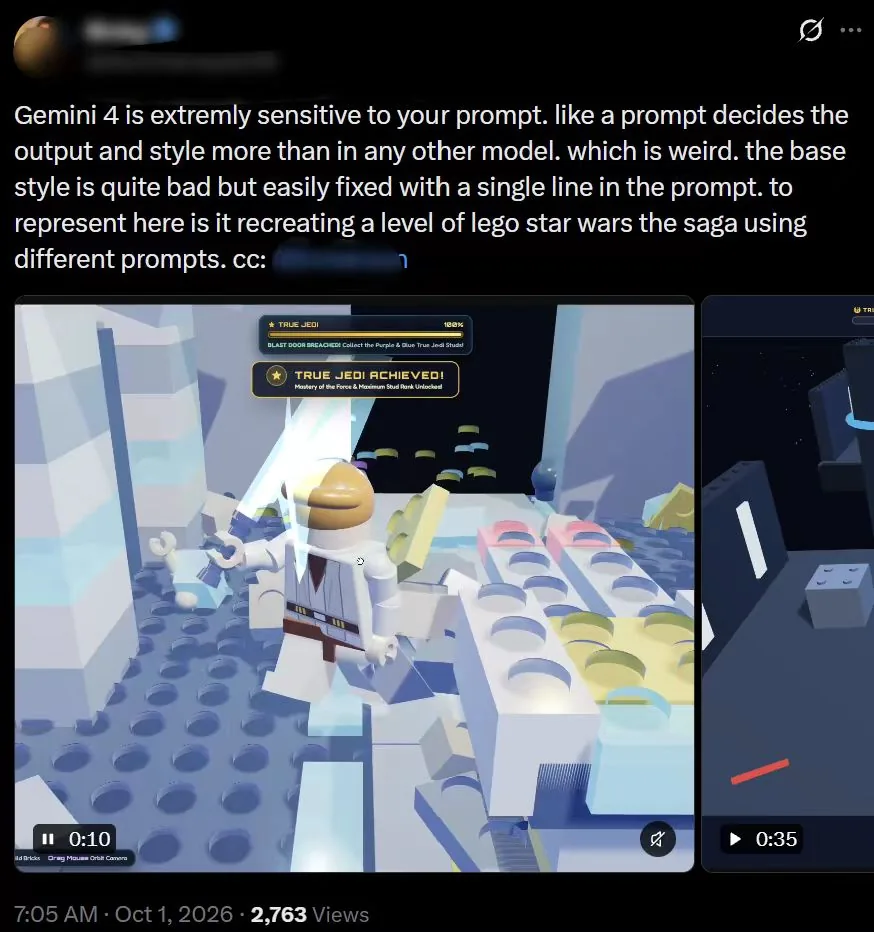
- Worth waiting: Creative creators needing high-fidelity 3D scene generation; users requiring consistent output without prompt tuning. Early adopters report Argon’s default output quality is subpar and highly sensitive to prompt phrasing.
In closing
Gemini 4 Argon signals a pivotal shift from general-purpose models toward specialized enterprise agents. While internal cases and benchmarks are compelling, the true test lies beyond Google’s walls—technical leadership in controlled settings does not guarantee seamless deployment, a lesson worth remembering as the enterprise AI race intensifies.