
A promising signal from deep mines
A long-running record from the Kidd Creek mine in northern Ontario suggests that hydrogen generated underground is real, measurable, and potentially usable—but not yet proven as a commercial energy resource.
In the 1990s, geochemist Barbara Sherwood Lollar and her team studied ancient brine deep inside Kidd Creek, a mine that reaches more than three kilometers into the ancient geological root of North America. The water had been isolated underground for more than a billion years. It also hosted microbes that live on hydrogen produced by reactions between water and rock, and in this setting also by radioactive decay that can split water molecules.
That finding has taken on new significance as interest grows in geologic hydrogen, meaning hydrogen that forms naturally within the Earth’s crust and migrates through rock. Hydrogen is often discussed as a clean fuel, but conventional production can involve substantial emissions or require more energy than the fuel ultimately contains. If usable underground hydrogen can be tapped directly, it could change that balance.
What the Kidd Creek numbers show
Sherwood Lollar and colleague Oliver Warr revisited more than a decade of hydrogen measurements from 35 boreholes at Kidd Creek. They found that each borehole consistently released an average of about eight kilograms of hydrogen per year. Extrapolated across more than 14,000 boreholes at the mine, that would amount to roughly 140 metric tons of hydrogen escaping through mine vents each year.
Key figures from the reported work include:
- Kidd Creek extends more than 3 kilometers underground.
- Its ancient brine had been trapped for more than 1 billion years.
- 35 boreholes averaged about 8 kilograms of hydrogen each per year.
- Across more than 14,000 boreholes, the inferred flow is about 140 metric tons per year.
- A separate case, the Bulqizë chromium mine in Albania, releases at least 200 metric tons per year.
The Kidd Creek total is not large enough to transform the energy system by itself. But if captured, it could potentially supply part of the mine’s own energy needs and serve as a local demonstration that naturally generated hydrogen can be put to practical use.
Exploration is expanding, but evidence is still thin

The broader promise is much larger. Researchers at the US Geological Survey have estimated that trillions of tons of hydrogen are generated within Earth’s crust. If even a small fraction could be recovered, it could meet global hydrogen demand for centuries.
That possibility has drawn startups into the field, including Australia’s HyTerra and Koloma, a company backed by Bill Gates. Both have explored parts of the US Midwest in search of ancient oceanic rocks associated with hydrogen generation.
So far, however, the search has not produced a publicly reported commercially viable reservoir. Public data also remains limited as companies compete for position, investment, and technical advantage. As Laurent Truche of the University of Grenoble Alpes put it, the remaining challenge is no longer simply proving that natural hydrogen exists; it is proving that it can be produced economically and reliably at commercial scale.
Stimulating hydrogen production
Some researchers and companies are also testing whether hydrogen production can be accelerated. The idea is to inject water, heat, or catalysts into reactive rocks that naturally generate hydrogen. A catalyst is a material that speeds up a chemical reaction without being consumed by it.
ARPA-E has funded more than a dozen such projects and set a target of speeding the reaction by a factor of 10,000, a level researchers consider potentially commercially viable for stimulated hydrogen production.
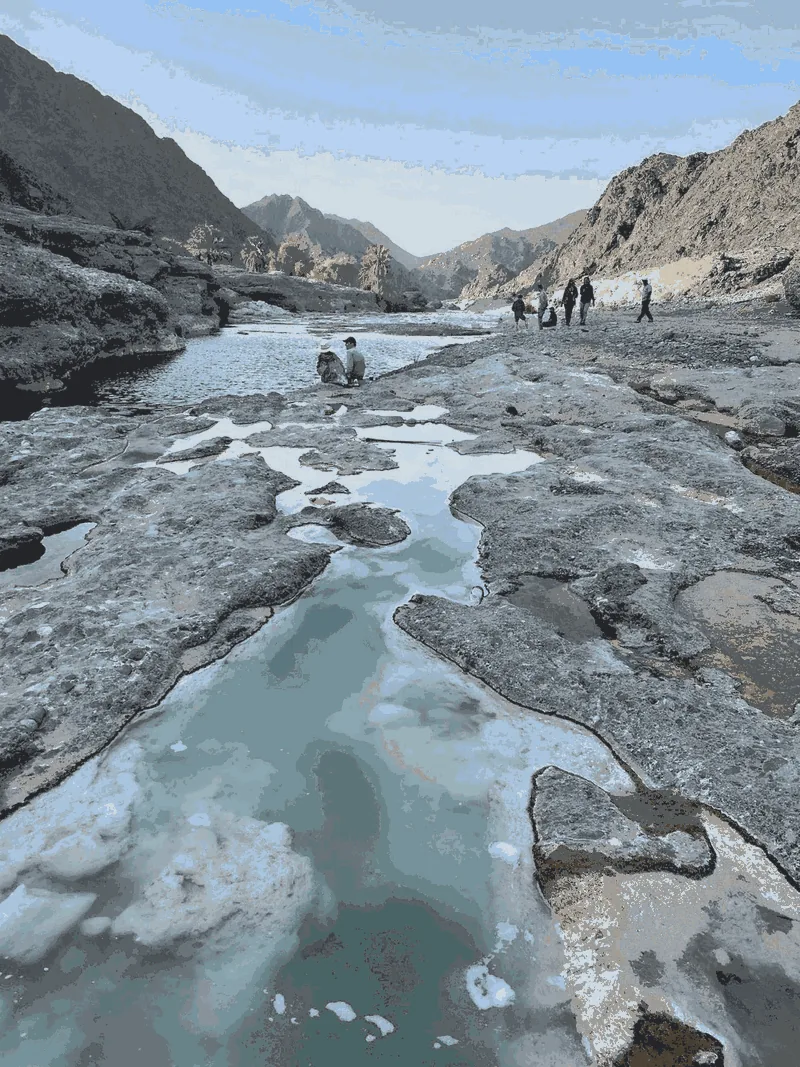
A recent test in the mountains of Oman offered an intriguing sign. A team drilled a one-kilometer borehole and injected 50,000 cubic meters of water into the rock. Several months later, when the well was opened, gas flowed out and was 90% hydrogen. Jo Shannon of the University of Southampton described the result at the European Geosciences Union conference, while also emphasizing that major unknowns remain.
The central question is whether the hydrogen was newly produced by the stimulation process or whether it had already been present underground and was merely released. That distinction will determine whether the method can be controlled, repeated, and scaled.
Outlook: useful resource or early-stage hope?
Geologic hydrogen is attractive because it could supply low-carbon fuel without relying entirely on conventional hydrogen production pathways. It may be especially relevant for local industrial or mining sites where capture and use can happen close together.
But the current evidence points to an early-stage field. Natural flows have been measured, and stimulated production has shown promising signs, yet commercial reservoirs and reliable large-scale production remain unproven. The next phase will hinge on three tests: stable output, low-cost capture, and clear evidence that stimulation creates new hydrogen rather than depleting preexisting pockets. Until then, geologic hydrogen remains one of the more intriguing—but still unvalidated—frontiers in clean energy.