
What Z.ai announced

Z.ai has introduced GLM-5.3, a new open-weights model release focused on coding agents and cyber-related reasoning. The company says the model uses the same base model as GLM-5.2, with all reported gains coming from expanded post-training rather than a new pretraining run.
Post-training refers to the stage after a base model is trained, where developers use instruction tuning, reinforcement learning, tool environments, and evaluation feedback to shape behavior for specific tasks. Z.ai says GLM-5.3 builds on the GLM-5.2 stack, including IndexShare for long-context efficiency, SAO for reinforcement learning on long-horizon tasks, and slime for large-scale asynchronous training. Over the past month, the company says it scaled the same system with more environments, more varied tasks, and more compute.
Coding gains move closer to real work
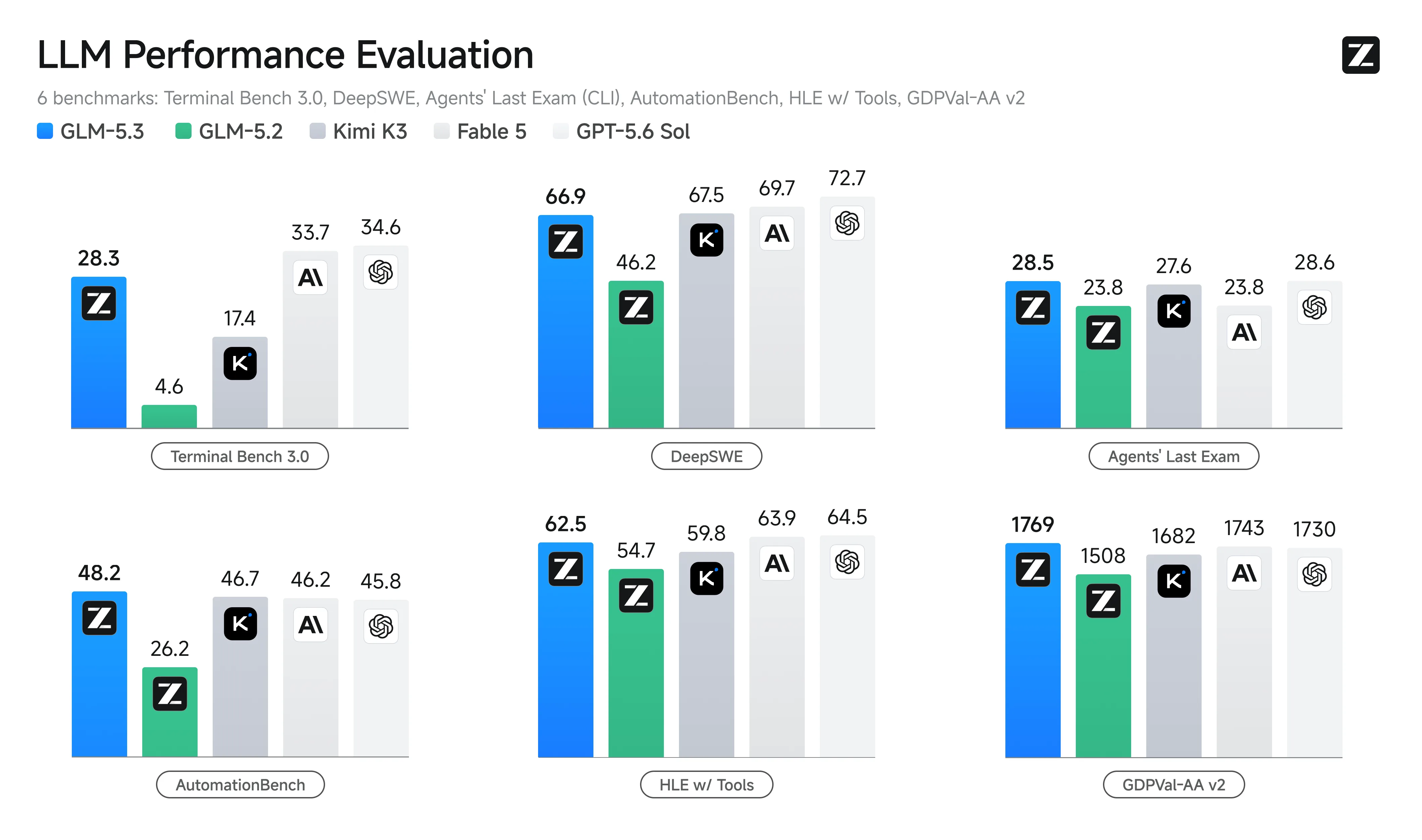
The headline claim is stronger coding performance, especially on tasks that resemble real engineering work rather than short programming exercises. Z.ai says GLM-5.3 improves by 50% over GLM-5.2 on its internal Z.ai Code Bench, a private benchmark designed around complex local development environments and realistic user scenarios.
The public benchmark picture shows large gains on long-horizon agentic tasks:
- Terminal Bench 3.0 rises from 4.6 on GLM-5.2 to 28.3 on GLM-5.3.
- DeepSWE v1.1 rises from 46.2 to 66.9.
- Agents’ Last Exam ALE-CLI rises from 23.8 to 28.5.
- AutomationBench v1.0.6 rises from 26.2 to 48.2.
Z.ai describes training environments that may require the model to work with compute clusters, storage systems, internal documentation, codebases, and experiment results. In one machine-learning infrastructure scenario, the model must diagnose bottlenecks, implement optimizations, run experiments, and deliver measurable end-to-end speedups while preserving correctness. That matters because modern coding agents are increasingly evaluated not only on whether they can write code, but whether they can own a multi-step workflow.
Environment scaling becomes the hard part
A major theme in the release is that scaling agent training now depends heavily on the quality of task environments. Z.ai says useful environments must be executable, verifiable, and close to professional work. To scale them, the company built pipelines that synthesize runnable long-horizon environments and, for some tasks, reinforcement-learning reward signals.
The process uses research agents to extract task patterns from real work and convert them into environments with multi-step dependencies and hidden state. A judge agent then checks whether the task is solvable. Verifiers are created without access to reference solutions, while solver trajectories are used to detect and close reward shortcuts.
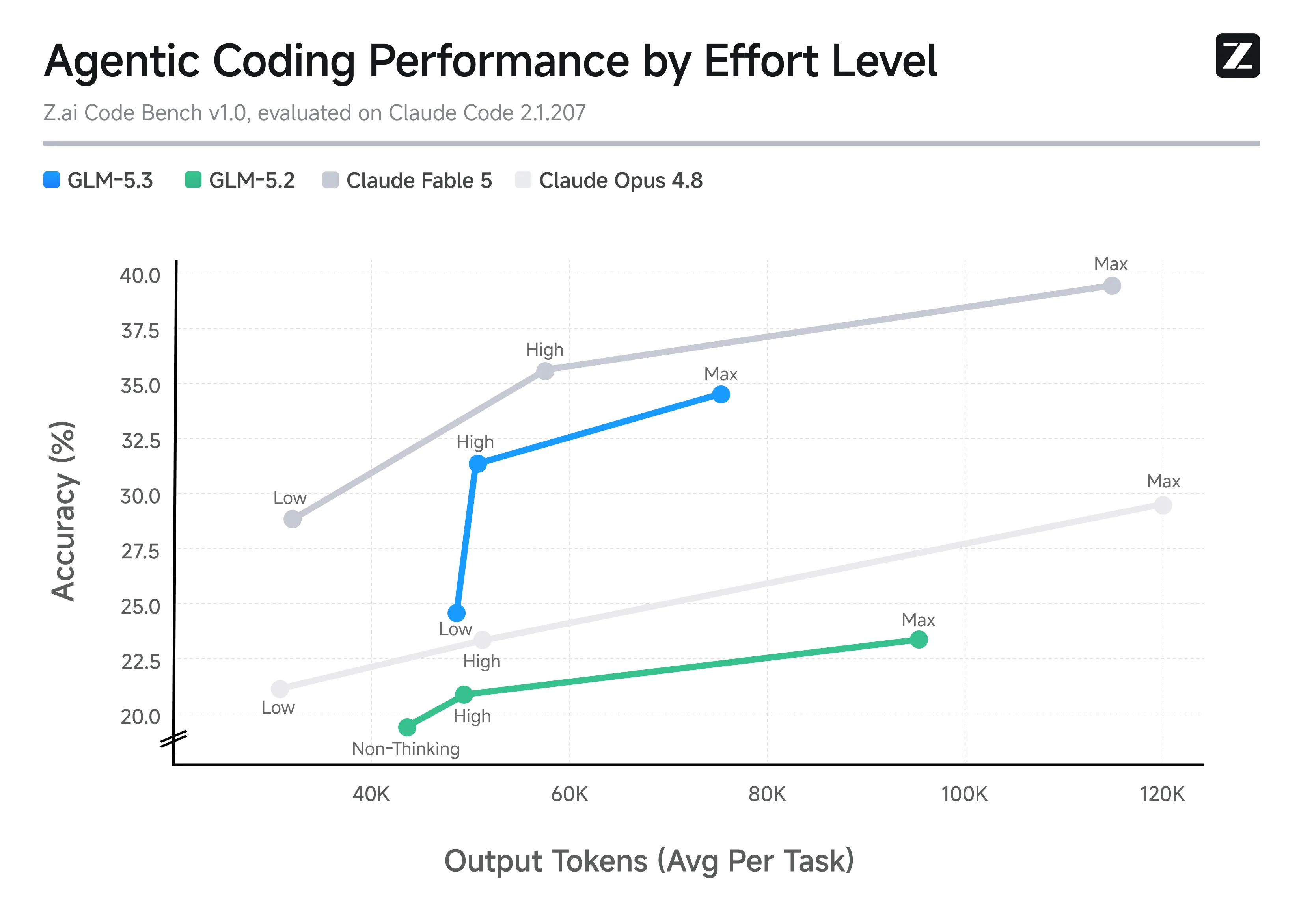
On Z.ai Code Bench, the company also reports better token efficiency. At Max effort, GLM-5.3 reaches 34.5% using roughly 75,000 output tokens per task, compared with GLM-5.2 at 23.4% using 96,000. At High effort, GLM-5.3 reaches 31.4% with about 50,000 output tokens, above Claude Opus 4.8 at 29.5% with 120,000. GLM-5.3 still trails Claude Fable 5, which reaches 39.5% at Max effort.
Cyber capability rises alongside coding
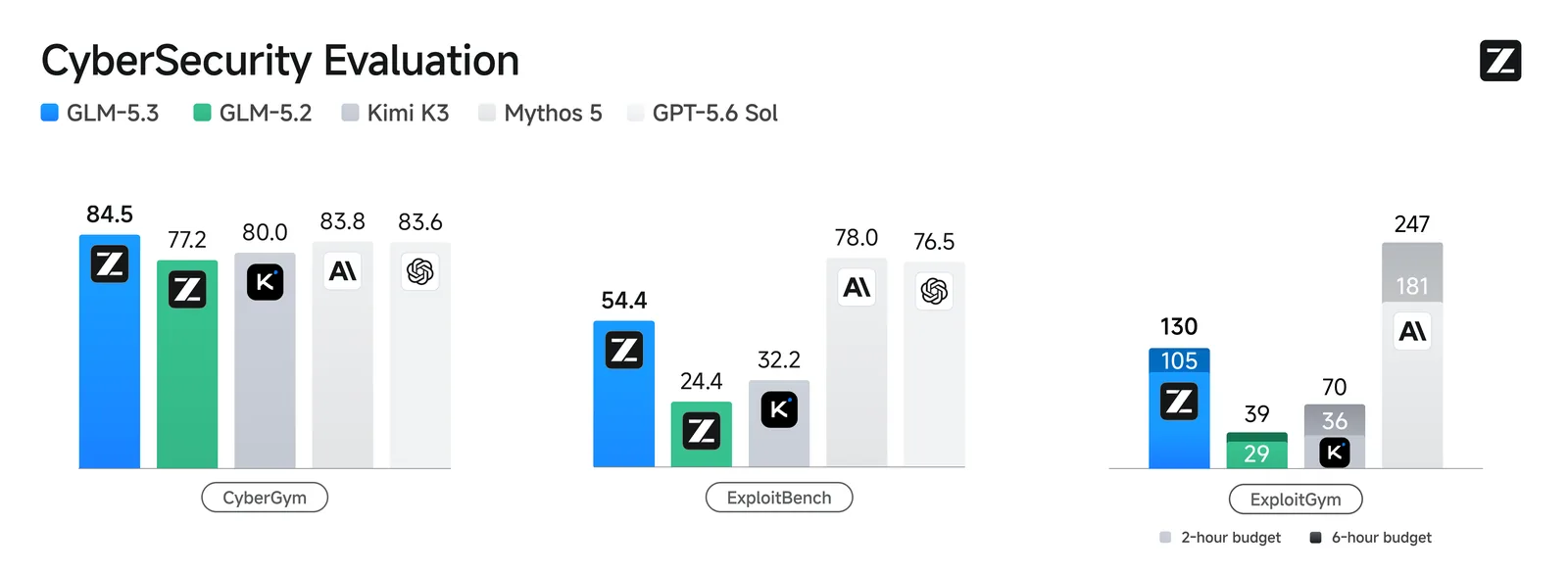
Z.ai also says GLM-5.3 developed stronger cyber capabilities after vulnerability discovery data and environments were added to the post-training mix. The company expected better vulnerability reasoning, but says the model began to form plans across multiple stages of exploitation chains.
The reported cyber benchmark results are mixed but notable:
- CyberGym: GLM-5.3 scores 84.5%, up from GLM-5.2 at 77.2%.
- ExploitBench: GLM-5.3 reaches 54.4%, more than doubling GLM-5.2 at 24.4%.
- ExploitGym: GLM-5.3 completes 105 tasks within two hours and 130 within six hours, compared with 29 and 39 for GLM-5.2.
The pattern is important: the further the benchmark moves up the exploitation chain, the larger the improvement over GLM-5.2. At the same time, the gap to leading closed models remains substantial in the harder exploitation settings. For example, Fable 5 and GPT-5.6 Sol score 78.0% and 76.5% on ExploitBench, and complete many more ExploitGym tasks.
Why it matters
GLM-5.3 shows how open-weights competition is shifting from base-model scale toward post-training systems, long-horizon environments, and verifiable agent workflows. For developers, that could mean more useful assistants for debugging, refactoring, infrastructure optimization, and research engineering tasks. For enterprises, private and realistic benchmarks may be more relevant than generic leaderboard scores.
The cyber results also make the release more sensitive. Z.ai says it will publish the weights two weeks after launch, once safety evaluation and hardening are complete. That delay reflects a broader industry challenge: as coding agents become more capable, the same training that improves legitimate software engineering can also strengthen security-relevant reasoning. The next phase of model competition will likely depend not just on capability, but on how responsibly those capabilities are packaged, evaluated, and released.