
Key Data Snapshot
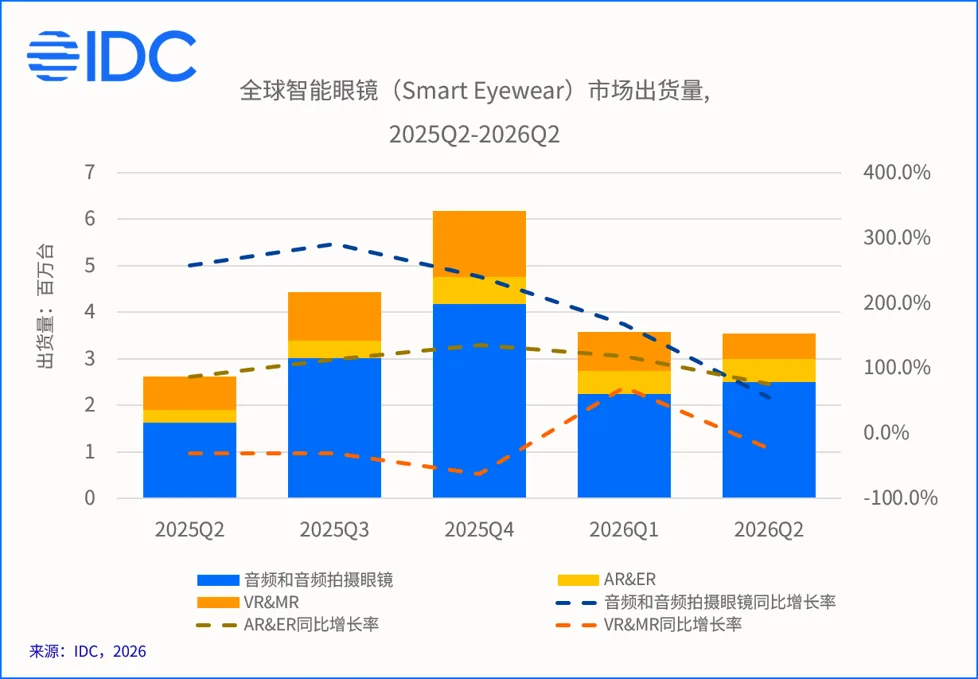
International Data Corporation (IDC) released its Q2 2026 Global Smart Eyewear market report on September 17, 2026, showing robust growth: global shipments reached 3.547 million units, up 35.3% year-over-year; H1 2026 cumulative shipments hit 7.114 million units, up 70.5% YoY. The market structure shows clear differentiation: audio and camera-enabled glasses drive growth, AR/ER glasses accelerate penetration, while VR/MR headsets face adjustment (market restructuring).
- Audio and audio-camera eyewear: 2.494 million units shipped (+54% YoY)
- AR/ER glasses: 505,000 units shipped (+75.7% YoY)
- VR/MR headsets: 548,000 units shipped (-23.3% YoY)
Market Landscape: Global Leaders Set Tone, Chinese Brands Accelerate Overseas Expansion
International leading players continue guiding industry direction. Meta maintains market leadership through its audio-class smart eyewear and is preparing new product launches; Apple’s first smart eyewear product has entered mass production countdown, with competition shifting from pure hardware shipments toward deep integration of ecosystems and AI experience.
Chinese tech innovators are expediting globalization. RayNeo (LeEco’s subsidiary) accelerates overseas expansion with Q3 iO series launch for display-class eyewear, maintaining leadership in global and China consumer AR&ER markets; Xreal’s overseas shipments account for over 60% of global, with Q3 Project Aura launch to enhance premium display-class positioning; Inmo plans celebrity tie-up with Wang Jialai for fashion segment; Viture focuses on niche markets with stable performance in North America; Rokid increases overseas shipments, ranking #1 in global non-full-color glasses segment.
Unexpected Counterpoint: China’s First Negative Growth
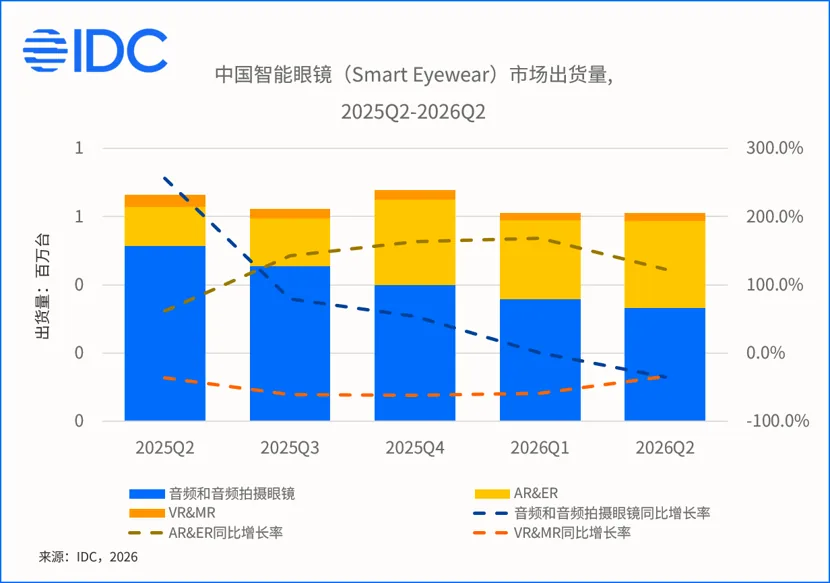
Despite global strength, China’s Q2 smart eyewear shipments fell 8.0% YoY to 611,000 units—the market’s first negative quarter. The decline stems primarily from audio glasses: audio and audio-camera eyewear dropped 35.4% YoY to 332,000 units.
Structural improvements coexist with challenges:
- Audio-camera eyewear now exceeds audio-only at 55.3% market share (+81.4% YoY)
- Leading brands entering lifecycle maturity without sufficient new product succession
- Product homogenization deters replacement cycles
- Despite subsidies and promotions, user purchase decisions remain cautious
IDC analysts note smart eyewear as a critical AI-enabled interaction interface remains underexploited: only when experience, content ecosystems, and practical applications mature will the industry and consumer base expand sustainably.
Representative Product Lines (Public Data Only)
| Brand | Product Line | Positioning | Overseas Share/Performance |
|---|---|---|---|
| RayNeo | GT Series | Premium viewing experience | #1 in global consumer AR&ER |
| RayNeo | V4 AI | Lightweight photography | Q3 iO series display launch |
| Xreal | XBX A01+ | Entry-level | Overseas >60% of global |
| Xreal | R1 | Gaming-focused | Project Aura Q3海外发布 |
| Rokid | Non-full-color | Office/industrial | #1 in global non-full-color |
| Inmo | Celebrity collab | Fashion segment | Q3 Wang Jialai tie-up |
| Viture | Niche models | Vertical markets | Stable North America performance |
Buyer Recommendations
Best for immediate purchase: Commuters needing real-time navigation/audio cues; budget-conscious audio-first users; content creators evaluating V4 AI’s lightweight camera performance.
Worth waiting for: AR interaction enthusiasts expecting immersive experiences; users deterred by current audio glasses homogenization; China consumers should wait for Q3 new launches assessing local ecosystem integration.
Final Note
Smart eyewear transitions from hardware competition to AI-ecosystem synergy. Regional slowdowns won’t offset long-term growth drivers: AR/ER glasses’ 75.7% surge and VR/MR’s cyclical correction confirm lightweight, real-time information interfaces as the next mobile computing mainstream.