
Google quietly launches Gemini 3.8 Flash: 1M token context window goes live
On September 2, Google quietly launched the Gemini 3.8 Flash model on the Google DeepMind website. Built on Gemini 3.7 Flash, the new model is aimed at individual users, developers, and enterprises. It supports up to a 1M token context window and up to 64K tokens of text output, with a knowledge cutoff date of March 2026. According to Google’s description, it is suitable for deploying general-purpose, production-ready agents at relatively low cost and at scale.
Multi-dimensional upgrades: balancing performance, cost, and latency
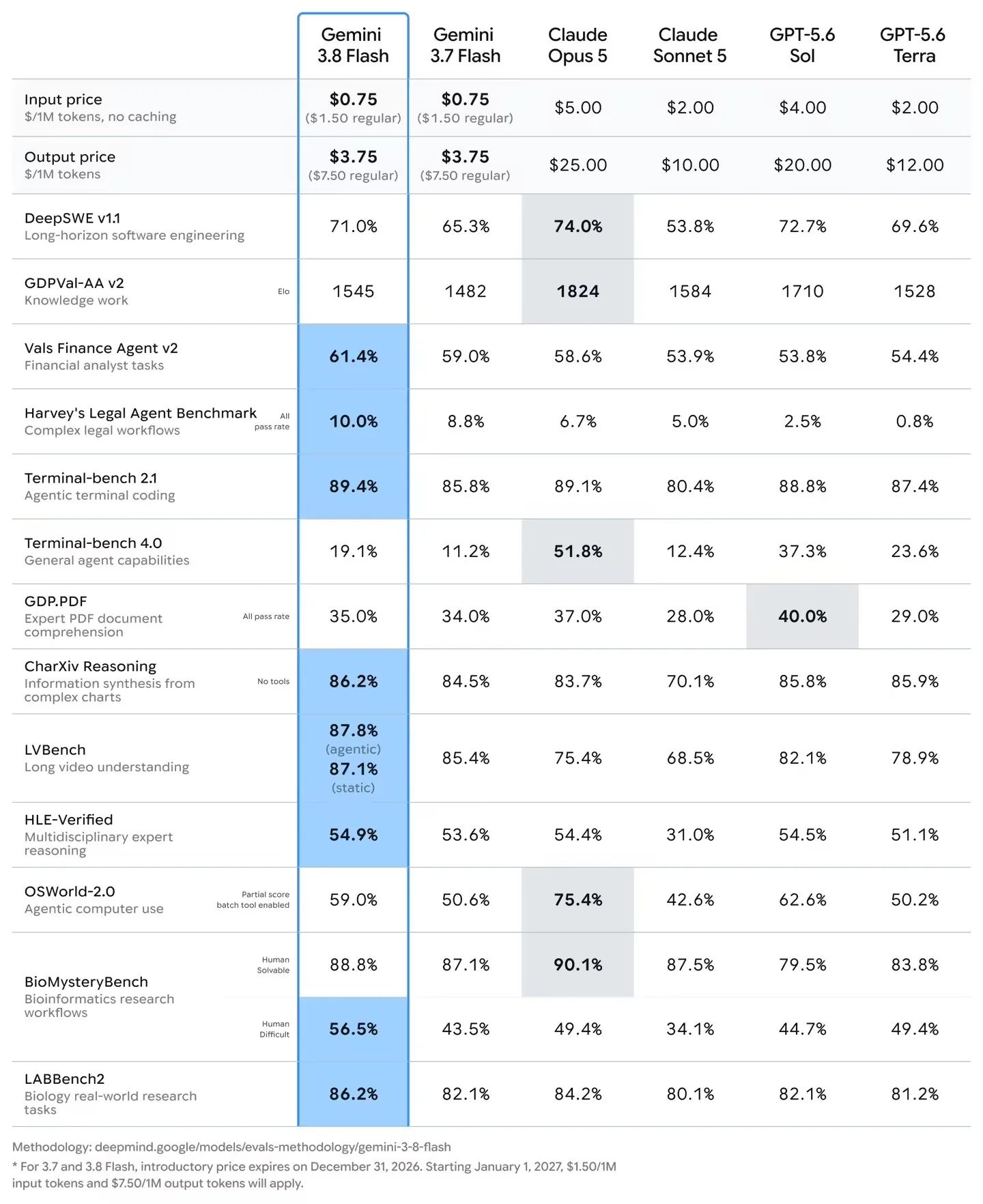
Gemini 3.8 Flash brings improvements in software engineering and agentic knowledge workflows. Google’s benchmark disclosures cover programming, knowledge processing, multimodal processing, long-context handling, computer-use capabilities, and scientific reasoning. The model also continues to support customizable effort levels, allowing users to balance quality, cost, and latency. That design fits different business needs: real-time customer-service conversations usually prioritize low latency, while code generation and complex knowledge work place more weight on output quality.
Notably, the combination of a 1M token context window and 64K token output strengthens the model’s ability to handle long documents and complex task chains. This makes it more suitable for tasks such as long-form report generation, cross-document analysis, codebase understanding, and API documentation drafting, while reducing the engineering overhead of repeatedly splitting context and stitching outputs together.
Key capability overview (based on official disclosures)
| Capability | Gemini 3.8 Flash | Notes |
|---|---|---|
| Context window | Up to 1M tokens | Built on Gemini 3.7 Flash |
| Text output | Up to 64K tokens | Supports long-form output |
| Knowledge cutoff | March 2026 | Some domains may be updated later, while others may still reflect knowledge as of January 2025 |
| Focus areas | Software engineering, agent tasks, knowledge processing | Designed for production deployment scenarios |
| Cost control | Customizable effort level | Used to balance quality, cost, and latency |
Practical use cases and user recommendations
Users who may want to try it now:
- Small and midsize development teams seeking lower-cost deployment of general-purpose agents for multi-step automation, such as requirements analysis → prototyping → test case generation;
- Content production teams handling knowledge-intensive work such as long-document summarization, translation, and meeting notes;
- Researchers working on literature reviews, experimental interpretation, or scientific writing assistance.
Users who should evaluate carefully:
- Projects that depend heavily on high-frequency real-time interaction should test actual cost, response speed, and stability before large-scale deployment;
- Applications that require knowledge after March 2026 will need external retrieval or other update mechanisms.
In closing

The launch of Gemini 3.8 Flash again reflects the industry’s shift from a “parameter race” toward a race for engineering usability. The combination of a 1M token context window and 64K token output makes end-to-end handling of complex workflows more practical. As models increasingly act as multi-step coordinators rather than single-turn answer engines, the development paradigm for AI-native applications will continue to evolve.