
Google is making visible watermarks optional for AI-generated media in Gemini and Flow, while continuing to embed hidden provenance signals in the background.
A visible mark becomes a setting
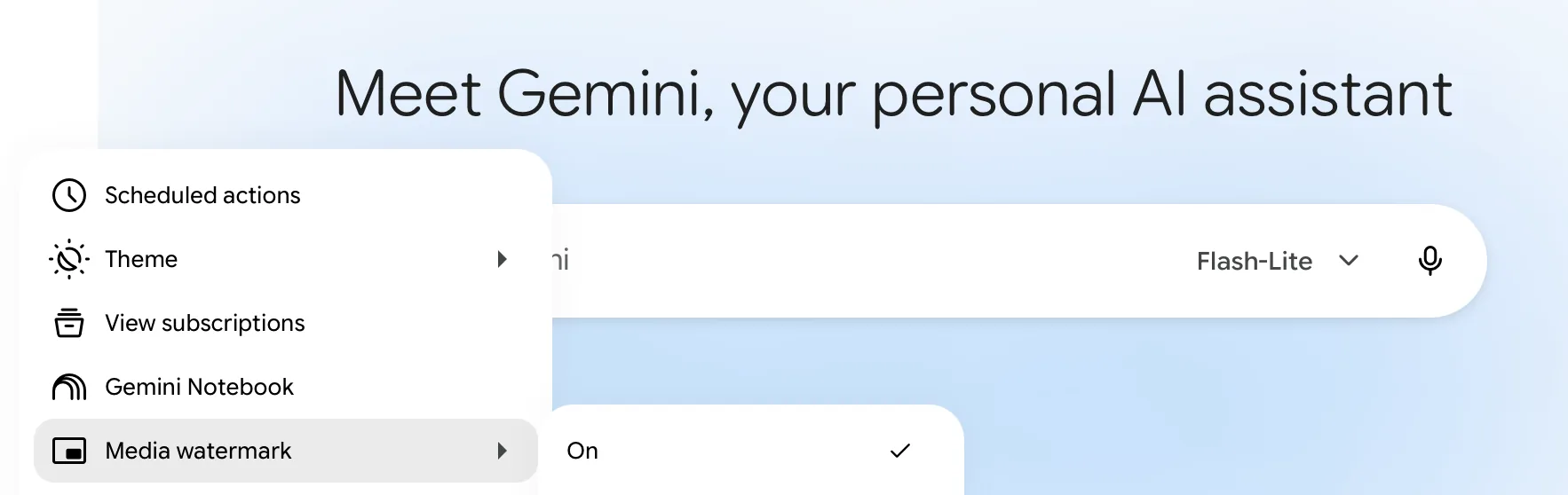
According to The Verge, Google is adding a new “Media watermark” toggle to Gemini and Flow, its AI video generation tool. When the setting is turned off, the company will remove the small “sparkle” watermark that appears in the bottom-right corner of media generated with Google’s Nano Banana and Omni models.
The change applies to AI-generated images, videos, and music. It does not mean Google is dropping AI labeling altogether. Instead, the company is shifting the user-facing watermark from a mandatory visual element to an optional display choice.
Josh Woodward, vice president of Google Labs, Gemini, and AI Studio, said AI-generated content will still include invisible SynthID watermarks and C2PA metadata. Users will still be able to ask Gemini or Search whether a piece of content is AI-generated if those markers are present.
Hidden provenance takes priority
Two technologies matter in this update. SynthID is Google’s invisible watermarking system for AI-generated content; it is intended to be detectable by supported tools rather than obvious to the human eye. C2PA is a metadata standard for recording content provenance, such as how a file was created or modified.
Visible watermarks are easy to understand, but they can interfere with the look of an image or video and can often be cropped or edited away. Hidden watermarks and metadata are less disruptive for creators, but they also make AI origin less immediately obvious to ordinary viewers.
That trade-off is central to Google’s move. The company is giving creators cleaner outputs while keeping a verification layer for platforms, tools, and users who know where to check.
Google follows a broader industry pattern

The Verge notes that other AI image generators, including those from OpenAI and Meta, do not use visible watermarks. OpenAI relies on SynthID and C2PA to signal AI generation, while Meta has introduced its own Content Seal standard. Anthropic also announced this week that it is applying invisible watermarks to both AI-generated text and images.
The direction is clear: major AI companies are moving away from always-visible badges and toward background provenance systems. That approach better fits professional creative workflows, but it also increases dependence on detection tools and platform support.
Key facts from the update include:
- Products affected: Gemini and Flow, with Search planned later;
- Media affected: AI-generated images, videos, and music;
- Visible mark removed: the bottom-right “sparkle” watermark;
- Signals retained: invisible SynthID watermarks and C2PA metadata;
- Limit: the toggle will not launch in countries that require visible watermarks.
What it means for AI content disclosure
Google’s update shows how AI disclosure is becoming less about what every viewer can see and more about what systems can verify. For creators, optional visible watermarks reduce friction and make generated media easier to use in polished projects. For platforms and regulators, invisible provenance may be more useful at scale.
The risk is that transparency becomes less accessible to casual viewers. If AI origin is no longer visible on the media itself, verification depends on tools such as Gemini or Search, as well as the durability of watermark and metadata standards.
In the near term, visible watermarks are likely to remain where regulation requires them or where creators choose to keep them. Over time, the more important question will be whether systems like SynthID, C2PA, and Content Seal can work reliably across platforms and survive the messy reality of online editing, reposting, and remixing.